It was the silence that always got to Deborah. Not the heavy, empty silence of the house before dawn, but the quiet, steady hum of things being settled. She heard it in the way her son, Caleb, closed the front door with a deliberate click late at night, in the way he set his keys in the chipped ceramic bowl on the hallway table. A man’s sounds. Not the thunderous, clumsy noises of the boy she’d raised alone in a cramped apartment off Broad Street in Johnson City, but a firm, purposeful quiet. She had built that quiet around him for twenty-four years, a fortress held together by double shifts at the hospital and the stubborn belief that they didn’t need anyone else. She was a nurse; she fixed things. She’d fixed his scraped knees, his broken arm from a skateboarding fall in ninth grade, his feverish nights when the power was cut off and she’d wrapped him in her own coat.
She was sitting on the worn tweed couch, soaking her feet in a basin of Epsom salts after a brutal twelve-hour rotation in the cardiology unit, when Caleb came in from his shift at the construction supply yard. He didn’t grab a beer from the fridge like he usually did. He stood in the archway between the kitchen and the living room, still dusty with fine gray silt, and she saw his jaw set in a way that instantly made her stomach drop. It was the same look his father, a guitar player named Rick who vanished before Caleb’s first birthday, had in the only photograph she’d ever kept. A look that promised a decision had already been made, and you were just being informed of the news.
“Mom, I’m gonna ask Mona to marry me.”
Deborah stopped moving. The water in the basin rippled. Caleb wasn’t a senior at a college getting a red diploma; he was a twenty-four-year-old logistics coordinator, two years out of community college, with calloused hands and a truck that was half paid off. His whole world was supposed to be his next promotion, not a wedding band.
“Mona?” The name came out sharp, a scalpel’s edge. “You want to lock that down? What’s the rush, Caleb? You’re not even twenty-five.”
“There’s no rush. It’s just… right.” He leaned against the doorframe. “I want you to get to know her. Really know her. Not just that stiff ‘hello’ you do when she picks me up.”
Deborah lifted her feet out of the basin, the water dripping onto the hardwood. “So, what’s the story? She’s… what, thirty now? Working at that nail salon on Market Street?”
“She’s twenty-nine. She’s the manager, Mom, it’s a real job. And it’s not just her.” He paused, and the quiet suddenly turned fragile, like a glass held too tight. “She has a daughter. Mia. She’ll be four next month.”
A hot, blinding pressure built behind Deborah’s eyes. Twenty-nine. A child. This wasn’t just a girl her son was dating; this was a whole life, pre-assembled and waiting for a replacement part. She saw it with brutal clarity: a single mother from a strip-mall salon, looking for a young, strong, stable paycheck to pull her out of the mess some other deadbeat had left behind.
“Oh, no. Absolutely not.” Deborah stood up, ignoring the sharp pain in her lower back. “You’re going to play Daddy to some flight attendant’s grandkid? Rick was a musician who took off on an Asian tour and didn’t bother with a plane ticket back from Bangkok. You want to clean up the same mess I spent my whole life scrubbing out of this house?”
“Don’t do that.” Caleb’s voice was low, a fault line shifting underground. “This isn’t you and Dad. Mona’s ex-husband is a trauma surgeon in Nashville. He’s not a deadbeat, he’s just an absentee who pays his support and calls on Sundays. This isn’t a rescue mission.”
“You’re twenty-four! You pay your truck off by hauling drywall on weekends! You’re going to strap yourself to a kid who needs braces in five years and a woman who will blame you for every time her first marriage didn’t work out? You’re going to throw away your freedom, your hiking trips, your chance to save up for a down payment on a real house just so you can be the backup plan?”
Caleb straightened up. He wasn’t taller than her, but in that moment, he seemed to fill the entire doorway. His eyes, the same shade of faded denim blue as her own, didn’t blink.
“You threw all that away,” he said quietly. “For me.”
The air left Deborah’s lungs in a sick rush.
“You think I wanted you to repeat my mistakes?” she whispered, her voice cracking. “I wanted you to fly, Caleb. I worked my body to the bone so you wouldn’t have to anchor yourself to a sinking ship.”
“Maybe I don’t see a family as an anchor, Mom.” He grabbed his keys from the ceramic bowl. “Her name is Ramona. Her daughter draws pictures of our cat. I love them. I wanted you to see what I see, but you’re too busy looking for cracks in the concrete to notice the garden growing in the yard.”
He left. The door didn’t slam; he pulled it shut with that same infuriating, careful click. Deborah stood there, her wet, pruned feet leaving prints on the floor as she paced. The silence he left behind was not the comfortable, shared quiet they’d built over twenty-four years. It was a void. A condemnation.
She didn’t sleep that night. She sat at the kitchen table, scrolling through online records, her nurse’s logic trying to find the pathology in this Mona woman. A failed marriage. A kid on the wrong side of the math. By 6:00 a.m., when the coffee pot beeped, a reckless, desperate plan had calcified in her chest. She wasn’t going to sit in this silence and wait for the wreck.
It was a Saturday, her day off. She knew the address because Caleb had it pinned on a shared grocery delivery map. A little wooden bungalow on Chestnut Street, over in the Tree Streets neighborhood, painted a faded seafoam green. The kind of place where the porch sagged just a little, and the wind chimes were made of old silverware. Deborah drove over in her old Subaru, still wearing her gardening jeans and a sweater that smelled faintly of lavender fabric softener. She felt like a ghost haunting a battlefield she hadn’t been invited to.
She grabbed the small paper bag from the passenger seat. Inside was a wooden train engine, beautifully carved and painted. She’d bought it for Caleb when he was five, one grueling Christmas where the tips were good. He’d named it “Mighty Mo.” It had sat on his dresser for a decade. She didn’t know why she brought it. A peace offering? A poison pill? A test.
Standing on the sagging porch, she felt the weight of her fifty-two years in her knees. She knocked before she could lose her nerve. The door swung open, and Deborah felt her prepared interrogation script vanish.
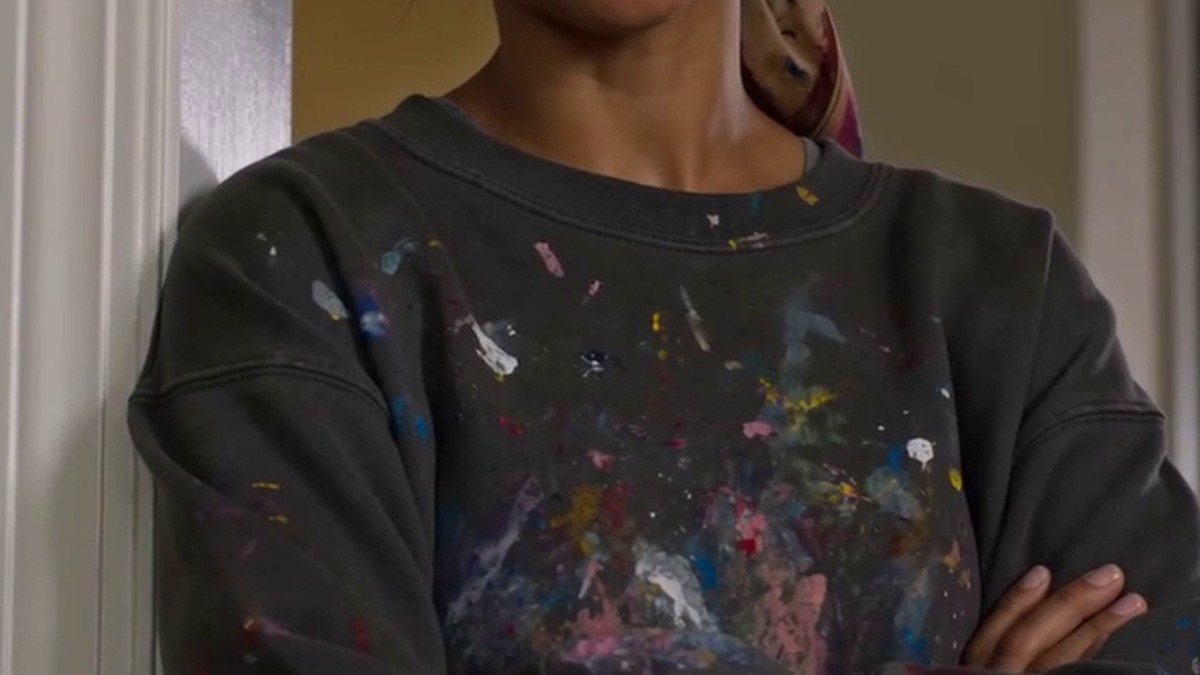
Mona wasn’t the predatory, acrylic-nailed siren Deborah had constructed in her mind. She was bare-faced, with deep, intelligent brown eyes that looked like they’d already cataloged every ounce of hostility Deborah was carrying. Her hair was pulled back in a silk scarf, and she was wearing an old, paint-stained University of Memphis sweatshirt. She had the wiry, durable look of a woman who knew how to unclog a sink and assemble an IKEA bookshelf without losing her temper.
“Mrs. Hargrove,” Mona said. It wasn’t a question. A calm, steady acknowledgment. “I saw you pull up. You better come in. Fair warning, the living room is a disaster zone.”
It wasn’t a disaster. It was cluttered with crayons and construction paper. A little girl with an explosion of dark curls and a crooked hand-knitted sweater was lying on her stomach on the rug, tongue sticking out in concentration as she drew a lopsided blue cat.
“That’s Mia,” Mona said, leaning against the hallway wall. “Mia, baby, this is Mr. Caleb’s mom.”
Mia looked up. Her eyes were the same shade of deep, warm brown as her mother’s, but they held none of the guardedness. Just pure, feral curiosity. “Did you bring snacks? Mama said we couldn’t have snacks until my room is clean, but my room is a whole mess.”
Deborah was thrown. This wasn’t a stiff “nice to meet you, ma’am.” This was a negotiation. Before she could stop herself, the twenty-year-old nurse in her, the one who could coax a vein out of hiding, answered, “Not snacks, sweetheart. But I did bring Mighty Mo.” She pulled the train engine out of the paper bag.
Mia sat up, discarding her crayon. “It’s a choo-choo.”
“It’s a steam engine,” Deborah corrected gently, her joints popping as she knelt down on the rug. “See the wheels? They move. And the little red thing here? That’s the piston.”
She hadn’t sat on a floor and played in over fifteen years. But her hands remembered. She rolled the train engine across the braided rug, the little wooden wheels clicking over the bumps. Mia watched, mesmerized. She didn’t grab; she waited, watching the mechanics of it.
“He’s moving slow,” Mia observed.
“He needs a track,” Deborah said. “You can’t just let him go anywhere. He needs a path.”
“Can we make a path?”
Mona hadn’t moved from the wall. Deborah braced for a sharp comment, a protective dismissal. But when she glanced up, Mona’s expression had shifted. The armor was still there, but the eyes were softer, wetter. Because Mona wasn’t seeing an enraged mother-in-law right now. She was seeing a woman kneeling on the floor, talking about pistons and paths, engaging with her daughter not as a burden, but as a small, interesting human being.
They used a long, thin, red leather bookmark and a stack of board books to build an improvised railway track. For twenty minutes, Deborah did not interrogate the mother. She argued with a four-year-old about locomotive physics.
It was when Mia waddled off to find her favorite stuffed animal that the silence returned, but it was different now. Mona handed Deborah a glass of iced water. “You didn’t come here to play trains, Mrs. Hargrove.”
Deborah held the cold glass to her temple. “No. I came here to tell you that you’ve made a mistake. That my son is too young to be ruined by a ready-made family.”
Mona nodded, waiting.
“But I ruined myself for him,” Deborah said, her voice fraying at the edges. “I starved, I worked the night shift in the cardiac unit, I did it all on my own so he wouldn’t be ‘that kid with the dad in Bangkok.’ I hated him a little for growing up and wanting to plant his flag here. With you. But I look at this…” she gestured at the mess of books and the train on the floor, “…and I don’t see a ruin. I see him.”
Mona finally sat down on the edge of the coffee table, close enough that Deborah could smell her clean, unscented lotion. “I’ve done the math. The odds are that a second marriage fails. That a guy who’s twenty-four and signing up for a four-year-old might bail when she’s a screaming teenager. I know all the worst-case scenarios, Deborah. I live with them.” She paused. “But sometimes, the train stays on the tracks. And I’m not betting on a crash. Neither is Caleb.”
The words hit Deborah right in the sternum. Her son, the quiet man with the careful hands, had found his track. And for the first time since he’d walked out of the door, Deborah realized the fortress she’d built wasn’t for him. It was a cage for her. A cage where she could be the noble victim, the lone survivor.
Mia finally returned, dragging a very battered stuffed unicorn by its horn. She dropped the unicorn unceremoniously on the tracks, causing a massive collision with Mighty Mo. “Crash,” she announced, satisfied.
Deborah laughed. A dry, rusty, unguarded laugh. A laugh from some deep part of her she thought she’d donated to the hospital’s lost and found decades ago. She reached out and picked up the little train engine. “You know, Caleb never could handle the stops,” she told Mia. “He always wanted to go full throttle.”
The wedding was at the county clerk’s office on a windy Thursday afternoon three months later. There was no cake, just a late lunch at a dive bar downtown that served surprisingly good fried pickles. But that wasn’t the real ceremony. The real ceremony was a year later, on a sweltering July evening, when Deborah let herself into the seafoam green bungalow with the spare key they’d given her. A new, glossy nameplate was stuck to the wall by the door—Garcia-Hargrove—in childish, sticky letters.
“Grandma Deb! You’re late!” Mia shrieked, barreling into her shins. She was already in her dinosaur pajamas, her hair smelling like chamomile shampoo. “Mama’s too slow! The popcorn is screaming!”
“The popcorn is burning, that means,” Mona called from the kitchen, a soft, exasperated lilt in her voice. She was hugely pregnant now, waddling with the awkward grace of a ship at full sail, one hand on her lower back. “Don’t just stand in the doorway, Deb. Come fix the fire your son started.”
Deborah took over the stove while Caleb, paint-splattered from fixing up the nursery, rustled in the hall closet to bring out a projector. Movie night. It was their strange weekly ritual now. She’d refused to be the lonely grandmother in the nursing home waiting for a Sunday call; she had inserted herself into the chaos. She’d mended Mia’s unicorn, she’d taught Caleb how to fold a fitted sheet when Mona’s belly got too big, and she’d learned to sleep through the sound of tiny feet pattering to the bathroom at 3:00 a.m. when she slept over in their guest room.
They watched an old, scratched-up copy of *The Polar Express*, because Mia had an obsession with trains that Deborah fully acknowledged was her fault. Halfway through, with the butter-soggy popcorn bowl shared between them on the couch, Mona gasped.
“Caleb,” she said, her voice deceptively even. “Don’t freak out, but my water just broke on your mother’s quilt.”
The house erupted into the beautiful choreography of controlled panic. Caleb, who was now a junior project manager who could run a ten-man construction crew without breaking a sweat, went ghost-white and started looking for the car keys that were in his hand. Mia began to cry, not from fear, but because nobody paused the train movie.
And Deborah, the veteran nurse, took charge. She scooped Mia up onto her hip with a grunt, grabbed the hospital go-bag from the front door, and looked Mona straight in the eye. “We’re taking the Subaru. You’re not squeezing out my next grandchild in a pickup truck. Caleb, you’re driving. I have Mia.”
It was in the waiting room at the Franklin Woods Community Hospital, at 4:32 a.m. on a Sunday, with Mia asleep on two chairs pushed together and covered in Deborah’s coat, that she got the news. Caleb walked through the double doors, a dazed, exhausted look plastered on his face. He wasn’t carrying a phone to show a picture. He just stood there, shoulders shaking slightly, and choked out, “A boy. We’re naming him Rick.”
Deborah flinched. The ghost of the man in Bangkok. She started to protest, the old instinct flaring like a bad hip. “Caleb—”
“No, Mom, listen to me.” He wiped his nose on his sleeve, looking less like a project manager and more like her little boy in the garden, covered in dirt. “We’re not naming him *after* my father. We’re reclaiming the name. Dad broke it and threw it in our face. We’re taking it back. For the boy who’s going to grow up with a dad who stays, and a mom who’s a fortress, and a grandma who shows up with a train before she even decides if she likes you.”
Deborah opened her mouth, but no words came. The silence was back, but it wasn’t a void this time. It was full.
Two days later, on a Tuesday, she went back to the seafoam green house to air it out before Mona and the baby came home. The house smelled of fresh paint and the faint, lingering scent of burnt popcorn. She was stripping the sheets off the couch when she looked down. There, on the coffee table, was the wooden train engine. Mighty Mo.
Next to it, drawn in wobbly purple crayon on a scrap of construction paper, was a picture of a much larger train. A blue engine, a green engine, and a tiny little red caboose. Underneath, in Mona’s neat, careful handwriting, were the words Mia had dictated: “My family. By Mia.” There were stick figures in the windows. And on the very top of the caboose, a tiny stick figure with a curly squiggle on its head—Grandma Deb.
She didn’t frame the picture. She took a cube magnet shaped like a nurse’s cap and stuck it to the refrigerator, right over the grocery list. She straightened Mighty Mo’s wheels so he was perfectly aligned, facing the front door. Ready for whatever came next.