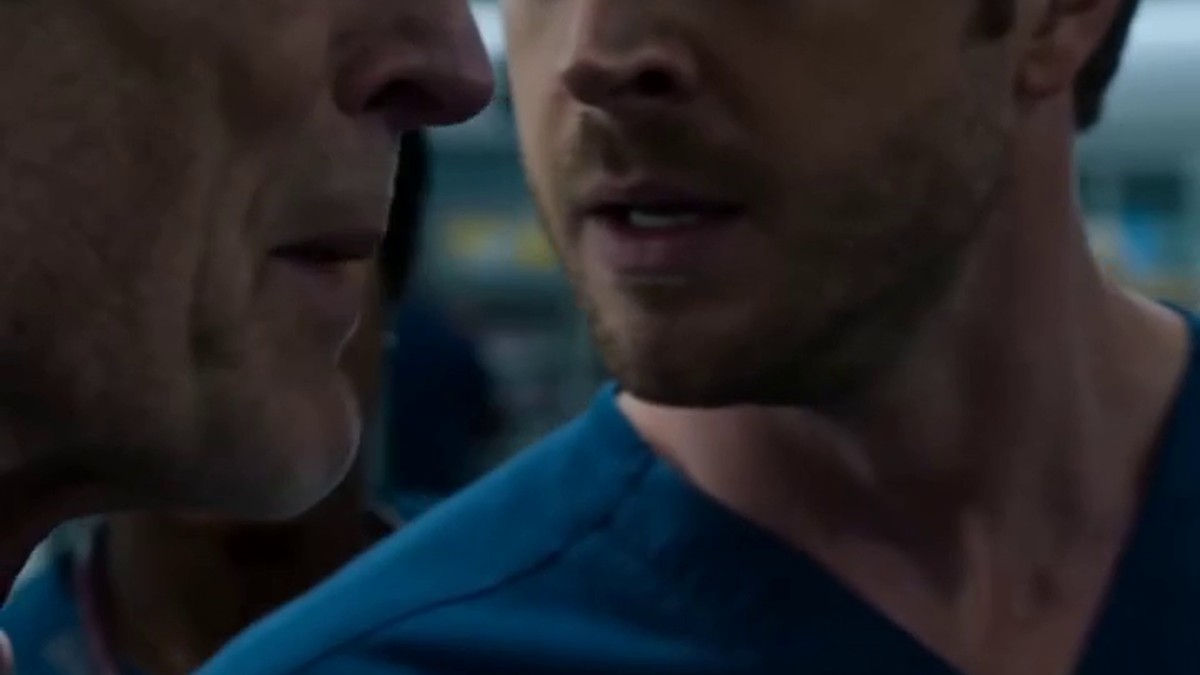
Dr. Lucas Grant pressed the heels of his palms against his eyes, letting the fluorescent glare of the ER fade behind a shower of phosphenes. His shift had ended ten minutes ago, but his feet still carried the ache of twelve hours stitching wounds and delivering hard news. Outside the sliding doors, a Denver December was frosting the streets, but inside, the stale, recycled air of Mercy General hummed with its usual indifferent rhythm. He was just reaching for his coat when a commotion sliced through the lobby—an old man’s voice, ragged, fraying at the edges.
“Please… she’s burning up. You have to help her.”
Lucas’s hand stopped mid-air. Something in that voice snagged on a memory, a forgotten splinter. He turned and walked toward the admission desk, curiosity shifting into a cold, sudden dread.
A man in a threadbare wool coat stood clutching a little girl to his chest. She couldn’t have been more than five, her blond curls plastered to a forehead glistening with sweat, her cheeks flushed a dangerous crimson. Her small fingers twitched weakly against his collar.
The receptionist, a steely-eyed woman with a nameplate reading *Cynthia*, recited the policy without looking up. “Sir, you need to pay the deposit before we can admit her. It’s five hundred dollars. Do you have insurance?”
The old man’s shoulders sagged. “I don’t… I don’t have that cash on me. I’ll get it, I swear, just let her see a doctor first—”
“I’m sorry. Rules.”
The child stirred, her voice a thin, cracking wail. “Grandpa… it hurts…”
Lucas saw the old man’s face crumple, the way his arms tightened around the girl as if he could press life back into her with sheer will. And then the old man looked up, scanning the hallway with desperate, watery eyes, and he saw Lucas.
He froze.
Lucas felt the floor tilt. The face was older, carved deeper with lines of worry and time, but the eyes—a piercing, faded blue—were the same ones that had once stared at him across a dinner table in a different life. Harry Grant. His father.
A wave of nausea rolled through him, followed by a flood of images he’d buried: a screaming match in a kitchen, a slammed door, the silence of six years. His father had vanished after Claire’s funeral, after Lucas had hurled accusations so venomous they’d scoured the air between them. And now here he stood, a ghost in a hospital lobby, holding a dying child.
Lucas’s training kicked in before his heart could catch up. He strode forward, voice calm and hard. “Take her to Exam Room Three. Now.”
Cynthia opened her mouth to protest, but the look on his face must have warned her off. A nurse hurried over with a wheelchair, and Lucas knelt beside the girl, gently peeling back her eyelid, checking her pulse. The skin beneath his fingers was molten.
He lifted his gaze to his father. The word came out before he could strangle it. “Dad?”
Harry’s breath hitched. Tears spilled over the creased cheeks. “Lucas… my God, Lucas.”
For a moment, nothing else existed in that lobby. The nurses, the beeping monitors, the curious stares of patients—all of it dissolved into the silent, crackling space between estranged son and shattered father.
Lucas swallowed the knot in his throat. “We’ll talk later. Right now, she needs fluids and a spinal tap. She could have meningitis.”
As the gurney whisked the girl away, Harry grabbed Lucas’s wrist with a grip that felt like iron. His face had gone bone-white, and something else flickered behind the tears—terror mixed with a raw, trembling urgency.
“Lucas, wait.”
“What?”
Harry’s lips moved, but no sound came. He tried again, voice cracking into a whisper. “The girl… Sophie. She isn’t just my granddaughter.”
Lucas jerked his arm back. “What are you talking about?”
His father swayed on his feet. He looked as if he were about to shatter into a thousand pieces. “She’s… she’s your daughter.”
The word hit Lucas like a defibrillator to the chest. His mind blanked, then roared back with a single, impossible thought: *Claire was pregnant?* He hadn’t known. Hadn’t suspected. After the crash, after the funeral, he’d shut out everyone—including Claire’s parents, who’d moved away in their own ocean of grief. There had been no sign, no letter, no call. And his father, who had once been his closest confidant, had chosen to bury this secret.
Harry was crying openly now, shoulders shaking. “It wasn’t supposed to be like this. After you and Claire… after you told me you never wanted to see me again… her mother came to me. She said the baby survived the accident. A miracle, they said. Claire had been eight months pregnant, Lucas. Eight months. They saved Sophie by emergency C-section, but they lost Claire on the table. I was so scared you’d hate me even more, that you’d think I was trying to use the child to trap you… so I took her. I thought I could raise her, give her a good life, until I found the right moment to tell you. But there was never a right moment. And now she’s sick, and I’m broke, and you’re the only doctor I knew could save her. I’m so sorry. I’m so, so sorry.”
Lucas heard a roar in his ears, as if the blood in his veins had turned to a river of fire. His daughter. That pale, fever-ravaged child on the gurney was his daughter. And she was dying. He turned and ran.
In the exam room, chaos was already in motion. The pediatrician on call had started an IV and was prepping a lumbar puncture. Sophie’s tiny body arched in pain, a thin cry rising from her lips. Lucas pushed past the nurse, grabbing the lab kit. “I need results five minutes ago. And call the PICU—we’re going to need a bed.”
For the next hour, he lived in a bubble of sterile panic. The spinal fluid came back cloudy, teeming with bacteria—meningococcal meningitis, the worst kind. He made the calls, ordered the antibiotics, held Sophie’s tiny hand when she seized, and didn’t let himself think about anything else. His father hovered in the doorway, a silent sentinel, his face a mask of guilt and hope.
When the seizures stopped and her fever finally began to drop, Lucas slumped against the wall and let out a breath he hadn’t known he’d been holding. Sophie’s breathing steadied, the monitors beeping a steady, reassuring rhythm. She was going to live.
The hallway outside was empty except for Harry, who sat on a plastic chair with his head in his hands. Lucas approached, his shoes clicking softly on the linoleum. For a long time, neither spoke.
“She’s stable,” Lucas finally said. “The next twenty-four hours are critical, but she’s strong.”
Harry lifted his face. His eyes were red-rimmed, hollow. “I didn’t deserve to keep her from you. I know that. I was a coward.”
Lucas stared at the wall, a watercolor of a mountain landscape someone had hung to soften the antiseptic sterility. The anger was still there, a hot coal in his gut, but it was no longer the only fire. Grief had twisted it into something else—a desperate, bewildering love for a child he’d never met until an hour ago.
“You should have told me,” he said, his voice hoarse. “I lost Claire, and then I lost you, and all that time I had a daughter and didn’t know it. You robbed me of five years.”
“I know.”
“And yet…” Lucas turned to face the old man—*his* old man, who had held Sophie through every fevered night before this one, who had fed her and sung to her and probably told her stories about a father who was a hero, a doctor who saved lives. “You brought her to me when it mattered. You gave her a chance.”
Harry’s chin trembled. “She looks like Claire. Has her smile. And your stubbornness. She’d argue with a fence post.”
A laugh, unbidden and painful, escaped Lucas’s throat. He rubbed his eyes. “I want to know everything. Everything I missed. Her first word, her favorite food, what makes her cry.”
“She calls you ‘Daddy in the photograph,’” Harry whispered. “I kept a picture of you on the mantle. She’d kiss it goodnight.”
Lucas’s composure finally broke. He slid down the wall until he was sitting on the cold floor, and his father joined him, shoulder to shoulder. Two men, cracked by years of silence, huddled outside a room where a little girl slept.
The days that followed were a blur of hospital visits, paperwork, and halting conversations. Lucas took a leave of absence and spent nights in the PICU chair, holding Sophie’s hand while she recovered, memorizing the curve of her nose and the flutter of her eyelashes. When she woke, confused but smiling, and called him “the doctor man,” he told her gently, “I’m your dad.” She didn’t quite understand, but she let him hug her, and that was enough.
The legal tangles, the explanations to social services, the slow rebuilding of trust between father and son—it all took months. But by the time the Denver spring melted the last snow, Lucas had moved into a small house with a backyard, and Harry lived in the guest room. Sophie’s laughter rang through the halls, chasing away the ghosts of old grudges.
One evening, as the three of them sat on the porch watching the sunset, Sophie crawled into Lucas’s lap and said, “Grandpa told me you were always my daddy. You just had to find me.”
Lucas looked over at his father, who met his eyes with a tentative, hopeful smile. He wrapped an arm around his daughter and pulled the old man into the embrace. “He found me too,” Lucas said.
And in the golden light of that Denver evening, the fracture that had split a family so brutally began, at last, to heal.