Edward Cole was late. Again.
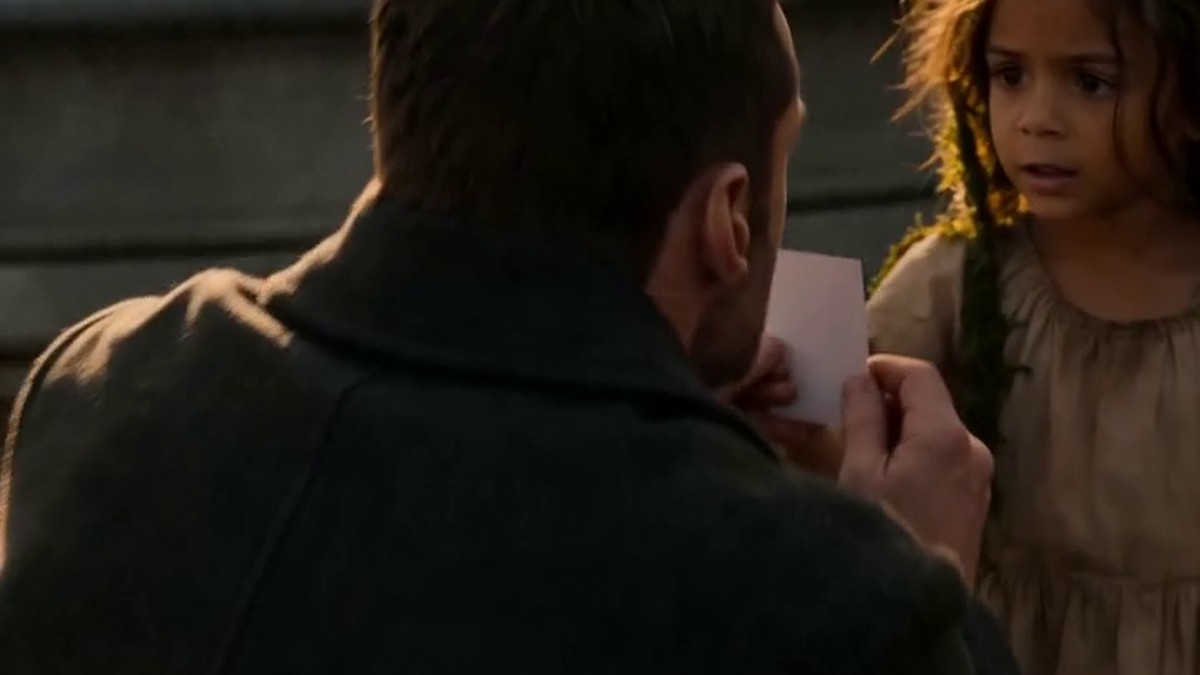
He cut through Chippewa Square, weaving past tourists and moss-draped oaks, one hand clamped on his phone, the other jammed into the pocket of his wool coat. A photograph slipped from the lining and fluttered onto the old bricks without a sound. He didn’t notice.
He was already ten paces away when a thin, high voice called out.
“Mister, why do you have a picture of my mommy?”
The words hooked him mid-stride. He turned, the leather of his shoes grinding against the wet stone. A little girl, no more than six, stood barefoot by the wrought-iron fence. Her dress was a faded rag, her knees scabbed, her brown hair tangled with bits of Spanish moss. In her grimy hands she held the four-by-six snapshot that had just escaped his coat.
Edward walked back slowly, the blood draining from his face.
“What did you say?” His voice came out in a rasp.
“My mommy,” the girl repeated, unblinking. She raised the photo so he could see. The woman in it had deep hazel eyes, a soft mouth, and dark curls just like the child’s. It was Margaret. His wife. Dead six years.
Edward knelt, taking the photograph with trembling fingers. “That’s not possible,” he whispered. “That’s my wife. She died a long time ago.”
The girl did not flinch. She looked him straight in the eye, her jaw set with a certainty no child her age should possess.
“No,” she said. “My mom is alive.”
Edward stared at the picture, then at the girl. It was like looking through a tear in time. The same wide-set eyes, the same gentle slope of the nose, the exact same mouth. He felt the ground tilt.
“Where is your mom?” he managed.
“At the trailer.” She pointed past the cathedral, toward the river. “She’s cleaning the diner till evening.”
“Take me to her.”
The girl pressed her lips together, thinking. Then she reached up and took Edward’s hand with the kind of trust only a hungry child can offer a stranger with a familiar face.
They walked together past the old cotton warehouses, the air thick with the smell of fried shrimp and diesel from the port. The child’s toes left small wet prints on the pavement. She said her name was Emmy. She said they lived in a rusty trailer down by the canal, and that sometimes she came to the square to beg because the tips her mom made weren’t enough. Edward swallowed hard.
When they rounded the corner onto a weed-choked lot, his heart nearly stopped. The door of the corroded Airstream opened, and a woman stepped out.
She wore a stained apron. Her hair was pulled into a tight, graying bun, and deep exhaustion lined her face. But those eyes—those hazel eyes—belonged to a ghost.
“Margaret,” he breathed.
The woman froze. Her gaze flicked from Edward to the child and back. “I’m sorry, do I know you?” Her accent was the same soft Savannah drawl, but there was no recognition in her expression. Just weary caution.
Edward held up the photograph.
Her face paled. She took a step back, bracing herself against the trailer’s flimsy doorframe. “That woman… she looks like me.”
“She *is* you,” Edward said, his voice cracking. “You vanished six years ago. A boating accident, they said. They never found your body. I buried an empty casket.”
Margaret—or whoever she was now—shook her head slowly. “I don’t remember anything before the hospital. A man named Tom said I was his wife. He found me by the river, half-drowned, and told me I’d been in an accident. He brought me here. He died last year. Left me with Emmy.”
Edward’s gaze dropped to the little girl, who had pressed herself against her mother’s leg. “Emmy,” he said, his throat tight. “How old are you?”
The girl held up her fingers, then counted again more carefully. “Five and ten months,” she said. “My birthday’s in April.”
Edward’s mind raced. Five years and ten months old, birthday in April. It was February now. If she was born in April five years ago, then nine months before that placed conception almost exactly seven years back. Margaret had disappeared in late February six years ago. He had never known she was pregnant. The numbers locked into place with terrible clarity.
“Margaret,” he said, his voice low and steady, “she’s my daughter. You were carrying her when you vanished.”
The woman’s face crumpled with disbelief. “No. No, that’s—Tom was—”
But she couldn’t finish the sentence, because the truth already ate at the edges of her borrowed past. Over the years, she had pieced together scraps about Tom: a solitary dock worker who pulled her from the shallows near the Talmadge Bridge, convinced she’d been thrown from a pleasure boat. He’d told the ER nurses she was his missing wife, then taken her home to the trailer when she couldn’t produce her own name. The child came two months later, and he never tried to touch her—he’d only wanted a family to replace the one he’d lost a decade before. In his own broken way, he had saved her life and trapped her in a lie.
Edward saw the terror in her eyes—the terror of a woman whose entire identity was a fiction.
He didn’t push. Instead, he pulled out his phone and made a quiet call to a private lab on Abercorn Street. He offered to pay for tests, for a hotel room, for food that wasn’t scavenged from diner trash. He promised nothing but answers.
The next days were a held breath. The DNA sample was taken in a sterile white room while Emmy colored butterflies in a waiting chair. Edward stayed close, patient, his heart a war drum. Margaret—who was still Margaret somewhere deep inside—watched him with a guarded, tear-bright gaze.
On the third afternoon, the results came back.
Edward found her in the hotel lobby, Emmy dozing on her lap. He knelt before them, the printed report trembling in his hand.
“She’s mine,” he said. “She’s our daughter. And you are my wife.”
Margaret’s hand flew to her mouth. She stared at the paper, at the impossible numbers, and then back at Edward’s face. A strange pressure built behind her eyes—not the sharp burst of returning memory, but a deep, wordless ache that felt like recognition without image. No forgotten days suddenly lit up. Only the weight of a truth she couldn’t remember living.
She lowered the paper. “I still don’t know you,” she whispered. “I wish I could tell you I do, but it’s just… darkness.”
Edward didn’t look away. “Then let me earn the chance to be known again.”
Emmy woke up, confused, and crawled onto the couch next to them. She stared at Edward with those serious hazel eyes. “Are you my daddy?”
Edward nodded, tears cutting tracks down his cheeks. “I am. I’m so sorry I wasn’t there.”
The girl considered this for a moment. Then she climbed into his lap, fitting herself against his chest as naturally as if she’d been doing it since birth.
“Can you help my mommy?” she whispered, pressing her face into his coat.
“I’m going to try,” Edward said, looking at the woman in his arms. “Everything I have.”
Margaret looked up at him then, her expression softer but still uncertain. She had no memory of the house on Victory Drive or the gardenias or the off-key singing in the shower. But the hollow ache inside her now had a shape. It had a name. And it was sitting right here, holding her daughter, crying without shame.
“Edward,” she said, testing the name like a new language.
He smiled through the tears. “Yeah. That’s me.”
They stayed like that—three strangers bound by blood and the ruins of a stolen past—until Emmy’s stomach growled and made them all laugh. Edward took them to a diner with red vinyl booths and bottomless coffee. Over pancakes and syrup, he told Margaret about the life she’d forgotten, not demanding she reclaim it but offering pieces she could hold up to the light. She listened, asking small questions, and for the first time the future felt less like a locked door.
That night, they walked along the riverfront, the setting sun painting the water in copper and gold. Edward carried a sleeping Emmy in his arms. Margaret walked beside him, her hand hesitantly resting in the crook of his elbow.
“I’m scared,” she admitted. “What if I’m not her anymore?”
Edward stopped and turned to her. “You’re whoever you choose to be. But you gave me a daughter I didn’t know existed, and I see the woman I loved in you every time you look at her.” He brushed a stray hair from her face. “We have a second chance. I’m not losing you again.”
She looked at Emmy, at the face that mirrored her own, and then at Edward, whose hope was a fierce, living thing. The fear didn’t vanish, but it loosened its grip. She didn’t need to remember—not yet—to choose to stay.
“Okay,” she whispered. “Okay.”
They stood there as the streetlamps flickered on along the promenade. The old city hummed around them, full of secrets and sudden gifts. And for the first time in six long years, Edward’s heart felt whole—stitched together by a photograph, a child’s question, and a love that had refused to stay buried.