November rain comes in off Boston Harbor with a certain mean streak. It slaps the windows of the Granary Club on Congress Street like it's trying to get in. I walked through the front door at seven fifty in the evening with my security chief, Paul Brogan, two steps behind me. Paul had been with me since before my father died, eleven years ago, and he knew better than to speak while I was counting empty tables.
The maître d' had done exactly what I'd ordered. Every reservation canceled. Every door watched. The whole building sealed until morning. I was there to remind Judge Calloway about the price of loyalty — a forty-year-old Barolo was already breathing on table five. Ward Whitfield, keeper of the family's good name, about to protect it the only way his father had ever taught him. That was the plan.
The plan died at table nine.
A woman sat by the rain-streaked window with a child on a velvet chair. The kid was on her knees, bending over the white tablecloth, pressing a purple crayon in circles. The woman had dark hair swept over one shoulder. A gray wool coat. A face I used to wake up next to.
Mara.
For about three seconds, I thought I was seeing things. Not her — the fact that she was here, in a building I'd sealed under my own name. Then the past opened like a trapdoor.
Five years ago, I'd annulled our marriage after the doctors at Mass General told us, in a small windowless room, that the damage from her ectopic pregnancy the year before had left her unable to carry another child to term. My mother called her barren. My cousins called her a dry well. I believed the doctors. I believed my mother more. I signed the papers. One signature, one envelope, twenty minutes. She took a cab from our house on Commonwealth Avenue. I watched from the window and told myself it was for the best.
What none of us knew — what Mara herself didn't know for six more weeks — was that she was already carrying a child the doctors said could never exist.
The little girl looked up.
And I saw the mark behind her left ear.
A small crescent-shaped birthmark, pale as the edge of a thumbnail, sitting exactly where my father had his. Where his father had his. In every Whitfield portrait hanging at the Athenaeum, that same little moon sits behind the left ear. They called it the Whitfield moon. My father used to say it meant we were marked for a certain kind of life.
The crayon rolled off the table. It hit the marble and stopped at the toe of my shoe.
Nobody moved. Paul cleared his throat behind me. I didn't turn around.
I bent down, picked up the crayon, and walked to the table. My hand shook as I offered it to her.
"You dropped this," I said.
The girl looked at my hand. She didn't take it. She turned to her mother. "Mama, why is that man breathing like Grandpa?"
Mara put an arm around the girl and drew her close. Her face was calm in a way I'd never once seen in six years of marriage — the calm of someone who has rehearsed a moment so many times that living it feels almost easy.
"Is she mine?" My voice broke on the word.
Mara didn't answer right away. She reached into a worn black leather tote and took out a folded paper, setting it on the table beside the child's drawing. A birth certificate. The name at the top read: **Nora Leland**. Mother: Mara Leland. Father: blank.
"Her name is Nora," Mara said. "She's mine. Only mine. I made sure of that, too — reissued this yesterday. Your name was never going to sit next to hers."
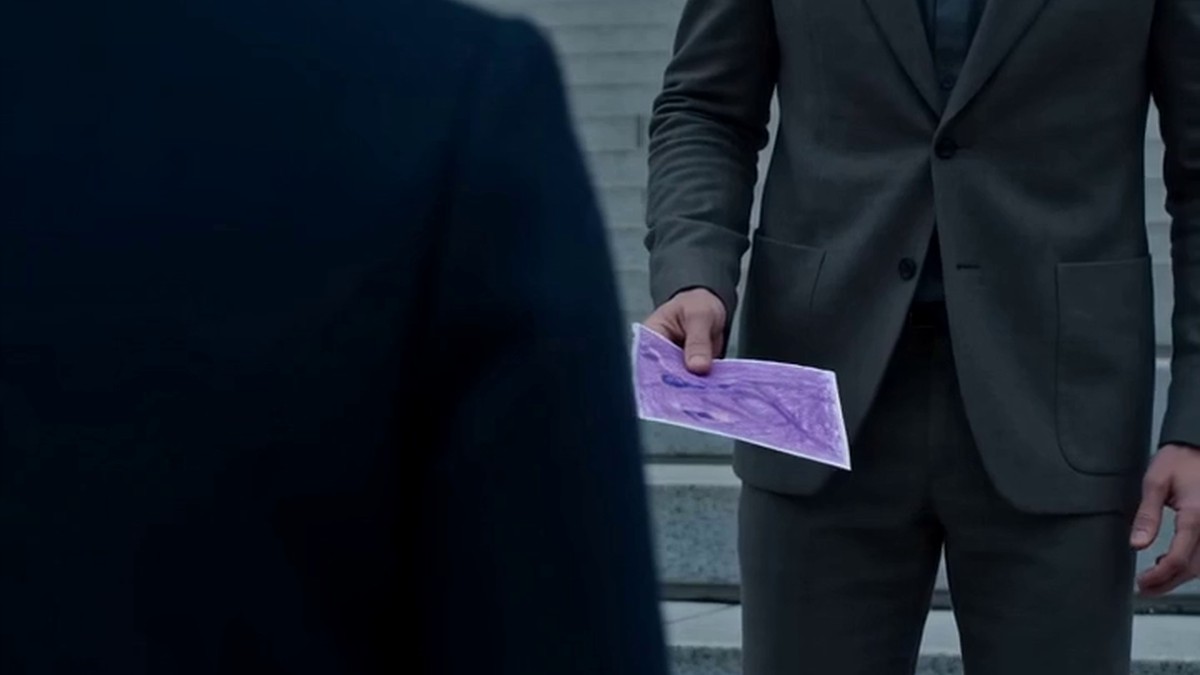
The girl pointed at the purple squiggle on the tablecloth. "That's the moon," she said. "I'm making it purple."
I didn't look at the drawing yet. "Mara — the doctors said —"
"The doctors were wrong. I found out two months after you signed. I was already three months along by then." She said it flatly, like a fact she'd worn smooth from repeating it to herself in the dark. "I thought about calling you. I sat with the phone in my hand for an hour. Then I thought about your mother's voice, and your signature on that decree, and I put the phone down."
The back door of the restaurant opened. A man stepped through in a navy suit, carrying a black folder. He wasn't one of mine. Behind him, two more men, their jackets open just enough to show the badge clips on their belts.
"There," Mara said. "Those are the people you should meet."
The man in the navy suit set the folder on the table beside the birth certificate. He looked at me with the kind of politeness that has teeth. "Mr. Whitfield, I'm Special Agent Daniel Reyes, FBI. Judge Calloway was taken into custody in the parking garage ten minutes ago. He's been cooperating for six weeks."
Reyes opened the folder. Inside was a copy of a federal warrant, a photograph of the judge in a wire, and a document I recognized — the annulment decree I'd signed five years earlier. Judge Calloway's signature was on the approval line beneath mine, dated the same afternoon, stamped and filed before the mandatory medical review period had even run.
"Your mother paid Calloway to fast-track that annulment," Reyes said. "Waived the second medical opinion the court requires, backdated the filing, sealed the record so it couldn't be reopened for challenge. He did the same thing for three other families on the waterfront deals — favors traded for zoning votes. Mara found the fast-track filing two years ago while she was digging through probate records for something else entirely. She recognized your mother's handwriting on the request." He tapped the decree. "That's the fraud at the core of your family's arrangement with this judge. Yours was just the one that came with a birth certificate attached."
I could have called Paul. I could have had my attorneys on the phone in thirty seconds. Instead I looked at Mara. She was buttoning the child's coat — a little red thing with wooden toggles. The girl was still drawing, adding a second moon to the tablecloth.
"You don't have to do this," I said.
Mara finished the last toggle. She put the child's hand in hers and stood. "I'm not doing anything to you, Ward. I'm just not letting you touch her." She folded the birth certificate back into her bag. "Her name is Nora. She's four years old. She likes purple, and the moon, and the story about the lighthouse at Marblehead Neck. Her favorite word is 'why.' She's never asked about you. She never will."
She walked toward the back door. Reyes and the other agents stepped aside. The child looked over her shoulder at me once, then turned back and said something to her mother that I couldn't hear.
At the door, Mara stopped without turning around. "I kept her from you for four years, three months, and eleven days. Not because of the doctors — because of what your family does to anything it decides it owns. I came forward to the FBI a year ago because I wanted Calloway gone before Nora was old enough to understand what a Whitfield is. Tonight wasn't in the plan. Reyes needed this room emptied for the arrest, and your maître d' happened to book the only open table for a woman and a child. I saw the reservation sheet a week ago and I could have canceled. I didn't." She was quiet for a moment. "I wanted you to see her face once, up close, before the papers made her a stranger to you forever. Now you have."
The door closed behind her.
Reyes snapped the folder shut. "We can do this the easy way or the hard way, Mr. Whitfield. The warrants are signed. The judge's testimony is sealed. Your attorneys will want to talk to me before morning."
I didn't answer him. My eyes were on the table where Nora had been drawing. Next to the purple moon, she'd added a small yellow star. Under it, in wobbly letters, one word: *Mama*.
Paul Brogan picked up the fallen crayon and set it back on the table, next to the drawing, the way you'd set down something breakable. "Boss?"
I reached past him and took the paper instead of the crayon. The tablecloth tore a little where the purple wax had pressed hard into the weave. I folded the drawing once, along the crease Nora's own small hand had pressed into it, and put it in my coat pocket.
"Cancel the Barolo," I said. "Tell Reyes my attorneys will call his office in the morning, not tonight."
Paul frowned. "And the judge?"
"Let him have his six weeks of cooperation. I don't care anymore." I looked at the empty velvet chair, at the two moons and the star still drying on the tablecloth. "Get my coat, Paul. I'm not staying for dinner."
I walked out past Reyes, past the agents, out into the rain coming off the harbor, with a four-year-old's drawing folded flat against my chest and no idea, for the first time in eleven years of running my father's business, what I was supposed to do next.