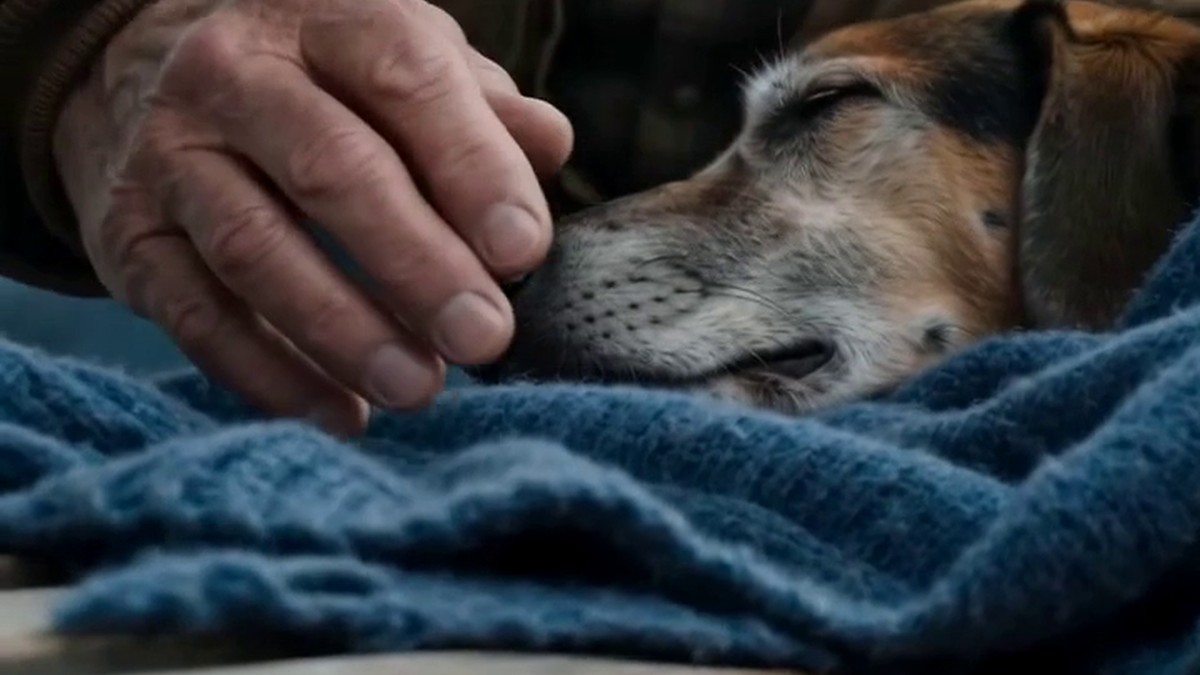
The first time I saw Lucky, I was locking up the parish hall after a finance meeting that had gone on way too long. She was curled on the third step of St. Anne’s, right where the concrete had a crack shaped like the state of Florida. Gray muzzle, cloudy eyes. One of her back legs stuck out at a weird angle, like it had healed wrong and nobody ever set it. She didn’t look up when I passed.
That was March. By mid-April, she was there every evening. Same time, same step, always before the sun dropped below the roofline of the ShopRite across the street. She’d limp up Main Street from the direction of the old mill houses, take the steps one at a time, and sit down facing the big wooden doors. Didn’t beg. Didn’t bark. Didn’t even turn her head when the kids from the middle school rode past on bikes, kicking up gravel.
My name is Joe Callahan. I’ve been sexton at St. Anne’s in Millbrook, New York, for nine years. I unlock the doors in the morning, sweep the floor, fix whatever the weather breaks, and lock up at night. I’m sixty-two. I’ve seen a lot of sad things walk past this church, but I’d never seen a dog keep a schedule like that.
People started leaving food out for her. Teddy, the guy who runs the deli on Church Street, brought her a slice of turkey every Tuesday. She’d sniff it, take maybe one bite, and push the rest around with her nose. Like eating wasn’t the point. Like she was there for something else.
One evening, I sat down on the step beside her with a cup of coffee and a ham sandwich. My back ached from replacing a ceiling tile in the storage room after a leak. I ripped off a piece of the ham and held it out.
“Here you go, girl. What’s your story?”
She didn’t take it. She kept staring at the door.
That’s when Carol Butterfield came shuffling up the walk with her walker, those little tennis balls on the bottom making a soft scratching sound on the pavement. Carol’s been coming to St. Anne’s since before I was born. She knows everybody’s business, but she’s not mean about it. She just notices things.
She stopped next to us, breathing hard from the walk. “That’s Lucky,” she said. “Helen Deveraux’s dog.”
Helen Deveraux. The name hit me like a cold draft through the vestibule. Helen had died in February. I’d helped set up the chairs for her funeral. She was eighty-seven, lived alone in the yellow bungalow on Fox Chase Lane, always wore the same blue scarf around her neck even in the summer. I used to see her at the Saturday evening Mass, always in the second pew from the back, left side. She always had a little bag of hard candies she’d slip to the altar boys.
“Helen found her in a dumpster behind the old Price Chopper,” Carol said. “Just a puppy. Eyes still closed. Helen carried her home in her jacket, fed her with a dropper. Kept her alive.”
I looked down at the dog. The gray on her muzzle wasn’t just age. It was fourteen, fifteen years of waiting outside this church.
Helen never drove, so she walked to Mass every evening. Lucky would trot along beside her, then wait on the steps until the doors opened. The story goes that Helen would come out, bend down, and say something to the dog every single time. Carol told me what it was. “There you are, my sweet girl. Let’s go home.”
Except Helen didn’t come out anymore.
When she went into the hospital with pneumonia in January, Lucky waited on the porch of the yellow bungalow. The neighbor across the street, a man named Frank, started leaving food out. Lucky wouldn’t leave the house. She slept on the mat by the front door, nose pressed against the gap at the bottom, like she could smell Helen inside.
After the funeral, Frank tried to keep Lucky at his place. He put a blanket in his garage, set up a water bowl, brought her inside when it snowed. But every evening, around six-fifteen, Lucky would push through whatever gap she could find and make her way to St. Anne’s. It took her about twenty minutes to do the mile and a half. She knew every crack in the sidewalk, every driveway she had to avoid because of the dogs behind the fences.
She was waiting for the door to open. For Helen to come out and say those words.
I started leaving the side door unlocked. Not the big wooden doors that make that heavy sound when they swing, but the smaller one by the sacristy, the one I use in the morning. One evening, I opened it and stood behind it, just watching.
Lucky padded inside. Her claws made a soft clicking on the tile. She walked down the center aisle, past the pews with the faded red cushions, past the statue of Mary with the chipped finger, all the way to the front. There, on a small table next to the altar, we had set up a memorial display for Helen. Her photo in a brass frame, a few candles, a small vase of silk flowers that Carol had donated.
The dog stopped. She looked at the photo for a long moment. Then she walked up and pressed her nose against the edge of the table, right below the frame. She didn’t make a sound.
She lay down at the foot of the table, curled into a tight ball, and stayed there until I finally had to close up at nine.
After that, it became a routine. Every evening, I’d leave the side door cracked. Lucky would come in, walk to the front, and settle by Helen’s photo. Sometimes she’d stay an hour. Sometimes longer. I’d sweep around her, careful not to disturb her. Some nights I’d sit in the back pew and just watch her breathe.
I’m not a man who thinks animals go to heaven or any of that. I keep the building clean, I fix what’s broken, I don’t get involved. But I started looking forward to that dog. When I’d hear her claws on the tile, I’d feel something loosen in my chest.
Then, one night in late May, she didn’t come.
I waited until eight, then nine, then ten. No Lucky. I locked up and walked out onto the front steps. The street was quiet. A single car went past, its headlights sweeping over the church lawn. Nothing.
I didn’t sleep well that night, which is unusual for me. I’m a heavy sleeper. I once slept through a lightning strike that took out the old maple tree next to my truck.
The next morning, I drove over to Fox Chase Lane before sunrise. The yellow bungalow sat dark and empty. On the front porch, there was a cardboard box. Frank had told me he’d boxed up Helen’s old clothes for the Salvation Army, and the pickup had happened that week. But whoever came must have missed this one box, because it was still sitting there, half-open from the rain.
Lucky was on the porch swing.
She was lying on Helen’s blue scarf. The same one Helen always wore around her neck. The dog had her head resting on it like a pillow, one paw draped over the fabric. She wasn’t breathing.
I sat down on the porch steps and cried like I haven’t cried since my wife passed six years ago.
We buried her in the little garden behind the church, next to the small statue of St. Francis that the parish put in back in the eighties. Frank made a wooden marker. Carol got it engraved at the shop over in Poughkeepsie. It doesn’t say anything fancy. Just her name, two dates, and eight words that Carol picked out.
“A dog who loved truly never forgets the way home.”
I still unlock the side door every evening at six. Out of habit, I guess. Some nights, when I’m sweeping the aisle and the light comes through the stained glass just right, I catch myself looking at the table by the altar where Helen’s photo used to be.
The photo’s gone now. I moved it into the parish office, where I can see it while I do paperwork.
But sometimes, when I’m alone in the building late at night, I swear I can hear the soft clicking of claws on the tile. Just for a second. Like she’s still coming in.
I don’t know much about what dogs feel. I just know I’ve never seen anything like that, and I don’t expect to again.
Some people in town still ask me about her. The deli guy, Teddy, still puts a slice of turkey on the second step every Tuesday, right where she used to sit. By Wednesday morning, it’s always gone. Probably a raccoon.
Probably.
I keep fixing what’s broken here. I keep unlocking the door at six. And every evening, when the sun drops below the ShopRite roofline, I look out at the front steps.
The third one is still cracked, shaped like Florida.
That’s where she’d sit.
That’s where I still leave the light on.
There are things in this world that don’t make sense until you see them with your own eyes. A dog who keeps a six-fifteen appointment for months after the one person she ever loved has left this world. A dog who walks a mile and a half on a bad leg just to lie down next to a photograph.
I don’t know what that is. I just know I was there to see it, and I’ll be there every evening at six, just in case she comes back.