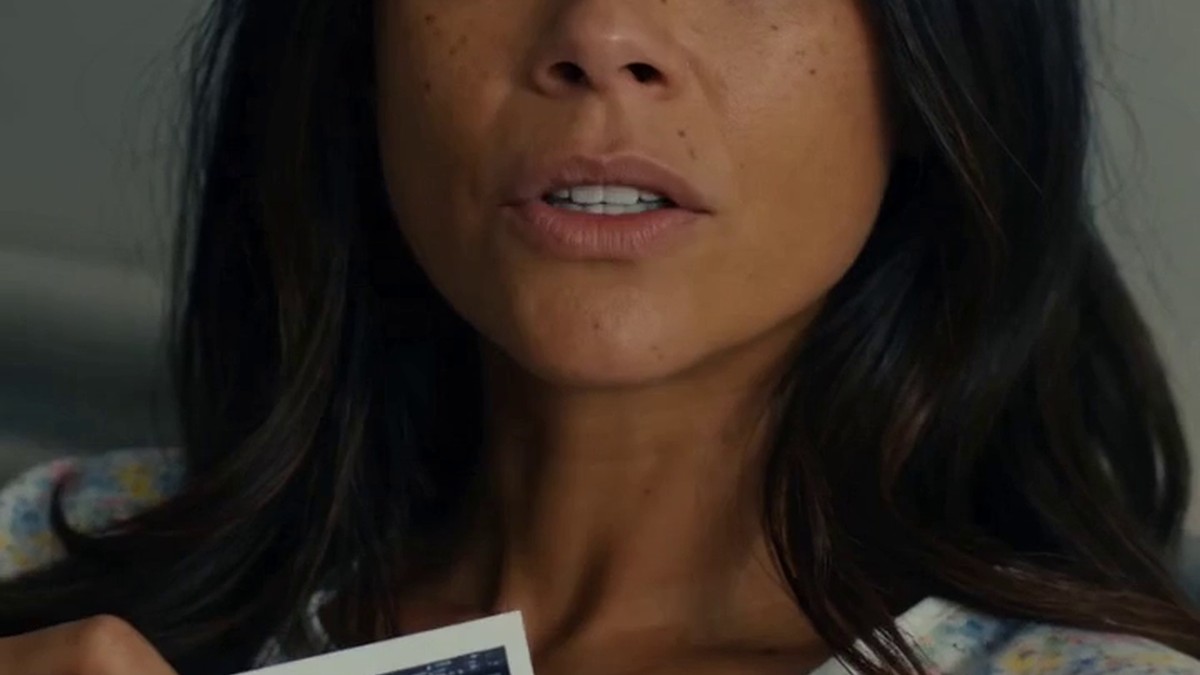
Kamila sat on the hallway floor reading the same bank text for the third time. Four hundred dollars. Gone from the account at 7:42 p.m., a Zelle transfer to a contact saved in Thomas's phone as "Mom."
Yesterday at that same hour they'd been standing in a paint store on Maple Avenue in Columbus, Ohio. Thomas held up a color fan deck; Kamila pressed a wallpaper sample against her stomach, gray teddy bears printed across it. Five months along. They'd picked "Milk Fog" for the nursery walls and a pine crib that still smelled like sap. The clerk wrote their names in the layaway book and took a fifty-dollar deposit.
Now Kamila stared at the text and at the wallpaper swatch still pinched between her fingers. The cardboard corner had curled from sweat.
"Thomas!" she called toward the kitchen.
No answer. She knew he was there. Standing at the window, back to the door, holding a mug of coffee he wasn't drinking. He always stood like that when he was lying.
She got up. The floorboards in their old apartment near Franklin Park creaked. She passed the stroller her sister had dropped off a week ago — secondhand, from her nephew, green, one wheel bent. She passed the box of onesies she'd washed the day before and hadn't put away yet.
She walked into the kitchen. Thomas leaned against the windowsill. Across the street, a porch light flickered on and off, on and off — someone had promised the neighbors months ago they'd fix the sensor.
"Four hundred dollars." She set the phone on the table, screen up.
Thomas didn't move.
"Mom called last night," he said to the glass. "She needed help with the electric bill. Shutoff notice was for today."
Kamila pressed her palms flat on the counter. It was sticky with juice she'd spilled that morning, distracted.
"Your mother sold the garage three months ago for forty thousand dollars. In February she took two thousand from us for a 'new window.' In May, twelve hundred for her 'sister's funeral in Cleveland.' Somehow the sister called afterward — from a spa."
Thomas set down his mug. He didn't turn around.
"It's her money, Kamila. Not my business what she did with the garage."
"And our money is your business alone?" Kamila lifted the wallpaper sample she was still holding. "We put a deposit on the crib. Fifty dollars. Four hundred and fifty left to pay. And you send her four hundred without asking me."
"She's my mother."
"And what am I?" Kamila threw the swatch onto the table. The cardboard bounced off the mug's rim. Coffee splashed across the checkered tablecloth. "I'm carrying your child. You think that's nothing?"
Thomas finally turned around. His face was red, like he'd come in from the cold. But outside it was September.
"Don't make this a scene. We'll buy the crib later. The baby won't fall apart sleeping in the stroller for a month."
Kamila studied him. His clenched jaw. His thumb, rubbing the same spot on the counter's edge, where the laminate had started to peel away from the board.
"When," she said quietly, "does your mother stop being more important than your own kid?"
He didn't answer. Outside, the porch light died for good.
Kamila rested a hand on her belly. A kick, small and firm, like the baby wanted to say something too.
"You know, Tom," she said, "I brought you something from work."
She went to the hallway and came back with a folder. She set it beside the spilled coffee.
"What is it?"
"The lease. Signed. This apartment isn't yours. It's not mine. It's Aunt Irene's." She opened the folder, pulled out two sheets. "We pay eighteen hundred a month. Starting January it goes up ten percent because the HOA is raising fees. It's all right here, in black and white."
Thomas looked at the pages. His thumb went still.
"So what?"
"So we can't afford your mother. So starting today, I'm not putting one more dollar into an account you use to bail her out." Kamila pulled her phone from her pocket. "You've got a choice. Either we open a joint account just for the baby, with a cap you can't touch without my signature. Or I move in with my sister."
Silence settled over the kitchen. Only the refrigerator hummed.
"You're threatening me," he muttered.
"No. I'm informing you."
"You don't just move out when you're pregnant."
"You don't rob your wife when she's pregnant," she shot back. Then she walked out.
That evening Thomas went to his mother's. She heard the door shut. Heard the key turn twice. Heard him take the stairs two at a time — the way he always had, since the day she'd met him.
She called her sister. Then Aunt Irene. Then she pulled a bag from the closet and started packing the baby's things.
She packed calmly. The cloth diapers her grandmother had picked out. A onesie with a duckling on it, bought at a thrift store on Route 9 for two dollars. And the wallpaper swatch, curled at the corner, teddy bears and all.
Thomas came home after eleven. Sober. That was new — usually after visiting his mother he came back with a six-pack. Not this time.
"Kamila, let's talk." He stood in the bedroom doorway.
She lay on the bed, still dressed. The packed bag sat on the floor beside her.
"Your mother signed a promissory note," she said quietly. "Last week. Six thousand dollars. Want to guess who's supposed to pay it off?"
Thomas went pale.
"How do you know that?"
"Because your mother called me at noon. Said if I'm going to refuse her money, at least let the baby be born with a name she can still afford. I'll quote her exactly: 'Tommy always picks his mother.'"
"She didn't say that."
"Call her and ask."
Thomas reached for his phone. He didn't dial. He just looked at the screen, as if the answer might appear there on its own.
"That's a lie," he finally said.
"And you've been lying for six months. Ever since you sold our ski gear to give her money for a 'kitchen remodel.' Forgot I found the receipt? The skis were worth twelve hundred. You sold them for six hundred."
Thomas sat down on the edge of the bed. The mattress dipped under him. Kamila caught his scent — the cologne his mother had given him for his birthday. Heavy, sweet, suffocating.
"I just wanted to help," he whispered.
"Help that destroys your family isn't help." Kamila stood. She picked up the bag. "I'm going to my sister's."
"Stay. Please."
"Why?"
"Because I love you."
"And I love our baby. And I won't let her grow up in a house where money disappears and you pretend it's normal."
She passed him in the doorway. He didn't stop her. Maybe he wanted to. Maybe he raised a hand. She didn't feel it.
She came back the next morning for the rest of her things.
Thomas was asleep on the living room couch. The folder she'd left in the kitchen sat on the table. Next to it, his phone. And a note.
*"Paid October's rent. All of it. Don't send anything. — Thomas."*
Kamila read it twice. There was no third time. She stuffed the note into her bag, grabbed the box of onesies, and left.
She called Aunt Irene from the bus. The bus turned onto Broad Street, sunlight bouncing off the river.
"Aunt Irene, I'm moving out. I want to end the lease."
"What about Tommy?"
"He can stay. Or go back to his mother's. That's his call now."
Aunt Irene was quiet for a moment.
"It's my apartment," she finally said. "I always told you that boy had too soft a heart. But you — you're too hard."
"No, Aunt Irene. I just stopped paying for his mother."
They ended the lease that Tuesday. Kamila paid Aunt Irene the back rent for September — four hundred and eighty dollars. The exact amount Thomas had wired his mother. Except this money went toward repainting the stairwell and new mailboxes.
Wednesday, she changed her mailing address to her sister's place.
Thursday, Thomas called. She didn't pick up. He texted: *"Mom says you're a bad wife."*
She wrote back: *"She told me I'm a bad mother because I won't hand over money for your last name."*
He didn't write anything else.
Friday, she went to the bank. Opened a savings account for the baby. Deposited the first two hundred dollars — what she'd made from overtime. The teller, older, glasses on a chain, asked:
"Saving up for something?"
"A crib," Kamila said. "Pine wood. And wallpaper with teddy bears."
The teller smiled.
"My grandson had that kind. Ripped it right off the wall when he was two. Teething."
"Maybe skip the bears, then," Kamila muttered.
Saturday, Thomas showed up outside her sister's building. He buzzed the intercom. Kamila watched him through the kitchen window, shifting his weight foot to foot, straightening his collar, staring into the camera like he didn't know what to say.
She didn't answer.
He buzzed again. Then a third time.
She stepped out onto the balcony. Thomas looked up.
"Come back," he said. "What do I have to do for you to come back?"
"Send your mother four hundred dollars," Kamila said. "Yours. Not ours. Don't tell me about it. Just give it to her. And then come here and tell me that from now on, our account is only ours."
"Why should I give her anything?"
"To find out if you can say no even when nobody's watching."
Thomas looked up at her. The porch light across the street flickered on and off.
"And if she says no thanks?"
"Then you still haven't understood a thing."
He stepped back from the entrance. He didn't leave right away — he stood by the dumpster for a while. Then he got on the bus.
That evening she got a text from the bank: a deposit, four hundred dollars. Memo: "Refund for the baby."
She called him.
"What is this?"
"You told me to give it to Mom. I did. My own money. From my PlayStation savings. And then I realized I owe you the exact same amount." His voice cracked. "So I'm paying it back."
"That's not how this works, Tom."
"I know. But you've got to start somewhere."
She didn't come back. Not right away.
For a month they met on neutral ground. A coffee shop downtown, the clinic for her ultrasound, walks through the arboretum. Thomas carried the grocery bags. Brought her prenatal vitamins because she kept forgetting. Never touched her phone.
In November she went with him to a lawyer. They drew up a postnuptial agreement and joint authorization for a new account at a different bank. Account name: "Baby Fund." Anyone could deposit; withdrawals needed both signatures.
In December, Thomas called his mother with Kamila in the room. He put it on speaker.
"Mom, I'm not paying off your note. I won't co-sign anything. And I'm not giving you four hundred dollars for the electric bill. If you want help, show me your bank statements first."
His mother yelled. For a long time. Kamila heard words no mother should say to her son. Thomas listened. His thumb rubbed the edge of the table. But he didn't hang up.
"Mom, I love you," he said at the end. "But I won't pay for your lies anymore."
He ended the call. Set the phone face-down on the table.
Kamila walked over. She took his hand. First time in two months.
"You paid," she said.
"For what?"
"For us."
In January, their daughter was born. In the nursery stood the pine crib. On the wall — wallpaper with gray teddy bears, but only on one wall, because they'd run short.
Thomas arrived at the hospital with the stroller. The green one, from her nephew. He carried it up the stairs because the elevator was out.
Kamila lay with the baby on her chest, asleep. Thomas sat beside her, watching them.
On the nightstand sat a pharmacy receipt. Prenatal vitamins. Twelve dollars. Next to it, his phone, banking app open. On the screen — the "Baby Fund" account. Balance: one thousand two hundred forty dollars.
Thomas pulled a hundred-dollar bill from his wallet and set it beside the receipt. Then he picked up the phone and typed in a transfer. Amount: one hundred dollars. Memo: "First payment on the skis."
It took him less than a minute. But Kamila opened her eyes right as he tapped send.
"What are you doing?" she asked.
"Paying off debts," he said, and turned the screen toward her.
Kamila looked at the screen. Then at him. Then at their daughter.
"She has your eyes," she said softly.
Thomas stood, walked to the bed, and leaned down. Their daughter wrapped her hand around his finger. Tight.
"And your strength," he added. "Thank God for that."
Outside the hospital window, snow fell — the first of the season. Big flakes stuck to the glass and melted before they had the chance to slide down.