The slap cracked through the ballroom like a gunshot.
Conversations died mid-sentence. The string quartet's melody dissolved into stunned silence. Orange juice ran in thin rivulets down the maid's uniform, pooling on the marble floor around the broken pieces of the serving tray. She stood perfectly still, one trembling hand pressed against her cheek, heat radiating from where the blow had landed.
Across from her, Isabella Sterling vibrated with fury.
"You ruined my birthday party!"
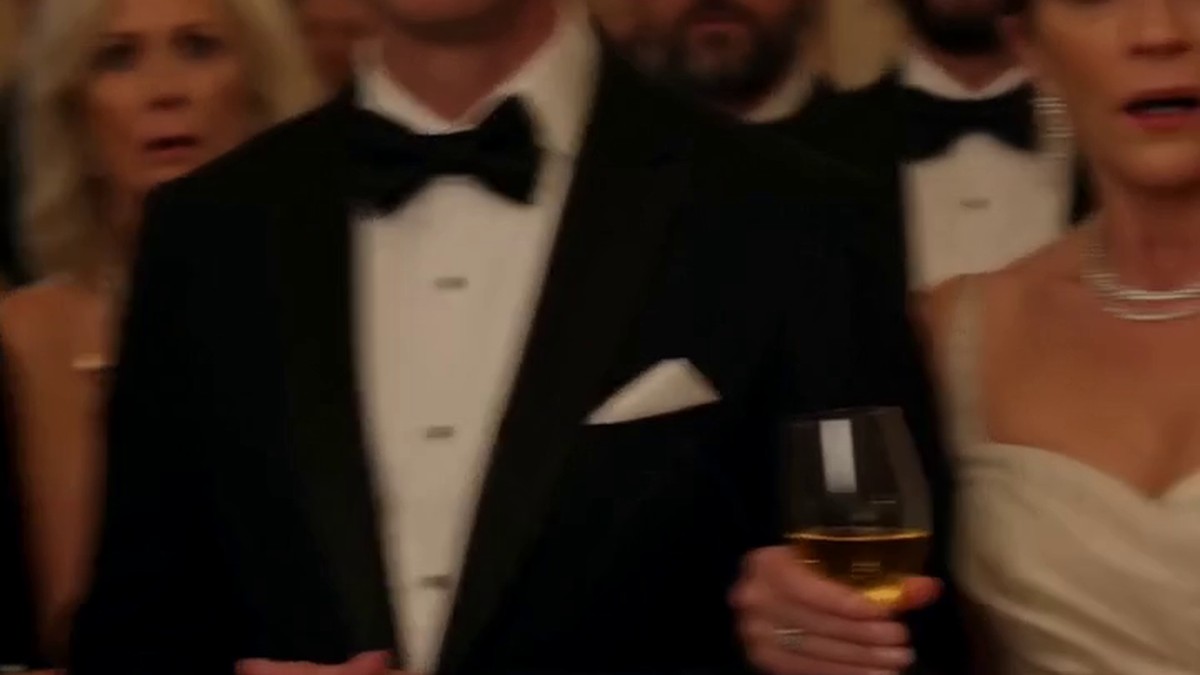
Two dozen guests stared. Some had gone pale with shock. Others wore the barely concealed smirk of people witnessing drama they'd recount for years. Not one of them moved to intervene. Not one of them said a word.
The maid lowered her head. Her shoulders curved inward. Every person in that room — every silk dress, every tailored suit, every champagne flute held aloft — leaned almost imperceptibly forward, waiting for the apology that was supposed to come. The quiet, obligatory *I'm so sorry, Miss Sterling*. The natural order, restored.
Instead, she looked up.
Her eyes were filled with tears she refused to let fall.
"Happy birthday," she said softly. Then, barely above a whisper: "Sister."
The room didn't just go quiet. It calcified. The very air seemed to stop moving.
Isabella's smile collapsed.
"What did you just say?"
The maid reached into her apron pocket with steady, deliberate fingers and withdrew a small silver locket. It was scratched with age, the kind of object that had been handled ten thousand times in ten thousand private moments. She opened it slowly. Inside, pressed behind clouded glass, was a photograph so faded it looked like it belonged to another century.
Two little girls. Matching white dresses with yellow ribbons. Standing side by side in front of a stone fountain.
Several guests leaned forward. Then the whispers started — because every one of them recognized that fountain. The three-tiered basin at the center of the Sterling Estate's east garden. It had appeared in society magazines. Charity galas. The family's Christmas card three years running.
The maid raised the locket higher so no one in the room could claim they hadn't seen it.
"I didn't come for money," she said. Her voice had stopped shaking. "I came to understand why my family threw me away."
A sharp collective inhale swept through the crowd.
And then, as if pulled by the same invisible thread, every head in the room turned.
Lady Evelyn Sterling stood at the far end of the room beneath the chandelier, draped in emerald silk, the undisputed center of every social universe she entered. She was seventy-one years old and had never, in living memory, looked anything less than composed.
She looked nothing like herself now.
The wine glass in her hand had begun to tremble. The color had drained from her face so completely she looked like a marble statue of a woman rather than a woman herself.
"No," she whispered. The word had no force behind it. Just air.
The maid's eyes never left her.
"Yes, Mother."
For three full seconds, nobody breathed.
Then the room erupted. Phones appeared from clutch bags and jacket pockets. Guests turned to each other with wide eyes, voices rising and tangling together. Isabella took one step backward, then another, as though the marble beneath her feet had suddenly become unreliable.
"This is a lie." Her voice had gone thin. "This is some kind of performance. Who put you up to this?"
The maid shook her head slowly. No theatrics. No cruelty. Just the quiet certainty of someone who had been carrying the truth for a very long time.
"You told everyone I died," she said. "I grew up wondering what I'd done wrong. I spent twenty-three years trying to understand what kind of child gets buried alive in a lie."
Lady Evelyn's free hand found the back of a chair. She gripped it.
Then the maid reached into her apron a second time.
What she produced made the first revelation look like a warm-up act.
A folded document. The paper had gone the color of old ivory, the creases deep and soft from years of careful unfolding and refolding. Even from across the room, it carried the unmistakable weight of something legal, something binding, something someone had gone to considerable lengths to keep hidden.
The moment Lady Evelyn's eyes landed on it, the wine glass slipped from her fingers. It shattered on the floor and nobody looked at it.
"Where did you get that?" Her voice had become something small and strange.
The maid didn't answer. She crossed to the long banquet table, moved aside a crystal vase of white peonies, and laid the document flat beside the spreading orange juice stain.
Isabella pushed through the frozen guests. She reached the table, looked down, and stopped.
The Sterling family seal — the wax impression that appeared on every legal deed, every trust document, every official declaration the family had produced for four generations — was stamped across the front page in faded burgundy.
The blood left Isabella's face.
"That's a birth certificate," said a man in the crowd. A lawyer. His voice was quiet but it carried. "And it has the estate's seal."
The maid smoothed the document flat with two fingers.
"My name," she said, "is Clara Evangeline Sterling. Born March the fourth, twenty-six years ago, at Whitmore Private Hospital." She looked at Isabella. "Three years before you."
Isabella's mouth opened. Closed.
"That would make you—" someone in the crowd began.
"The eldest daughter," Clara said. "The legal heir."
The room detonated.
Lady Evelyn finally moved. She straightened, released the chair, and drew herself up to her full height — the old reflex of a woman who had controlled rooms for half a century. Her voice came out cold and practiced, a locked door pretending to be a wall.
"This girl is unstable. Whatever she's fabricated, I assure you—"
"Mother." Clara's voice cut clean through. Not angry. Not pleading. Just absolute. "I have the hospital records. I have the letter you wrote to the attorney the week after my birth. I have the name of the couple you paid to take me and then abandoned when they couldn't afford to keep me." She paused. "I have everything. I've had it for two years. I didn't come here to destroy you. I came here because I needed to look at you and ask why."
The silence that followed was the loudest thing that had ever happened in that ballroom.
Lady Evelyn's composure fractured. Not all at once — but in small, visible pieces. Her jaw tightened. Her eyes grew bright. And then, in a voice so low that half the room had to strain to hear it, she said:
"You were sick. The doctors said you wouldn't survive the year. I couldn't—" She stopped. Started again. "Your father was gone. I was twenty-eight years old and I couldn't watch you die."
"But I didn't die," Clara said.
"No," Lady Evelyn whispered. "You didn't."
"You never checked."
Lady Evelyn said nothing.
It was Isabella who moved first. She picked up the document with shaking hands, read it, set it down, and read it again. When she finally looked up at Clara, something in her expression had shifted — the armor cracking, revealing something younger and more frightened underneath.
"You've been here," Isabella said slowly. "In this house. Working here."
"Eleven months," Clara said. "I needed to know who you all were before I decided whether it was worth knowing."
"And?"
Clara was quiet for a moment. She looked at the locket still resting in her palm, at the two small girls in their matching dresses standing beside the fountain — captured in a moment before the story took the turn it took.
"I watched you send food to the kitchen staff on cold nights," Clara said to Isabella. "I watched you sit with the elderly housekeeper when she got her diagnosis. I watched you be someone your mother's money never required you to be."
Isabella's eyes filled.
"And her?" She nodded toward Lady Evelyn without looking at her directly. "What did you decide about her?"
Clara finally crossed the room. She stopped in front of Lady Evelyn. The matriarch stood rigid, waiting for the verdict the way people wait for sentences.
Clara placed the locket gently in her mother's hand.
"I decided I didn't want revenge," she said. "I wanted a family. Whether there's anything left worth building — that's up to you."
Lady Evelyn looked down at the two girls in the photograph. Her hand closed around the locket.
For a moment her face did something no one in that room had ever seen it do.
She wept.
Not elegantly. Not quietly. The way people cry when they've held something back for over two decades and the wall finally gives way. Her shoulders shook. A sound escaped her that was nothing like the woman the world knew.
Isabella moved first. She put her arms around her mother.
Then, after a long pause — the longest pause — she reached out and took Clara's hand.
The guests had gone utterly silent. Phones lowered. No one spoke.
Outside the ballroom windows, the city hummed on, indifferent to everything.
Inside, in the wreckage of a birthday party and a quarter century of lies, three women stood together for the first time.
It wasn't forgiveness. Not yet. Forgiveness would take time, and lawyers, and long difficult conversations in rooms that weren't full of witnesses.
But it was a beginning.
And Clara Evangeline Sterling — who had spent her whole life being nobody's daughter — let herself believe that might be enough to start.