The kennel card said his name was Bruno, but I called him Hank from the first hour. He didn't answer to either one.
I'd been volunteering at the county animal shelter outside Dayton for eleven months when they brought him in. The intake sheet said owner surrender, and the reason box was just one word: *moving*. That word covers a lot of ground. Sometimes it's a job transfer to Florida. Sometimes it's a landlord. Sometimes it's a marriage that ended and the dog belongs to the person who left.
Hank was a black mutt, maybe forty pounds, with one ear that stood up and one that flopped. He had a white patch on his chest shaped like the state of Ohio. The first week, he wouldn't eat from my hand. Wouldn't take a treat. He sat in the corner of his run with his back against the cinder block and watched the door like he expected someone to walk through it and take him home.
They always watch the door at first. The smart ones stop after a while. Hank didn't.
My shift was Tuesdays and Thursdays, four to eight. I'd take the dogs out one by one, clean the runs, fill the water bowls. The shelter smell gets in your clothes, that mix of bleach and wet fur and something sharper underneath. You stop noticing it after a month. Your family doesn't.
Tuesdays I'd spend an extra ten minutes with Hank. I'd sit on the floor of his run with my back against the same cinder block and read him emails off my phone. Work stuff, mostly. I manage a warehouse distribution center, and the emails are about pallet counts and shift schedules. I read them out loud because a human voice, any voice, does something for a dog that's given up.
He never moved closer. He just watched the door.
In March, a family came in looking for a dog. Two kids, a mom, a dad who kept checking his watch. They walked the row of kennels twice. The little girl stopped at Hank's door and pressed her palm flat against the wire. Hank didn't get up. He didn't bark. He just sat there with his back to the block, watching them from under those half-closed eyes.
"He's shy," the mom said.
"He's shut down," I said. I didn't mean to say it out loud.
They adopted a yellow lab puppy named Biscuit who peed on the dad's shoe in the lobby. The dad laughed. Everyone laughed. Hank watched the door.
—
The thing about volunteering at a shelter is that you learn the difference between a dog who needs time and a dog who's run out of it. Hank had time until he didn't. The shelter was over capacity in April. The kennel cards got shuffled. New dogs came in chipped and collared and full of bark. The ones who'd been there longest got moved to the back row, where the light doesn't reach.
I came in on a Thursday and saw the orange sticker on Hank's card. It doesn't say what you think it says. It's just a color. But everyone who volunteers knows what the colors mean.
I asked Carol, the kennel manager, how long. She said ten days. Maybe two weeks if intake slowed down.
"He's a good dog," I said.
"They're all good dogs."
That night I sat with Hank for an hour. I read him the inventory report from Tuesday, all four pages. Numbers and part numbers and reorder quantities. His breathing evened out. For a second, I thought he was asleep. Then a car backfired in the parking lot and his eyes snapped open and went straight to the door.
"You can't wait for them forever," I said.
He lowered his head onto his front paws.
—
I called my wife from the shelter parking lot. Not to ask permission. We've been married sixteen years, and you don't need permission after sixteen years. You need to talk it through, because there's a mortgage and two kids in high school and a cat that already thinks it owns the house.
I told her about Hank. About the owner surrender. About the white patch shaped like Ohio.
"I don't know if he's housebroken," I said. "I don't know if he likes cats. I don't know if he's ever lived with kids."
She was quiet for a while. On the phone, in the dark, with the parking lot light buzzing overhead, I could hear her thinking.
"Bring him home on a trial basis," she said finally.
The next Tuesday, I filled out the foster paperwork. Carol raised her eyebrows but didn't say anything. The foster coordinator gave me a crate, a bag of food, and a list of rules. Rule number one was don't get attached. I'd already broken that one six weeks earlier, sitting on the floor of a kennel, reading a supply chain report to a dog who wouldn't look at me.
—
The first night in our house, Hank walked through every room twice. He sniffed the baseboards. Checked the closets. Stood at the front door for a long time, staring at it the same way he stared at the kennel door.
Then he lay down on the kitchen rug, put his head on his paws, and closed his eyes.
Our cat, a gray tabby named Soup, sat on the stairs and watched him the way a cat watches anything that might be a threat or might be furniture. Hank opened one eye, looked at Soup, and went back to sleep.
The kids came home from school and sat on the floor near him. Not touching. Just sitting. My daughter talked to him in a low voice about her biology project. My son showed him his phone, scrolling through videos. Hank raised his head once, sniffed the air, and put it back down.
By the end of the first week, he was eating. By the end of the second, he wagged his tail when I came home from work. Not a big wag. A small one, low and uncertain, like he was trying it out.
Carol called to check in. "How's he doing?"
"He's getting there."
"He's got two days left on the clock," she said. "What do you want to do?"
—
The adoption fee at the county shelter is $85. That covers shots and microchip and neutering. It's not a lot of money. It's not nothing, either.
I stood at the front counter with my wallet in my hand. The paper was in front of me. The pen was in front of me. Hank was at my feet, pressed against my leg, which was something he'd never done before.
The receptionist, a young woman with a piercing in her eyebrow, typed at her computer for a while. "He's been here a hundred and forty-three days," she said. "You know that?"
I nodded.
"That's a long time to watch a door."
"Where's the line I sign?"
She turned the paper toward me. I wrote my name. I slid the card across the counter. She ran it.
The receipt printed out. Eighty-five dollars. I have saved receipts from my whole life — car repairs, medical bills, groceries — and I don't think any of them ever meant as much as that one.
I folded it and put it in my pocket.
—
The shelter lobby is noisy on adoption days. Volunteers walk dogs through on leashes, and the dogs are excited and the people are excited and someone's always filling out paperwork at the folding table by the window.
When I walked toward the door, Hank walked with me. Not pulling. Not hanging back. Just beside me, his head at my knee, his ears up.
The automatic doors slid open. The air outside was cold, that late-September Ohio cold that comes before the leaves turn. Hank stopped in the doorway. He looked back into the lobby for a long moment. All those kennels, all those dogs, all that noise behind him.
Then he turned around and stepped outside.
The volunteer at the front desk, a man my age in a Buckeyes hoodie, raised a hand. "Good luck to you," he said. "Good luck to the both of you."
I don't believe luck has much to do with it. A hundred and forty-three days behind a cinder block wall, and the thing that got him out wasn't luck. It was a Tuesday and a Thursday, four to eight, over and over, sitting on a concrete floor reading about pallet counts until a dog decided it was safe to walk through a door.
But I raised my hand back anyway. It costs nothing to be decent.
Hank ran to the truck. Not far. Just to the end of the leash. He sniffed the tire, raised his leg, and looked at me over his shoulder with an expression I can only describe as *okay, where to now.*
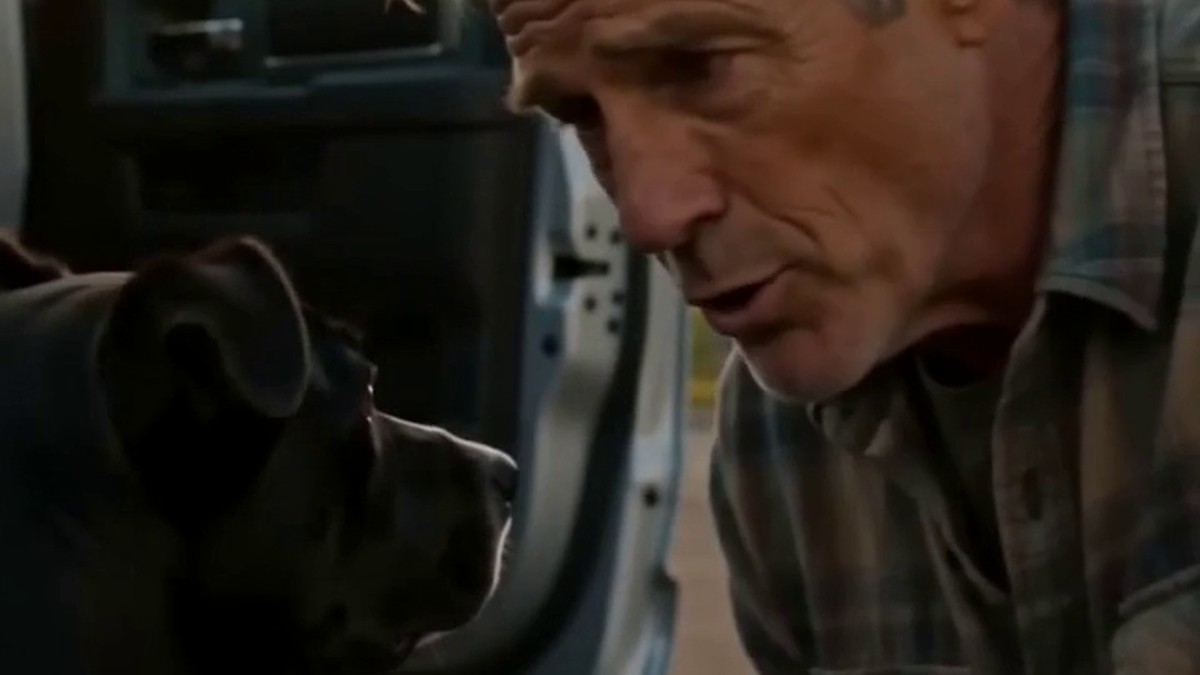
I opened the passenger door. He jumped in like he'd done it a thousand times. Sat in the seat with his front paws on the console and his nose pointed out the windshield.
I started the engine. The radio came on, some country station, a song about a man driving home to a wife and kids and a dog in the front seat, because that's what every country song is about.
Hank put his head on my shoulder.
The sun was going down over the cornfields west of town, all that flat land turning gold, and I drove home to my wife and my kids and that stupid cat, and the receipt was in my pocket the whole way.