The man didn’t look back at the old dog. Not once.
He stood at the reception desk of the Greenbriar Animal Clinic, one hand already fishing for his car keys, the other unhooking the leash with quick, practiced movements—like someone removing an old watch before a shower. The leash was faded blue nylon, frayed near the clip, with a brass clasp scratched dull.
“I don’t have time to mess with an old dog,” he said, his voice flat. He glanced at the clock above the door, not at the dog. “His back legs are shot. Just… put him down. Or find a shelter, I don’t know.”
Dr. Laura Michaels tilted her head, the reading glasses on a chain around her neck swinging gently. She looked from the man to the dog lying on the tile floor at his feet. A large, rust-colored mutt, the gray on his muzzle spreading upward like frost. One ear was torn, a healed split that gave him a lopsided, knowing expression. He didn’t whine. He just settled his chin on his paws and closed his eyes, as if this moment had been coming for a while.
“Are you certain?” Laura asked.
The man—David, according to the chart—shrugged. He was in his mid-fifties, clean polo shirt, good jacket. He smelled faintly of cedar and new car. “It’s a lot, you know? I got remarried. Claire’s got allergies, and the new condo… it’s all white carpet. He sheds like crazy. I just don’t have the time anymore.”
The word “time” came out faster than the rest, a tiny hitch in his breath, and then his face was blank again. He tossed the leash onto the counter. The tag clinked against the laminate—a small silver bone with two phone numbers etched on it, one fresh, one worn almost smooth.
He didn’t kneel down. Didn’t pat the dog’s head. He turned, pushed through the glass door, and vanished into the drizzle. The November air that slipped inside smelled of wet leaves and exhaust, and then the door sealed shut, and it was just the three of them: the vet, the tech standing frozen by the scale, and the dog.
Laura let out a slow breath and crouched, her knees protesting. “Alright, buddy. Let’s see what we’ve got.”
She ran her palm over the dog’s side. The fur was coarse and warm, the warmth of a house and a rug and years of sleeping beside a couch. The dog lifted his head and blinked at her. His eyes were cloudy but not vacant. He was old, yes—arthritis had swollen the joints in his hind legs, and he shifted his weight with a small grunt—but his heart was steady, his teeth surprisingly good. He could eat, he could walk with care, and he could definitely still shove his nose into a hand for a scratch.
On the tag, the first number was labeled “Dave.” Laura tried it. Straight to voicemail after four rings. She didn’t bother leaving a message.
The second number was smaller, the letters so thin she had to angle the tag toward the fluorescent light. “Julia.”
She pressed call.
The phone rang twice. Three times. Then a young woman’s voice, breathless, as if she’d just run inside. “Hello?”
“Hi, this is Dr. Michaels at Greenbriar Animal Clinic. Am I speaking with Julia?”
A pause. Guarded. “Yeah. Is something wrong?”
“We have your dog here. A large brown mix, torn left ear. His name is… well, the chart just says ‘Dog’ for now. A man named David brought him in and said he couldn’t keep him anymore.”
Silence. Then a sound like a hand pressed over the receiver, muffling something. When Julia spoke again, her voice was tighter, thinner. “Is he… is he alive?”
“He’s alive. He’s got arthritis and some stiffness, but nothing that can’t be managed. He needs a course of injections and someone to be around. He’s not a lost cause.”
“I’ll be there. Send me the address. Right now.”
The line went dead.
Laura stood there for a moment, still listening to the empty static, then slipped the phone into her pocket. She looked down at the dog. He hadn’t moved much, but his tail gave one slow, heavy thump against the tile. Like he knew.
She brought him a bowl of water. He drank, drops hanging from his graying whiskers, then settled onto an old blanket she pulled from the supply closet. It smelled like mothballs and antiseptic, but he burrowed his nose into a fold and closed his eyes again. Outside, the afternoon had turned dark, the parking lot lights flaring yellow on the wet asphalt.
Two hours later, the door swung open again, and this time the air that rushed in was cold and sharp with rain. Julia stood in the doorway, her coat soaked, her dark hair plastered to her forehead, sneakers squelching on the linoleum. She was maybe twenty-four, twenty-five, with the tired eyes of someone who works long shifts and still answers unknown calls.
She didn’t step inside at first. She just stared at the corner where the dog lay on the blanket, his head still down.
Then she moved. Slowly, like she was afraid he might be a ghost. She knelt right there on the wet floor, her jeans darkening, and she said his name.
“Rusty.”
The dog’s eyes opened. For a long second, he just looked at her, his tail still. Then his nostrils flared, his ears twitched, and his tail started to beat against the blanket—slow, then faster, a frantic rhythm. He tried to scramble up, but his back legs slipped, claws scraping the floor. He whined, a high, thin sound that didn’t belong to an old dog, and shoved his muzzle into her hands.
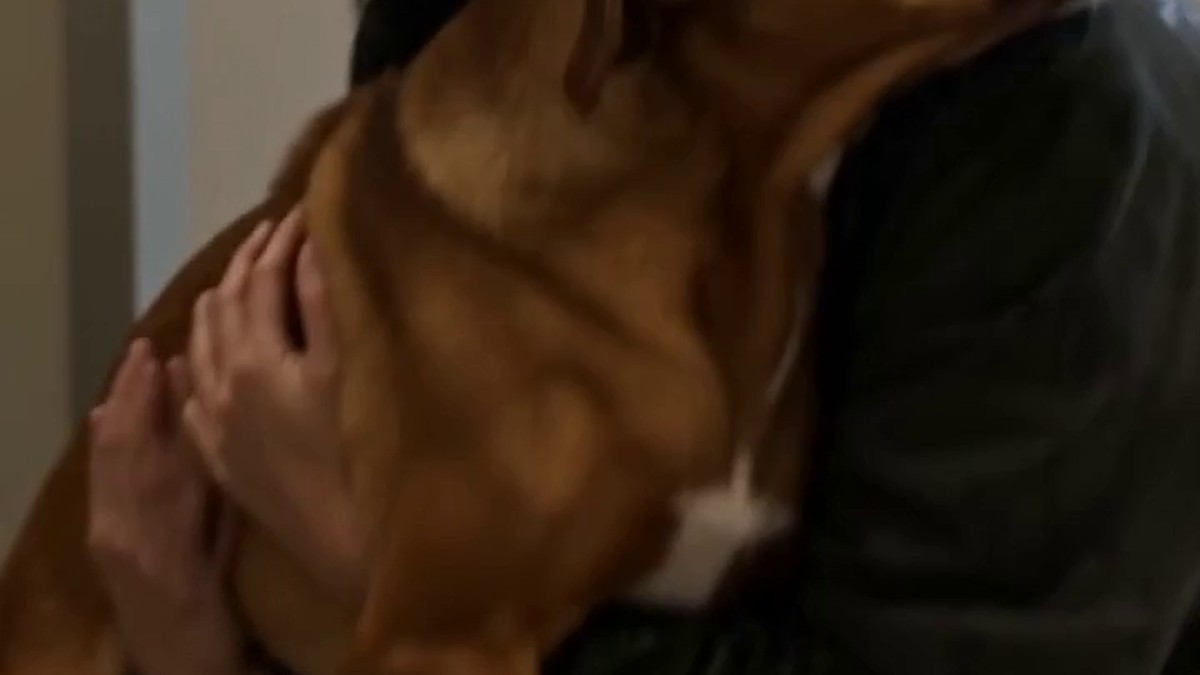
Julia wrapped her arms around his chest and pulled him close. He licked her face, her chin, the salt streaks she wasn’t bothering to wipe away. He made a sound deep in his throat, half whine, half sigh, and pressed his head into the curve of her neck.
Laura busied herself with a chart at the counter, cleaning her glasses even though they were spotless.
“He’s thirteen,” Julia said, not looking up. “Dad—David—found him on a construction site when I was ten. Some strays had torn his ear. Dad carried him home in his jacket, like a baby. Made me a bed for him out of an old sleeping bag.” She ran her fingers over the split ear, gently. “And now suddenly he has no time.”
There was no anger in her voice, just a quiet, bruised acceptance. Her hands were shaking, but she kept them in Rusty’s fur, and gradually the shaking stopped.
“The arthritis is manageable,” Laura said, her voice steady. “Injections every few weeks, a special diet, and warmth. He shouldn’t be alone for long stretches. But he’s not dying. He’s just old.”
Julia nodded. She stood, wiping her nose on her wet sleeve. “I’ll take him.” She said it like there was no other option on earth. “I’ve got a studio apartment. Six hundred square feet. A cat. I work eight to six. And zero reasons to leave him here.”
Laura unhooked the old leash from the edge of the desk and held it out. The faded nylon, the scratched clasp. Julia took it, her fingers closing around it like she was holding someone’s hand.
“C’mon, Rusty. Let’s go home.”
The dog stood, wobbling. His back legs trembled, and he listed to the right a little, but his tail kept wagging. He walked to the door, stopped, and looked back once at the blanket, the bowl, the flickering fluorescent light. Then he turned and followed her.
At the entrance, Julia paused. The rain had lightened to a mist, and the parking lot gleamed. Her car was an old Corolla parked at the far end of the lot—maybe a hundred yards away. For a dog with bad hips, it might as well have been a mile.
She didn’t hesitate. She crouched, scooped him up under his chest and hindquarters, and straightened with a grunt. He was heavy—seventy pounds of solid, rain-damp muscle and bone—but she locked her arms and started walking. His head rested against her shoulder, his hot breath on her neck, and the drizzle beaded silver on his rusty coat.
Laura watched from the window. The overhead light buzzed, blinked, and held steady.
On the counter, someone had started a new chart for the dog. It read: “Rusty, mix, approx. 13 yrs. Owner: David.” And then, in smaller, neater handwriting below it: “Julia.”
—
A week later, Laura got a text from an unknown number. It was a photo.
Rusty lay sprawled on a plaid blanket in a patch of late-afternoon sun. Beside him, a chunky gray cat was meticulously grooming the torn ear. Rusty’s eyes were shut, his mouth open just a little, one paw hanging off the blanket. He looked like a dog who’d never wait by another door in his life.
Under the photo was a single line: *He didn’t have time. We found it.*
Laura smiled and set her phone down. Through the clinic window, the rain had finally stopped, and the wet pavement was beginning to dry. She picked up the old leash still coiled on the counter—the one David had left behind—and dropped it into the donation bin. Then she turned back to the next patient, and the little bell over the door jingled.