Ruben didn’t make a scene. He simply unhooked the leash from the collar and let the loop fall onto the reception desk at Allandale Veterinary with a soft, metallic clink. His thumb was already smearing across his phone screen, half-turned toward the exit.
“I don’t have time for this,” he said. Not to the dog, but to the air just above Dr. Elaine Cole’s head. “He’s thirteen. His hips are shot. The wife is redoing the floors. You see the size of him? He sheds like a machine. Do what you gotta do. Put him down, ship him off, I don’t care.”
The dog—a barrel-chested shepherd mix the color of burnt honey with a torn left ear—lay flat on the cool linoleum. His name was Samson. He hadn’t been able to climb into the cab of Ruben’s truck by himself in two years, but this morning he’d heaved his front paws onto the running board because he thought they were going to the river. He always thought they were going to the river.
Ruben pushed through the glass door. A wave of July heat rolled into the lobby. An F-150 the color of wet cement idled at the curb. The passenger seat was empty. The door clicked shut, the truck pulled away, and Samson exhaled through his nose, a sound that wasn’t quite a sigh but was definitely an understanding.
Dr. Cole crouched down, her knees popping. She ran her palm down the dog’s flank, feeling the old rib cage, the swollen knobs of his hip joints. The dog’s tail gave a single, carpet-sweeping thud. His eyes, one clouded, one still sharp as honey, never left the glass door.
“Okay, big guy,” she murmured. “Let’s see who you belong to.”
His collar was old, high-quality leather worn smooth as saddle soap. On a steel ring hung a brass nameplate, scratched but legible: SAMSON. On the underside, two phone numbers had been etched by hand. The first, under the letters RUBEN, were deep, confident grooves. The second, below a single word—MARISOL—was lighter. Thinner. Almost hesitant, as if the person engraving it wasn’t sure she had the right.
She dialed Ruben first. Straight to voicemail. The inbox was full.
Elaine dialed the second number. It rang twice.
“Yeah?”
A woman’s voice. Low, crackling with the strain of talking over whatever noise was behind her—a commercial kitchen, by the sound of it, the clatter of pans and a hiss of steam.
“This is Dr. Elaine Cole at Allandale Veterinary. I’m calling about a dog. A shepherd mix. Samson. We have your number from his collar.”
The noise on the other end stopped. A door slammed, cutting off the kitchen sounds.
“Samson? What happened? Who brought him in? Where’s my father?”
The shift from confusion to a tight, steely alertness happened in the space of a breath. Elaine explained. A man, early sixties, gray stubble, green and white trucker cap. Left the dog. Refused to take calls.
“He left him there?” The words came out strangled, a hot, disbelieving whisper. “He drove him twenty miles across town to a vet he’s never used just to dump him? My father’s own dog?”
“He mentioned a wife. Allergies. New floors.”
A short, ugly laugh, completely devoid of humor. “Right. ‘Allergies.’ The wife is thirty-two and wants a white linen couch and a puppy that fits in her purse. She’s been saying Samson ‘stinks up the house’ since she moved in. But the real reason he got rid of him is simpler. Samson got old and inconvenient. It’s a family pattern.”
Elaine heard a car door slam in the background. “I’m in Mesa Roja,” Marisol said, her voice becoming distant as if she’d put the phone down on the seat. “I can be there in four hours. I have to get my shift covered. Don’t let them touch him. Don’t put him in a cage with strangers.”
“Miss, he’s heavy. He can’t walk well.”
“I carried him when I was ten. I’ll carry him now.”
The line went dead.
Elaine put down the phone and looked at the dog. He hadn’t moved. A drop of water from the air conditioner’s drip pan hit the metal window sill, a tiny, rhythmic punctuation mark in the silence. She got a steel bowl from the back, filled it, and set it by his muzzle. He lapped at it once, then twice, then rested his chin on the wet rim of the bowl, too tired to lift his head fully. She covered him with a surgical blanket, the blue fabric rising and falling with his breathing.
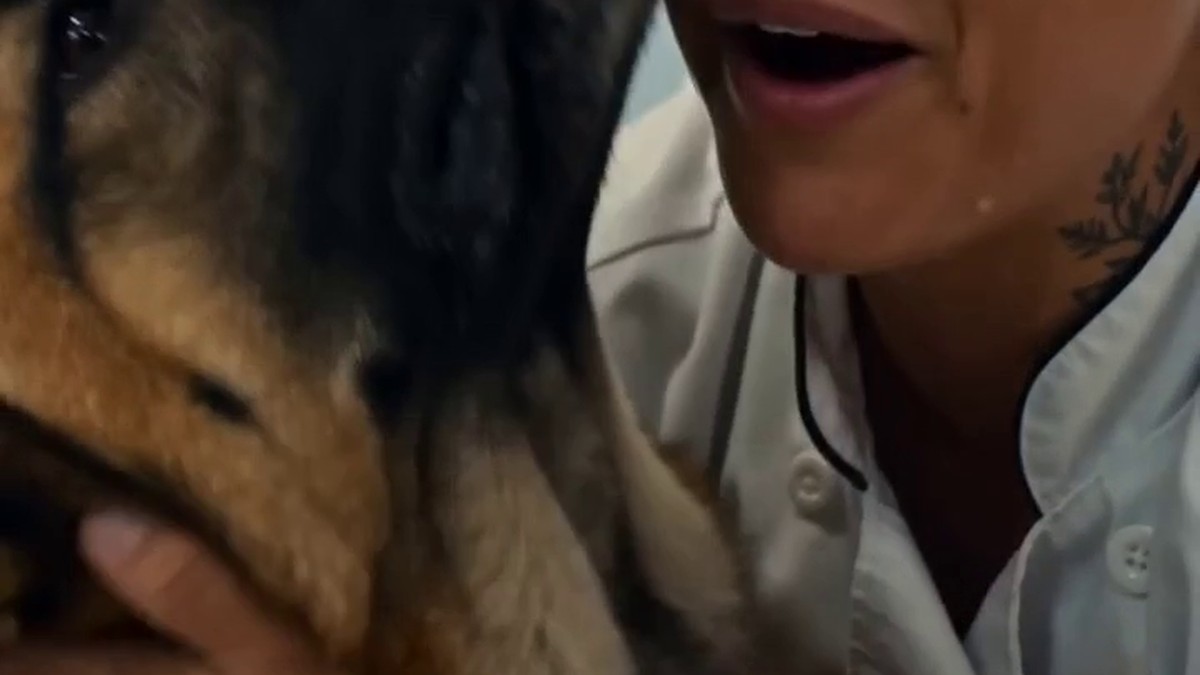
Four hours later, the glass door swung open and let in a blast of furnace-like air from the parking lot. A woman stood there, wires of dark hair plastered to her temples with sweat, a tattoo of a desert willow branch curling up from the collar of her grease-stained shirt. Marisol.
She didn’t look at Dr. Cole. She saw only the dark silhouette on the floor.
“Sam,” she said, and the word broke.
He heard her. His ragged left ear, the one torn in a fight with a coyote before Ruben had found him as a pup, rotated toward the sound. His head came up. The cloudy eye glistened under the fluorescent light. A whine started deep in his chest, a sound from a dream he’d given up on having.
He tried to stand. His back legs skittered on the linoleum, nails clicking, useless. He collapsed onto his side, panting, but his front paws were already paddling, trying to drag the dead weight of his hindquarters toward her. He was trying to run to her the only way he had left.
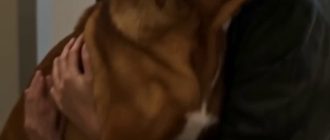
Marisol crossed the room in three strides and dropped to her knees on the cold floor. She slid her arms under his massive rib cage and pulled his head into her lap. He licked her face, her neck, her hands, a frantic, desperate grooming as if he could clean away the years they’d been apart. She didn’t wipe the slobber from her cheek.
“You remember me, huh? You remember?”
She ran her thumb over the torn cartilage of his ear. Her jaw was a hard line, but her eyes were liquid.
“He didn’t even bring back your leash,” she said to the dog, her voice flat. “The one I bought him for his sixtieth birthday. He left that, too.” She looked at the empty reception desk. “It’s the one thing about my father you could always count on. If it requires loyalty, he leaves it behind.”
Dr. Cole cleared her throat gently. “In terms of a discharge plan, his dysplasia is advanced. He’ll need pain management, Adequan injections, ramps if you have steps. He can’t be alone for long periods. And he’s heavy. Bathroom breaks will be a project.”
Marisol looked up. Her smile was a wound, but a determined one. “I’m a line cook. I smell like fryer oil and I handle forty-pound sacks of flour all day. Heavy, I can do. Lonely, I’m not going to let that happen.” She rubbed the soft velvet of his muzzle. “He waited at the front window for my dad to come home from work for a decade. Every single day, rain or shine. For a man who was never coming home to him. And now, in the end, the man actually showed up just to get rid of him.”
She stood up, bracing her back. “You got a service entrance? I’m not dragging him past a waiting room of people who’ll feel sorry for him. He’s had enough pity today.”
Out back, a dusty, primer-gray Honda Civic with a busted taillight sat baking in the sun. The back seat was down, covered in a moving blanket. Marisol left the engine running, the AC blasting, and came back for him.
She bent, threaded one arm under his tail and the other under his chest, and lifted with the deep, instinctive mechanics of someone who’d hauled bus tubs and stock pots her whole adult life. One hundred and ten pounds of aging, failing dog. His body went stiff for a second in panic, then he buried his nose in the crook of her neck and let his tongue loll out, panting and trusting her completely.
She walked him to the car, her back screaming, her arms shaking, and laid him on the soft blanket. He immediately curled into a tight, protective ball, the posture of an animal finally safe enough to be vulnerable.
Dr. Cole stood in the open bay door, watching. No one had paid the discharge fee. She’d have to write it off. She went back inside and opened the paper file, the one with Ruben’s name and insurance information on the front. She drew a bold, black line through his name. At the top of the chart, in fresh ink, she wrote: MARISOL ORTIZ.
Three weeks later, a text message appeared on the clinic’s general phone line from an unknown number. It was a picture. Samson was splayed out on his back on a worn-out, flour-dusted apron. A fat, orange tabby cat was curled up on the apron next to him, kneading the thick fur of his chest. His tongue was out, catching a stray drop of water from a sprinkler just out of frame. His eyes were closed, but his tail—that same tail that hadn’t wagged for his owner of thirteen years—was a dark, happy blur in the photo.
Under the picture, Marisol had written: Dad called. Wanted his old drill back. Told him I lost it in the move. Didn’t ask about Samson. Didn’t mention him once.
A second later, another message came through. It was a picture of a new collar, bright red with a pineapple print, lying on a table next to a fresh roll of vet wrap and a bag of joint treats. The final text simply said:
He’s got time now. All the time in the world. And so does someone else.