The fountain at Jamison Square danced in the late July heat. David Mitchell had been lounging on a bench, half-watching his seven-year-old daughter Sophie shriek as the water jets erupted around her. His phone buzzed with work emails, but the day was too lazy for urgency. Then Sophie’s voice cut through the splashing like a blade.
“Daddy! He looks just like me!”
David glanced up. Sophie was pointing toward a scrawny boy perched on the edge of the fountain, his sneakers soaked, a canvas shoulder bag crushed against his chest. The boy’s hair stuck out in dark tufts, his skin pale as milk, and his eyes — those deep, odd, lake-water blue — were a mirror of Sophie’s. A mirror of David’s own. The smile slipped off his face.
He walked over, heart thumping an off-beat rhythm. The boy didn’t flinch. Up close, the resemblance was unnerving, like a puzzle piece that had no business being here. “Hey, buddy,” David said, crouching. “What’s your name?”
The boy’s voice was small but clear. “Caleb.”
Sophie wedged herself between them, beaming. “I’m Sophie. That’s my dad.”
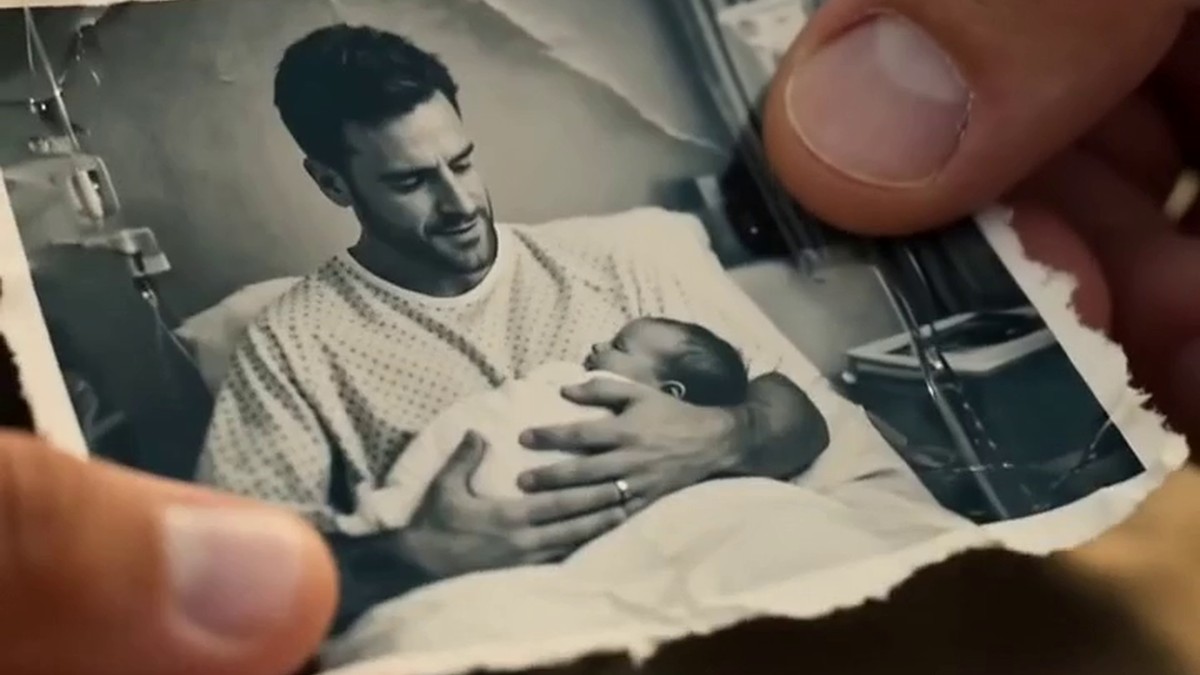
Caleb stared at David for a long, quiet moment. Then he rummaged in his bag and produced a photograph, its edges soft from handling. He pushed it toward David without a word. The black-and-white image showed a younger David in a hospital room, cradling a newborn swaddled in hospital linen. David’s thumbprint was smudged on the corner, a detail he’d long forgotten. The photo had vanished from his nightstand seven years ago, just days after his wife Lauren’s difficult delivery.
His hand shook. “Where did you get this?”
Caleb looked down at his water-stained sneakers. “My mama gave it to me.”
“What’s your mama’s name?”
“Rosa.” The boy swallowed. “She said if I ever met a man with blue eyes —” he glanced up, gaze steady, “— I should ask if he’s my dad.”
Sophie tugged at David’s wrist. “Daddy? What’s wrong?”
The world flattened. The fountain still chattered. Kids still laughed. A MAX train rumbled in the distance. But everything felt pulled behind a thick pane of glass. David’s mind spun back to the night of the birth: Lauren pale and exhausted, the doctors bustling, a baby girl placed in his arms — Sophie. And then a second cradle, a boy, wrapped in a blanket. He’d held both, just for a moment, before a nurse took the boy away with a frown and the attending physician’s voice cut in. Complications. We’re sorry. The second baby didn’t make it.
He’d believed them. He’d mourned a son he never buried.
Now the boy was sitting in front of him, breathing, real, wearing the same impossible chin.
“You’re my…” David’s throat closed around the word.
He took Caleb gently by the shoulder and led both children to a diner two blocks away. Over grilled cheese and chocolate milk, the story spilled out in fragments. Caleb’s mama, Rosa, had been a neonatal nurse at the very hospital where David’s twins were born. She’d raised Caleb in a tiny apartment off Sandy Boulevard, never married, fiercely protective. Three months ago, cancer took her fast. Before she died, she handed him the photo and a scrap of paper with a park name and a day: Jamison Square, Saturdays.
“She said you always bring your daughter here,” Caleb said, pushing a crust around his plate. “I’ve been coming every Saturday for five weeks. Waiting to see a man with blue eyes and a little girl who looks like me.”
David’s coffee sat cold and untouched. His wife Lauren had told him their son was stillborn. She’d held him as he cried, her own eyes dry and distant. He’d chalked it up to shock. Now the pieces rearranged themselves into something monstrous.
He pulled out his phone and called his wife.
“You need to come to the park right now. The diner next to it. Yeah, I know it’s your book club. This can’t wait.”
Twenty minutes later, Lauren walked in, her sundress bright against the sudden dim of the diner. She saw Caleb, and the color drained from her face. She gripped the back of a booth seat to steady herself.
“David, what is this?”
He stood, the photograph in his hand. “This is our son. The one you told me died.”
Lauren’s mouth opened, but nothing came. Her gaze darted from the photo to the boy’s face — her husband’s face in miniature — and back. A low, keening breath escaped her.
“I — I was so tired. After the twins came, I couldn’t… I couldn’t cope. Rosa said she could give him a good home. She said no one had to know. The doctor signed the certificate. I thought I was saving us all.”
David’s voice was hammer on steel. “You gave away our child. You let me grieve him.”
“I was drowning!” Lauren’s whisper cracked. “Every day I looked at Sophie and thought I’d fail them both. Rosa was so kind. She promised he’d be loved. I never saw him again. She moved, she changed her number. I told myself it was better.” Tears streaked her mascara. “I’ve lived with that ghost every single day.”
Caleb sat frozen, Sophie’s small hand suddenly gripping his under the table. She didn’t understand the grown-up words, but she understood her mother was crying and this strange boy who looked like her was shaking.
David wanted to rage. He wanted to shatter the diner window with his fist. But the man he was now, the father of two, swallowed the fire and spoke quietly. “We’ll deal with this later. Right now, this boy needs us.”
He knelt beside Caleb’s chair. “Caleb, I know this is scary. But I’m your father. I held you the day you were born, and I never stopped loving the idea of you. I’m so sorry I didn’t come find you. I’m here now. You’re not alone anymore.”
Caleb’s lower lip trembled. He didn’t cry — he’d learned not to — but his eyes welled up, and he nodded.
Sophie, with the uncomplicated clarity of seven, scooted off her seat and wrapped her arms around him. “You’re my brother,” she announced. “You can have my grilled cheese.”
A laugh, wet and raw, broke through David’s chest. He looked at Lauren, still crumpled in the aisle, and found no absolution there, only the long, tangled road ahead. But he also found a crack of something he hadn’t expected: relief. His son was alive.
The four of them left the diner together that afternoon. The fountain had been turned off for the day, the plaza quiet. David held the photograph and Caleb’s hand. Sophie danced ahead, leading the way home, talking nonstop about bunk beds and which toys she’d share. Lauren walked a few paces behind, her phone out — calling an attorney to sort the legal chaos, calling the temporary guardian Rosa’s sister had arranged, beginning the slow unspooling of a seven-year lie.
That night, in a two-story house in Southeast Portland, Caleb slept in a makeshift bed of couch cushions and Sophie’s spare comforter, the photo tucked under his pillow. David watched him breathe from the doorway before he finally let himself cry — for the years stolen, for the boy who had ridden buses alone to find a father, for the wife who had shattered his trust but, in her broken way, had also shattered herself.
In the morning, Sophie taught Caleb how to make waffles. Lauren made coffee and kept her distance, her eyes ringed with sleepless guilt. David took the photograph from under the pillow and framed it, placing it on the mantel next to Sophie’s baby picture. Two children. Twins.
He didn’t know if his marriage would survive. He didn’t know what the courts would say. But when Caleb wandered into the living room, hair still wild, and asked, “Can we go to the fountain again today?” David answered without hesitation.
“Yeah, buddy. We can.”
And for the first time in seven years, walking with his son on one side and his daughter on the other, David Mitchell felt something he hadn’t dared hope for: his family, whole.