Gabe’s phone began buzzing at exactly seven in the morning. He fumbled for it in the dark, already annoyed. The foreman's voice came through, skipping any kind of greeting.
"It's a dog."
Gabe sat up in bed, rubbing his eyes. He squinted at the clock, then at the window where thin gray light was barely beginning to push through the blinds. A dog. He’d hired a four-man demolition crew to tear down a rotting shed on a property he’d just bought, and now they were calling about a dog.
"What do you mean, a dog?"
"A dog, Gabe. Reddish one. Medium-sized. She’s planted herself right in front of the shed door and she won't let any of us near it. Growls every time we take a step closer."
"There are four of you. With crowbars."
"We tried yelling. We waved a two-by-four at her. Stomped our feet. She backs off maybe ten feet, circles around, and then lies right back down on the stoop. We can't get in."
Gabe swung his legs over the side of the bed and pressed the heel of his hand against his forehead. It was early May, and the air coming through the open window carried that heavy, mineral scent of wet earth. Nighttime chill still clung to the soil. He’d picked up the property for a song a few weeks back—an old two-bedroom that needed cosmetic work, and a detached shed that needed to disappear. The structure was a wreck: peeling green paint, a roof that sagged like a hammock, boards so swollen with rot you could smell the decay from the gate. The crew was already on the clock. The dumpster was sitting in the driveway. The job had been paid for up front.
He threw on jeans and a flannel, poured coffee into a travel mug, and was in his truck within ten minutes. He took one scalding sip on the way, burned his tongue, and cursed under his breath. Stray dogs were everywhere in this part of town. They haunted the dumpsters behind the strip mall, curled up near the heating vents behind the laundromat, trotted along the shoulder of the county road with their ribs showing. But one stray dog holding four grown men at bay? That was ridiculous.
He called the foreman again as he turned onto the gravel road.
"Don't go anywhere. I'm two minutes out. I'll handle it."
"We're not going anywhere," Billy said. His tone was almost serene. "We're having coffee. Dog's still here. Situation is unchanged."
Gabe tightened his grip on the steering wheel.
The yard was quiet when he pulled up. The sledgehammer lay flat in the wet grass. A crowbar leaned against the fence. Billy was sitting on an overturned bucket near the truck, cupping his hand around a cigarette to shield it from the breeze. Two other crew members were eating gas-station sandwiches in the cab of the truck, watching the scene like it was matinee theater.
"There she is."
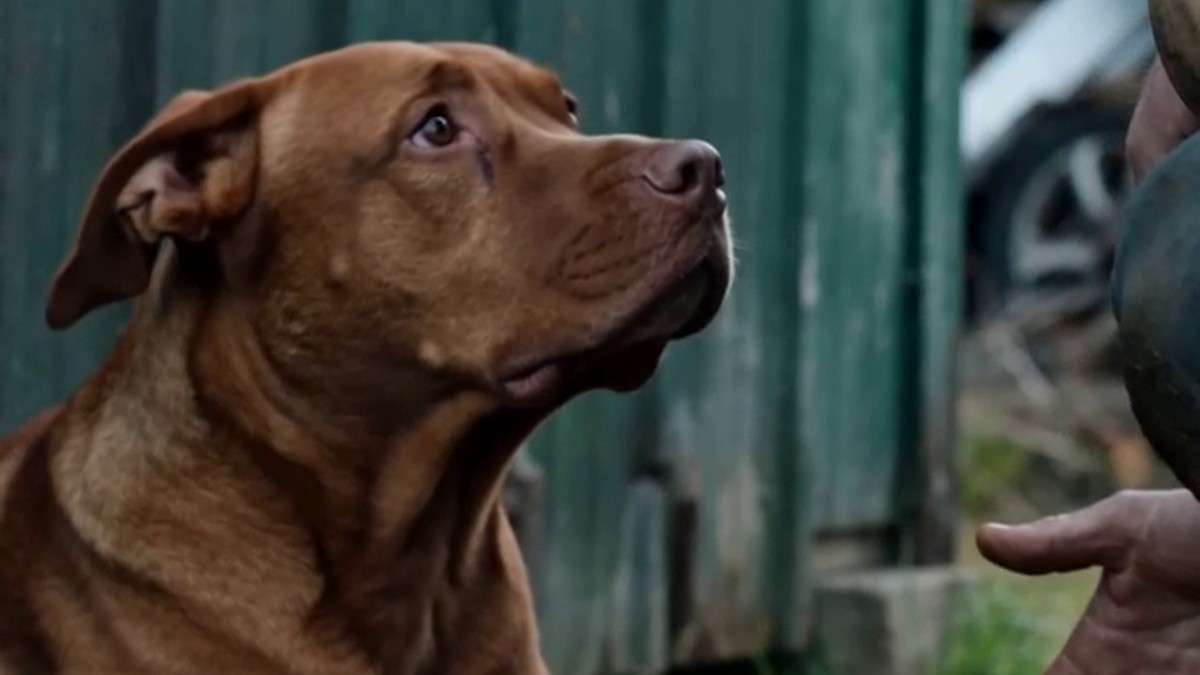
The dog lay directly in front of the shed entrance. She wasn't big. She wasn't small. One of her eyes was slightly hooded, the lid drooping in a way that suggested an old injury or a birth defect. Her coat was dull, matted in patches, and through the thin fur Gabe could count her ribs. She wasn't barking. She wasn't even standing. She just lay there, chin resting on her front paws, watching.
"Did you try the back?" Gabe asked. "Those boards are practically sawdust. You could—"
"We tried," Billy cut him off. "The second we move around the side, she runs around the other way and squares up exactly where we're heading. She's fast. And she's not stupid."
Gabe finished his coffee in one bitter swallow and set the mug on a fence post. The grass squelched under his boots as he walked toward the shed. The smell shifted as he got closer. Wet wood first. Then the heavy, fungal reek of rot. And underneath both, something faint and animal and strangely familiar, something he couldn't immediately name.
The dog lifted her head.
She didn't charge. Didn't bare her teeth. She just rose to her feet with a slow, deliberate weariness. The fur along her spine lifted slightly. Her tail gave a single nervous twitch.
"Go on," Gabe said, stomping his boot. "Get out of here."
She took half a step backward. Froze. Then stepped right back into position, blocking the door entirely. No growl. Just that steady, unblinking gaze.
He crouched down until he was at eye level with her. Maybe four feet between them. Her eyes were brown and wet, the droopy one leaking a little at the corner. There was no meanness in them. Something else lived there, something Gabe couldn't find a word for yet.
One of the crew approached and silently offered him a length of pipe. Gabe shook his head.
"Animal control won't get here before Tuesday," Billy said. "And the dumpster is only paid through end of day."
"I know."
Gabe stood up. His knees cracked, the sound sharp and obnoxious in the quiet yard. The dog didn't flinch.
"I'm going in."
"What if she bites?"
"She won't."
He said it more from stubbornness than certainty. He walked to the door. The dog let out her first real growl then—low, quiet, not a threat so much as a warning. A question.
He pushed the door open. The old hinges shrieked. The bottom edge scraped a raw line through the dirt. Gabe slid sideways through the gap and stepped into the dim, warm dark.
It was warmer than it should have been. Not the trapped heat of a spring afternoon, but something denser. Living. The air felt thick and humid and breathed in a way that made the hair on his arms stand up. He stopped just inside the doorway and inhaled. The smell was unmistakable now. It was exactly the way his mother's laundry room used to smell the time she brought home a cardboard box of orphaned kittens and tucked them beside the water heater with a heating pad and an old towel. Milk and warmth and tiny, helpless life.
His eyes adjusted. The shed revealed itself slowly. An old workbench cluttered with rusted paint cans. A coil of wire. A shovel with no handle. Hard-packed dirt floor. Scraps of last year's straw. Cobwebs sagging from the rafters, one thick strand trembling under the weight of a single bead of moisture.
Then he looked at the back corner.
The roof was still intact there, and a thin blade of morning light fell through a gap in the boards, illuminating a patch of floor like a stage. On that floor lay a gray wool blanket, frayed at the edges, worn thin in the middle. He remembered it. During the walkthrough before closing, he’d kicked it aside, assumed it was trash left by a squatter or the previous owner. Now the blanket had been shaped. Dragged and nudged and worried into a nest.
On it lay four puppies.
They were impossibly small. Two weeks old at most. Their eyes were still sealed shut, little dark creases where eyelids hadn't yet split. Ears flat against their round heads. They crawled over each other in slow, blind circles, mewling softly, nosing at the wool. The runt, a tiny thing with a dark patch on its back like a saddle, had burrowed partway under the edge of the blanket and was kicking one hind leg in its sleep.
Gabe didn't remember crouching down. He just found himself there, on his heels, hands hanging uselessly between his knees. The sunbeam fell across the puppies and turned their fur to spun gold.
He reached out and touched one small warm back with the tip of his finger. The puppy didn't wake. It just shifted and pressed closer to its siblings.
A soft rustle behind him. He turned.
The dog had slipped inside. She moved past him without a sound, circled around, and lay down beside her litter. He waited for the growl. The warning. The teeth. But the dog simply began to lick each puppy, slow and methodical, from crown to tail. Like he wasn't even there. Like the whole of her world began and ended on that gray blanket in that patch of light.
The runt found her first, nudging blindly until it latched on and began to nurse with tiny, desperate grunts. The others followed. The shed filled with nothing but the sound of suckling.
The dog closed her hooded eye, rested her chin on her paws, and sighed.
Gabe stayed there a long time. His knees went numb against the cold dirt. Time felt suspended, viscous. When he finally stood and stepped back out into the yard, Billy was waiting by the fence with a thermos. The truck radio was murmuring a weather report.
"Well?" Billy asked. "Rats?"
"No."
"What, then?"
"Puppies."
Billy blinked. "Puppies."
"Four of them. In the corner. Their eyes aren't even open yet."
Billy scratched absently at an old scar on his wrist, a tic he had whenever a situation refused to conform to the straightforward logic of demolition. "So what's the call? We taking the shed down or not?"
Gabe looked at the half-open door. Through the gap he could see the dog's rust-colored flank, rising and falling with her breath. She hadn't moved. She wasn't looking out. She already seemed to know the danger had passed.
He thought about what he'd just seen. She had no power to stop four men with tools. No weapons. No real chance of protecting those small blind creatures from anything that truly wanted to harm them. All she'd had was her body and her stubbornness and that narrow strip of rotting wood she'd decided was a threshold worth defending.
"No," he said. "We're not taking it down."
"When, then?"
"When the puppies are old enough."
Billy shrugged, let out a sharp whistle, and the yard erupted into the ordinary noise of a work crew packing up. The crowbar clanged against the truck bed. The sledgehammer thumped into its case. Doors slammed.
Gabe pulled out his phone before he'd fully decided what he was going to say.
"Megan? Hey. I need you to pick up some dog food. And bowls. Two of them, I think."
His wife was asking questions, her voice rising with confusion, but Gabe was watching the shed door. A rust-colored muzzle had appeared in the gap, tracking the truck as it backed slowly out of the driveway. The wind shifted, carrying the smell of new grass and gasoline and the lilacs blooming on the neighbor's property.
The dog blinked her one good eye, slow and calm.
Gabe ended the call. In the truck's cab he found the bottle of water and the sandwich Megan packed him every morning "just in case." He poured water into a dented old tin bowl he found lying against the shed wall, rusted and stained but still holding.
The dog didn't come out. But a wet black nose appeared in the dark crack of the doorway, sniffing.
He sat on the back steps of the house, unwrapped the sandwich, and took a bite. A bird somewhere beyond the fence was repeating the same three-note phrase, insistent and bright. The old shed stood exactly as it had. The paint still peeled. The roof still sagged. But the air coming through that half-open door no longer smelled like decay.
It smelled like milk. Like warmth. Like something that had decided, against all odds, to begin.
The gray blanket, the one he'd nearly thrown away as trash, had become a home.
—
The weeks that followed rearranged Gabe’s life in ways he hadn't expected. He found himself driving out to the property every morning before work, then again in the evening, until Megan finally looked at him across the dinner table and said, "You know, you could just admit you're smitten."
"I'm not smitten. I'm just making sure they don't freeze or starve or get eaten by a coyote."
"You bought a heating pad. And puppy formula. And you've named them."
"I haven't named them."
"You call the runt 'Patch.' That's a name."
Patch was the boldest of the litter, the first to open his eyes, the first to stagger out of the shed on unsteady legs and blink at the sun. His siblings followed: a cream-colored female who never stopped wagging her tail, a deep red male who was already stocky and serious, and another female with white socks on all four paws. Their mother—Gabe had started calling her Rusty, for lack of anything more poetic—watched these explorations from the doorway, her drooping eye giving her a permanently skeptical expression.
By June the puppies were tumbling around the yard, chasing dandelion fluff, tripping over their own feet. By July they were eating solid food and had discovered the joy of digging holes in Megan's newly planted flower beds. Gabe built a proper doghouse. He reinforced the fence. He took them all to the vet, a procession that required two trips in the truck and left the waiting room smelling distinctly of nervous puppy.
"I thought we were just waiting until they were old enough," Megan said one evening, sitting on the back steps with a glass of wine, watching Gabe throw a tennis ball for the fifth time in a row.
"We are."
"The shed is still standing. You haven't called Billy."
"I'll call him."
Megan smiled into her glass. "Sure you will."
August brought a heat wave that baked the grass to straw and sent the dogs sprawling in whatever shade they could find. The shed, for all its decrepitude, stayed cool inside—the dirt floor, the thick old boards, some trick of ventilation that Gabe couldn't figure out. The dogs still slept there sometimes, Rusty curled in the corner on that same gray blanket, the four pups—no longer pups, really, but lanky, half-grown creatures—piled around her.
Gabe would sit on an overturned crate and watch them breathe in the dim light, and sometimes he'd think about how close he'd come. How the crew had been minutes away from swinging sledgehammers into those walls. How if Rusty had run, if she'd been a different kind of dog, if he'd been a different kind of man, that corner would just be rubble now.
The call from the city came on a Thursday in September.
The voice on the other end was polite and bureaucratic. Code enforcement. The shed had been flagged as an unsafe structure. There had been complaints. It needed to come down within thirty days or the fines would start accumulating—daily, and significant.
Gabe hung up and stood in the kitchen for a long time. Through the window he could see the shed at the edge of the property, listing slightly to the left, its green paint faded to a pale ghost of itself. The dogs were sprawled in the yard around it. Patch was chewing on a stick. Rusty lay in her usual spot on the stoop, chin on her paws, watching the road.
He called Billy that afternoon.
"Finally ready?"
"I have to be. City's on my case."
"Next Tuesday work?"
Gabe looked at the calendar. Thirty days. He could do this. He had to do this.
"Tuesday's fine."
—
Tuesday dawned cool and clear. The crew arrived at seven, the same crew, the same truck, the same dumpster. Billy climbed out of the cab with a cup of gas-station coffee and surveyed the yard, where five dogs were now watching the intrusion with varying degrees of suspicion.
"Quite the operation you've got here," he said.
"They're friendly. Mostly."
Rusty had risen to her feet. She stood in front of the shed door, exactly where she'd been that morning in May. Her body was tense, her tail still. Her eyes tracked Billy's every movement.
"She remembers you," Gabe said.
"Smart dog."
Gabe had prepared for this. He'd set up a shaded pen near the house, lined with blankets and bowls of water and a few chew toys. Megan was home. The plan was to move the dogs there, keep them contained and calm while the shed came down.
It took twenty minutes and a trail of treats to coax Rusty away from her post. She went reluctantly, looking back over her shoulder every few steps, a low whine building in her throat. The pups followed her, picking up on her unease, their tails dropping.
Gabe closed the gate of the pen and scratched Rusty behind the ears. "It's okay, girl. It's just a building."
She leaned into his hand. But she didn't stop watching the shed.
The crew got to work. The sledgehammers started swinging. The old boards splintered with a sound like bones breaking. The roof came down in sections, shingles sliding off in a cascade of gray and green. Dust billowed into the morning air.
Gabe stood by the pen and watched the shed die.
It didn't take long. An hour, maybe less. The structure that had stood for decades, that had sheltered a mother and her newborns, that had become the center of a small universe of tennis balls and puppy breath and sun-warmed fur—it was just a pile of lumber now. Billy's crew loaded the debris into the dumpster with practiced efficiency.
And then it was done.
Gabe walked over to where the shed had been. The dirt was bare now, churned up by boots, scattered with splinters and bent nails. The corner where the puppies had been born was just a patch of earth, no different from any other.
Except.
Something was caught on a nail in one of the remaining floorboards. A scrap of fabric. Gray wool. Frayed at the edge.
He crouched down and pulled it free. A piece of the blanket. The blanket. It was smaller than his palm, worn thin as tissue, smelling of dust and dog and milk and time.
He looked over at the pen. Rusty was standing at the gate, her mismatched eyes fixed on him. The pups were crowded behind her, whining softly, not understanding why they'd been locked up, not understanding where their shelter had gone.
He walked back to the pen and opened the gate. The dogs poured out. They ran to the debris field, sniffing and circling, confused by the sudden absence where a familiar shape should have been. Rusty followed more slowly. She walked to the exact spot where the door had been. She sniffed the ground. She looked up at Gabe.
"I know," he said quietly. "I'm sorry."
That evening, sitting on the back steps while the dogs explored their newly expanded yard, Gabe called Megan out to look at something.
"What am I looking at?"
"The spot. Where the shed was."
"Okay. It's a dirt patch."
"Exactly. It's a dirt patch. Flat. Sunny. Perfect drainage."
Megan took a sip of her wine. "Are you building something?"
"I'm thinking a proper doghouse. A nice one. Insulated. With a porch."
"A porch."
"Rusty likes porches."
Megan laughed, that bright sound that had made him fall in love with her fifteen years ago. "You're going to build your dogs a house with a porch."
"They earned it."
And so he did. It took him most of October, working weekends and evenings, but by the time the first frost arrived there was a sturdy little structure standing exactly where the old shed had been. It had a sloped roof, a raised floor, a proper door with a flap, and yes—a small porch where a rust-colored dog could lie with her chin on her paws and watch the road.
The gray wool blanket, washed and folded, went inside.
Rusty walked in on the first cold night, sniffed every corner, and settled down in the exact center with a sigh that seemed to come from somewhere very deep and very old. The pups piled in around her, a tangle of limbs and tails, just as they had when they were small blind things in the dark.
Gabe stood in the doorway, flashlight in hand, watching them settle. The beam caught the scrap of blanket he'd pinned to the wall earlier that day, a small fragment of gray wool in a simple frame.
Megan came up behind him, slipping her arm through his. "Coming to bed?"
"In a minute."
She kissed his cheek and went back to the house. The yard was quiet. The stars were sharp and cold overhead. From inside the little house came the soft sound of contented breathing.
Rusty poked her head out once, blinked her droopy eye at him, and disappeared back inside.
Gabe turned off the flashlight and walked back across the frost-crisp grass toward the warm yellow windows of home, five sets of paws dreaming behind him in the dark.