The first time Liz saw Marcus, he was wrestling a broken bookshelf into a dumpster outside their apartment building. It was mid-July in Portland, the air thick with the smell of rain-soaked asphalt and someone’s burnt toast from a window three floors up. She’d offered him a bottle of water, he’d offered her a crooked smile, and eighteen months later they were married in a courthouse downtown with two witnesses and a playlist that kept skipping.
For the first two years, the question hung in the air at every family dinner, every backyard barbecue, every Sunday brunch Marcus’s mother insisted on hosting. "So. When are you two going to make me a grandmother?"
Liz would stir her mimosa and force a laugh. Marcus would squeeze her knee under the table and change the subject to the Trail Blazers. The truth was, they’d been trying. Had been trying since the night they got back from their honeymoon on the Oregon coast, actually—a rain-lashed week in a rented cabin where they’d mapped out their future on the back of a diner napkin. Two kids, a golden retriever, a house with a porch swing. The whole postcard.
But the months stacked up. Then the years.
Liz’s younger sister Cora got pregnant by accident with a guy she’d met at a food truck. Then her coworker Gretchen, twice. Then the barista at the coffee shop downstairs who always remembered Liz’s oat milk order. Everywhere Liz looked, women were swelling with life, glowing with it, complaining about swollen ankles and midnight cravings while Liz stood in the CVS aisle staring at ovulation kits like they held the secrets to the universe.
She never bought one. Neither of them went to a clinic. The fear sat between them on the couch every night, an invisible third person they refused to acknowledge.
Liz lay awake at 3 a.m. some nights, Marcus breathing softly beside her, and she’d run the same thought on a loop: *What if it’s me? What if I’m the broken one?* Meanwhile, Marcus sat in his truck outside the warehouse where he managed a flooring supply depot, gripping the steering wheel and thinking, *If I can’t give her this, what am I even for?* They were both so terrified of being the reason that they’d rather live in the not-knowing than crack open the possibility.
Five years in, they’d perfected the art of avoidance. When friends posted ultrasound photos, Liz scrolled past without a second glance. When Marcus’s mom brought out the old baby clothes she’d saved, they deflected. They renovated the guest bathroom. They took up hiking. They adopted the kind of careful cheerfulness that couples wrap around a wound neither will name.
Then Marcus brought home the dog.
It was a Tuesday, drizzling and gray. Liz was on the sofa, grading landscape architecture assignments from the community college class she taught, when the front door burst open and Marcus stumbled in holding something wrapped in his Carhartt jacket.
"Okay, don’t be mad," he said, before she’d even lowered her laptop.
The jacket squirmed. A nose appeared. Then two enormous, terrified brown eyes set in a wrinkled, seal-colored face.
"His name is Otis," Marcus continued, the words tumbling out. "He’s a pit bull mix, six months old, the shelter was full and they were gonna—Liz, he was on the list. The euthanasia list. I saw him and I just… I couldn’t walk away."
Liz closed her laptop. "Marcus, we’ve talked about this. I don’t do dogs. I don’t do hair on the furniture, I don’t do chewed baseboards, I don’t—"
Otis whimpered. It was a tiny, pathetic sound, completely at odds with his blocky head and muscular little body. He was trembling, his tail tucked so far under him it practically disappeared.
And Liz looked at that trembling dog, and she saw something she recognized. A creature desperate to be chosen, bracing for rejection.
"Fine," she heard herself say. "But he’s your problem. Walks, feeding, accidents—all yours."
Marcus beamed. Otis, as if understanding, let his tail give a single, cautious wag.
The first month was chaos. Otis chewed through three pairs of Liz’s Blundstones, ate an entire rotisserie chicken carcass from the trash, and developed a habit of howling at 2 a.m. for no apparent reason. Marcus cleaned up the messes, walked him in the rain, took him to obedience classes at the Petco on 82nd Avenue.
But somewhere around week six, something shifted. Marcus got called away on an overnight to a supplier in Seattle, and Liz came home to an empty house with just Otis for company. She fed him his kibble, took him out to the patch of grass by the dumpsters, and settled back on the couch with her laptop.
Otis climbed up beside her. All fifty pounds of him, ignoring the dog bed Marcus had paid eighty bucks for, and rested his blocky head on her thigh. He sighed—a deep, contented, human-sounding sigh—and closed his eyes.
Liz froze. Then, slowly, she rested her hand on his warm flank.
By the time Marcus got back the next evening, Otis had a new collar with little pineapples on it, a memory foam bed in the corner of the bedroom, and an Instagram account Liz had made that already had forty-seven followers.
"He’s still my responsibility?" Marcus asked, fighting a grin.
"He’s *ours*," Liz corrected, without looking up from the organic dog treat recipe she was reading on her phone.
Otis became their everything. Their weekends revolved around dog-friendly breweries and hikes in Forest Park. Their camera rolls were ninety percent his face. Liz bought him a raincoat with a hood, then a winter coat, then a ridiculous Halloween costume that made him look like a lobster. Marcus, who’d never been particularly sentimental, started calling Otis "my son" without a trace of irony.
For the first time in years, the empty room at the end of the hall—the one they’d painted a soft yellow when they moved in, the one with the closet that had never held anything but luggage and wrapping paper—stopped feeling like an accusation. Otis filled the silence. His nails clicking on the hardwood, his happy grumble when he rolled onto his back for belly rubs, the thump-thump-thump of his tail against the kitchen cabinets.
Three years. Three years of slobbery kisses and muddy pawprints and a joy so complete they almost forgot the ache it had replaced.
Then Otis stopped eating.
Sunday roast chicken, his absolute favorite—Liz would wave a piece under his nose and he’d turn his head away. Monday he ignored his breakfast entirely. By Wednesday, Liz noticed he’d lost weight, his ribs beginning to surface beneath his glossy gray coat.
"This is bad," she said, her voice tight. Marcus was already grabbing his keys.
The vet on Division Street had purple walls and a receptionist who offered them complimentary lavender tea. The doctor, a wiry man named Dr. Okonkwo with kind eyes and a no-nonsense manner, ran blood work while Liz sat in the corner clutching Otis’s head, whispering into his velvet ear.
Lymphoma. Aggressive. He gave them two weeks, maybe three with aggressive treatment.
They chose treatment. Of course they chose treatment. Marcus drained half their savings on chemotherapy, steroids, special diets Liz prepared from recipes she found in online forums at 3 a.m. She slept on the floor beside Otis’s bed, her hand resting on his side, feeling the rise and fall of his breathing. When he was too weak to walk, she carried him—all forty-eight pounds of him—down three flights of stairs to the grass and back up again.
Marcus would come home and find her like that, curled around the dog like a shield, and he’d quietly make dinner and bring her a plate she’d barely touch.
Seventeen days after the diagnosis, Liz woke at dawn and knew. The room was too still. The rhythmic snore she’d grown so used to was absent. Otis lay in his bed, his head on his paws the way he always slept, but the rise and fall of his ribs had stopped.
She didn’t scream. She lay down beside him on the cold floor, pressed her face into his neck where his scent still lingered—oatmeal shampoo and fritos and something warm and alive that was already fading—and she sobbed until her ribs ached.
They buried him in Marcus’s hometown, two hours south, on a hillside where the wild lupines grew. Liz couldn’t speak at the little funeral Marcus improvised. She just stood there, hollow.
After, the apartment was unbearable. The silence had teeth. Liz stopped teaching her classes—took a leave of absence, told the department chair it was a family emergency. She spent days in bed, the curtains drawn. She didn’t shower. She didn’t eat.
Then she started getting sick.
Morning after morning she’d stagger to the bathroom, heaving into the toilet until her stomach was a clenched fist. She blamed the grief. Marcus, watching her with worry coiling in his chest, blamed the grief too. Stress, he said, can wreck the body. She should see a doctor.
"I probably picked up something from Otis," Liz muttered one afternoon, slumped at the kitchen table while Marcus made her tea. "Some virus. You know how sick he was."
"That’s not how it works, sweetheart."
"I don’t care how it works. I just know I feel like garbage."
He made the appointment. Drove her there himself and sat in the waiting room, flipping through a *Sports Illustrated* from eight months ago, his knee bouncing.
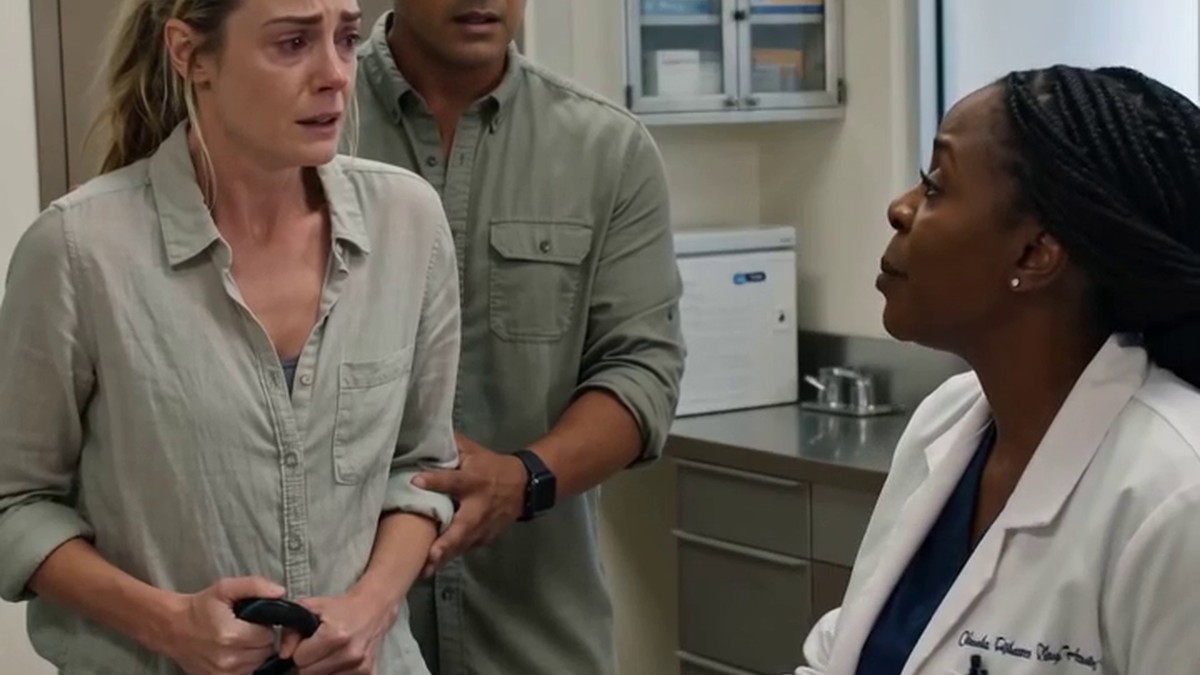
When Liz emerged forty-five minutes later, she was pale as paper. She walked right past him, out the automatic doors, into the parking lot where the February wind was cutting sharp and wet. Marcus followed, panic beginning to climb his throat.
"Liz. Liz, what did they say? Is it serious? Talk to me."
She turned. Her eyes were wet, but her mouth was doing something strange—twitching, trembling, fighting against an expression he couldn’t read.
"I’m pregnant," she said. "Eleven weeks."
The parking lot noise faded. The traffic on 39th Avenue, the distant wail of a MAX train, the gusting wind—all of it dropped away.
"That’s not possible," Marcus heard himself say.
"It’s possible. It happened. I saw the ultrasound." She laughed, a wet, shaky sound. "There’s a tiny person inside me, Marcus. With a heartbeat and everything. I thought I was sick with grief and the whole time I was growing a human."
He pulled her into his arms so hard she squeaked. She was shaking. He was shaking. Somewhere above them, a break in the clouds let through a blade of pale winter sun.
"Eleven weeks," he repeated into her hair. "Eleven weeks you’ve been walking around with our kid and we were crying over a dog."
"Otis wasn’t just a dog."
"No," he said. "No, he wasn’t. He was the one who got us here."
Liz pulled back, wiping her face with her sleeve. "What do you mean?"
"I mean we spent almost a decade trying so hard we suffocated whatever we were trying to make. And then Otis showed up and we stopped trying. We just… lived. We poured all that love into him and stopped obsessing about what we didn’t have. And then he left, and we were so gutted we couldn’t think about anything else at all." He cupped her face in his hands. "You stopped tracking your cycles. You stopped waking up at 5 a.m. to take your temperature. You stopped ordering those fertility teas from that sketchy website. You just grieved. And that’s when it happened."
Liz stared at him for a long moment. Then she let out a sound that was half laugh, half sob. "So you’re saying my uterus needed me to stop micromanaging it."
"I’m saying maybe your uterus has a sense of irony."
They stood in the parking lot until Liz’s teeth started chattering, and then Marcus bundled her into the truck and cranked the heat. On the way home, he stopped at the grocery store. She waited in the truck, watching people push carts through the slush, one hand pressed flat against her belly as if she could feel the life inside through all those layers of skin and muscle and time.
When Marcus came back, he had a bag of prenatal vitamins, a jar of dill pickles, a pint of rocky road, and a bouquet of grocery-store tulips wrapped in plastic.
"For starters," he said, handing them over.
At home, Liz stood in the hallway outside the yellow room. The door was closed, same as it had been for eight years. She opened it. The luggage was still there, the rolls of Christmas paper, a box of old textbooks. But now she saw different things. A crib against the wall. A mobile turning slowly in the breeze from the vent. The morning light catching dust motes and making them look like gold.
She didn’t say it out loud. She just closed the door, leaned her forehead against the frame, and let herself believe.
That night, for the first time since Otis died, they ate dinner at the table instead of on the couch. Liz wolfed down two helpings of pasta, and then the pickles, and then half the ice cream while Marcus watched with a dazed, disbelieving grin.
"Slow down," he said. "You’re eating for two, not for a football team."
"Don’t police my joy, Marcus."
He raised his hands in surrender.
Later, in bed, with the rain starting up again against the windows, Liz curled into his side and pressed her cheek to his chest.
"Do you think Otis knew?" she asked quietly. "Before he went. Do you think some part of him knew?"
Marcus was quiet for a long time. His hand traced slow circles on her shoulder.
"I think," he said finally, "that dog came into our lives to fix something we couldn’t fix ourselves. And I think when his job was done, he let go."
Liz didn’t answer. But she shifted, reaching for his hand and pressing it to the soft swell of her belly, where a heartbeat she’d seen on a grainy screen was already ticking away like a watch wound years too late and right on time.
She was thirty-nine years old. They’d been married almost a decade. And in the quiet dark of a rainy Portland night, with the ghost of a pit bull still curled at the foot of the bed, they finally started waiting for something that was actually coming.