The church smelled like candle wax and wet umbrellas. I sat on the wooden pew, twisting a crumpled tissue in my hand, listening to Father Michael read the names for the departed. "For the repose of the soul of God's servant Andrew…" — that one was mine, I'd ordered it ahead of time, paid twenty dollars. One year exactly since I lost my husband.
Right after mine came another request: "For the repose of Andrew, from Irene, with gratitude."
The name hit like a bell. Irene. With gratitude. I looked around the empty pews — almost no one there, just old Mrs. Whitfield working her rosary near the confessional. Outside, the rain came down thin and steady, and the number 6 bus rumbled past toward the park.
Andrew died of a heart attack — fast, they didn't even get the ambulance there in time. He was sixty-four. We'd lived thirty-five years together in that apartment on Chestnut Street, raised two daughters, paid off the loan on the Chevy Cruze he drove to go fishing every Tuesday. An ordinary carpenter at the furniture plant, golden hands. He could fix anything — an old cabinet, his granddaughter's mood. And he never said more than he had to.
The sacristy smelled of incense and the dust of old books. Father Michael flipped through a leather-bound notebook.
"Irene Kowalski," he read, bent over the page. "Requested it in person, a week ago. Paid cash."
"Is she from our parish?"
"No, Mrs. Novak. I don't recall her among the regulars. Middle-aged woman, dark hair going gray, crying while she filled out the card. That's all I can tell you."
I went home and made tea. The mug sat cooling on the table while I looked out at the lilac bush in the yard — the one Andrew planted when our younger daughter, Sophie, was born. The apartment was empty and still, just the refrigerator humming like an old engine.
I opened the hallway closet where his things still hung. Coat, work jacket from the plant, a sweater with worn elbows. In the work jacket pocket — sawdust, a nail, a button. In the coat — nothing. Then I went out to the little storage room off the balcony where he kept his tools.
There, in a candy tin he'd hidden behind cans of varnish, I found a note. Ordinary notebook paper, folded in quarters. Handwriting I didn't recognize, small and feminine: "Andrew, you have no idea what this meant to me. Thank you. I."
Our daughters reacted differently. Martha, the older one, said over video call from Chicago:
"Mom, let it go. Dad was a good man, he probably helped somebody out. Maybe he fixed something for her and she decided to have a Mass said. Why put yourself through this?"
Sophie drove up the next day. She read the note without a word, set it on the table, and stared out at the bus stop for a long time.
"Mom, what if it's something serious?" she finally asked. "Are you ready for that?"
I didn't answer. I didn't know what "ready" meant.
A week later I went back to the church. Mrs. Doyle, older than me, who'd worked in the parish office since Father Michael was in grade school, remembered the woman.
"I remember her because she wasn't from around here. Drove in from Elmwood, I think. Had on a maroon scarf, eyes all red from crying. Left a phone number, but I didn't push her on it, figured that was her business. She said, 'Please tell Father this is very important. He saved my life.'"
Saved my life. My Andrew, who was afraid of heights, hated doctors, and hid cash in an old coffee can. Saved a life.
That evening I found a business card. It was tucked inside a wooden chisel case Andrew had built himself and never let anyone open — said it was sharp, he didn't want anyone getting cut. I opened it for the first time in all those years. Inside were the chisels, lined up neatly, and a white rectangle: "Dr. Robert Chen, Licensed Therapist, Copernicus Ave, Suite 15. Tuesdays, 5:00 PM." On the back, in Andrew's handwriting: "Session 8."
Tuesday, five o'clock. Exactly when he was supposedly out fishing.
I called the next morning. The therapist said he couldn't discuss details, it was confidential, even after a patient's death. But after a pause he added — dropping the professional tone:
"Your husband talked about you a lot, Mrs. Novak. He used to say, 'I don't know how to explain this to her. I don't know how to explain it to myself.' He came to me a year and a half ago because a woman he barely knew had called him in the middle of the night, and he didn't know what to do with what happened next. He said he was afraid you'd never understand why a stranger mattered to him the way she did."
After that call I sat in the kitchen until midnight. I thought about how I'd shared a bed for thirty-five years with a man who went to see a therapist without ever telling me. Who saved someone's life, but never told me how. Who had an "Irene, with gratitude" and a folded note at the bottom of a candy tin.
I could have let it stay a rumor. Instead I remembered how Andrew looked at me the last day. He was lying on the couch, worn out from work, and said, "Ellen, I forgot to tell you something. I just don't know how." I'd waved him off — said the potatoes were burning, we'd talk later. An hour after that, he was gone.
I went back out to the storage room and looked through the tools again, slower this time. Behind the chisel case, wedged against the wall, was a second candy tin I'd missed. Inside it: a woman's wristwatch, stopped at some hour that meant nothing to me, and a folded receipt from a hardware store — a length of rope, a padlock, a chain, bought eighteen months ago, the same month as "Session 8." I didn't understand what it meant. But I knew where to find out.
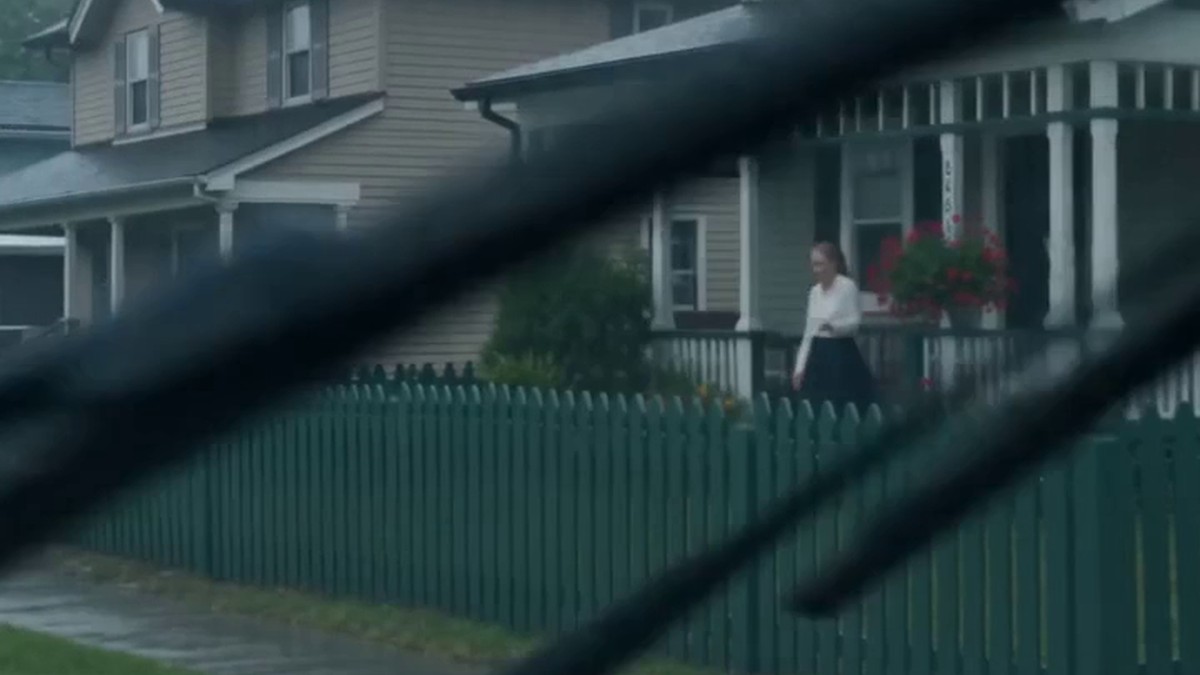
The next day I drove to Elmwood. Got the address from a friend at the post office — Irene Kowalski, 7 Birchwood Lane. A small house with a green fence, an old apple tree in the yard, pots of red geraniums on the porch. I knocked.
The woman opened the door almost right away, as if she'd been expecting someone. About fifty-five, gray hair in a bun, dark circles under her eyes. She wore a maroon sweater. The same color.
"Are you Irene?" I asked.
She nodded, and her hands started to shake.
"I'm Ellen. Andrew's wife."
She stepped back, gripping the doorframe. "Mrs. Novak. I — please, come in. I've been wanting to call you for a year and just kept losing my nerve."
I held out the tin with the watch and the receipt instead of stepping inside. "I found this. I don't know what it means. I want you to tell me."
She looked at the watch and pressed her fingers to her mouth. "That's mine," she said. "He kept it. I didn't know he kept it."
She told me, standing right there in the doorway, because I wouldn't come past it. Eighteen months ago she'd been ready to walk into the river behind the mill on Route 9 — had the rope and the chain already in her trunk, bought that same afternoon, so there'd be no chance of changing her mind halfway down. Andrew had been parked nearby waiting on a delivery of lumber, saw her sitting on the guardrail in the rain with the car running, and didn't drive away. He sat with her for four hours. He gave her his coffee. He didn't call anyone, didn't lecture her, just stayed until she agreed to get in his truck instead of going into the water. He drove her home, and then he kept driving back — Tuesdays, for months, first to check on her, then to sit with her while she talked, until she asked him once why he never mentioned it to his wife.
"He said you'd worry I was more than what I was," Irene said. "He said some things are too heavy to hand somebody you love, so you carry them yourself instead. He gave me his coffee that night and he never once made me feel like a burden. That's what I meant. He saved my life. Not a metaphor, Mrs. Novak. He saved my actual life."
I stood on that porch a long time, the rain starting to bead on the geraniums. Then I reached into my bag and took out the folded note — the one I'd found in the tin, the one that started this whole year of not sleeping.
"This is yours," I said, and gave it back to her. "I don't need it anymore."
She took it with both hands like it was something that might break.
"Thank you," I told her, and meant it, though it took me the whole drive back to understand what I was thanking her for.
I got behind the wheel and started the engine. Some old song I didn't recognize was playing on the radio. I thought about the CD account Andrew and I had built up over the years, thirty-eight thousand dollars he'd always said was for the girls' kids someday — and thought that whatever else he'd kept from me, that part of him, at least, had never wavered. I'd go to the bank Monday and put it in Martha's and Sophie's names, same as we'd always planned. That much of him I didn't have to relearn.
As I drove out of Elmwood, the rain kept falling steady on the windshield, and I looked straight ahead at the wet road, and for the first time in a year, I didn't cry. Not because the missing had stopped, but because I finally understood what I'd been missing.