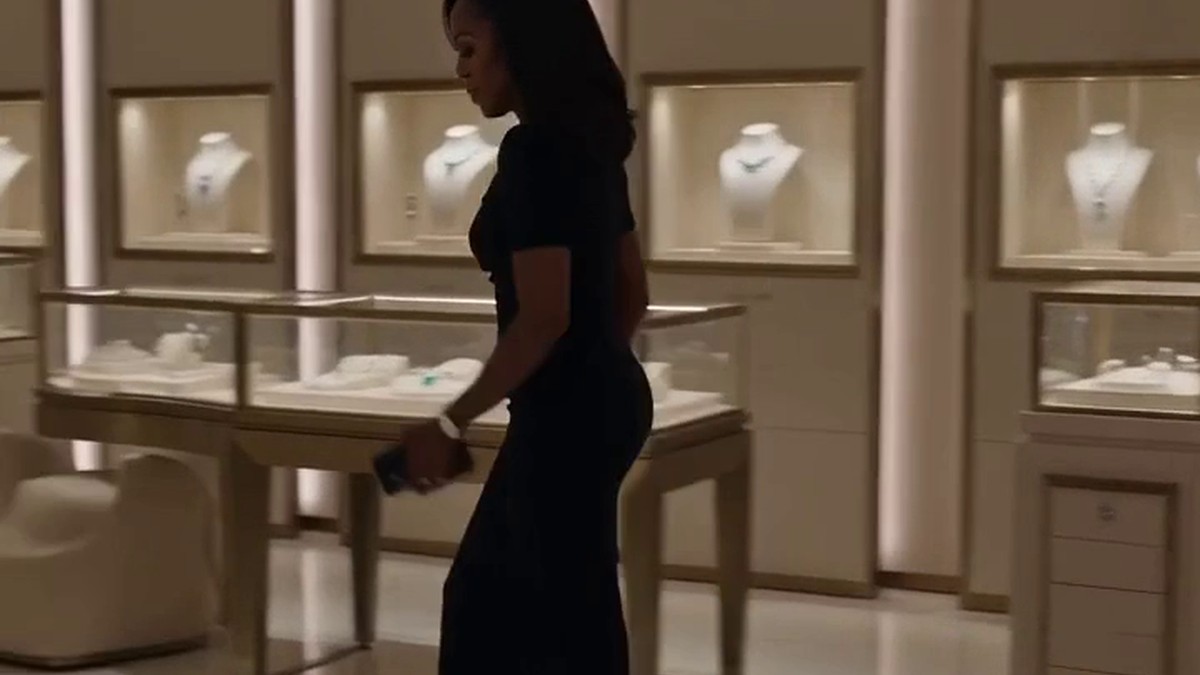
The shove came out of nowhere—shoulder to shoulder, hard enough that Vivienne Delacroix had to brace herself against the edge of a glass display case or she might have stumbled into a tiered pyramid of ruby pendants.
The boutique went dead silent. Not the sterile, expensive silence that comes with marble floors and soft lighting. The frozen, breath-held silence of people watching a scene they knew they’d be retelling at dinner.
Vivienne straightened up, smoothed the front of her simple black sheath dress, and slowly turned to face the woman who had just tried to knock her off her heels.
The woman was in her mid-twenties, blonde, poured into a magenta silk jumpsuit that probably cost more than a semester at a private college. She wore the kind of smile that wasn’t really a smile—just teeth and entitlement. Her eyes flickered over Vivienne’s dress, her lack of jewelry, the understated leather handbag tucked beneath her arm. The assessment took half a second.
“Excuse me,” the woman said, loud enough for the whole sales floor to hear. “You’re blocking the VIP cases. This area is for actual clients.”
Vivienne didn’t blink. She didn’t glance down at herself. She didn’t glance at Marcus Cole, her CFO, who had frozen mid-sentence beside her, a velvet box still open in his palm.
Instead, Vivienne gave the woman a long, calm look—the kind of look that makes angry people angrier because it tells them they aren’t even worth a reaction.
The woman stepped closer. Her nameplate, pinned discreetly near the lapel of her jumpsuit, read *Portia Sinclair, Floor Manager.* But the energy she radiated said *Owner’s Daughter Who’s Never Been Told No.*
“Maybe you didn’t hear me,” Portia said, lowering her voice into something more venomous. “You don’t belong here. There’s a department store three blocks down. Much more your speed.”
A few customers nearby pretended to study the diamond earrings in the case. One of them, an elderly woman in a cashmere wrap, set down her champagne flute with a tiny clink. The sales associates stood behind the counters, eyes darting toward the door to the back office, clearly hoping someone with more authority would emerge.
Marcus took a step forward. “Now, wait a minute—”
Vivienne raised one hand, and he stopped.
She didn’t argue. Didn’t defend herself. Didn’t protest, didn’t posture, didn’t reach for some imaginary proof of status. She simply turned away from Portia and began walking across the showroom floor, her heels clicking on the polished marble with the kind of unhurried rhythm that made it feel like the whole store had suddenly become her living room.
Portia’s smile widened. She thought she’d won. She thought the woman in the no-name dress was leaving with her tail between her legs.
Vivienne passed the case with the estate pieces, the locked cabinet holding a single forty-carat sapphire, the velvet-roped area where a security guard stood watch over a necklace that had once belonged to a European royal. She stopped beneath the brightest chandelier in the entire boutique, the one that rained down light like molten silver.
Then she reached into her handbag and pulled out her phone.
Portia’s smile faltered just a fraction.
Vivienne lifted the phone to her ear. Her voice, when she spoke, was perfectly even. It carried through the quiet like someone reading the weather report.
“Hi, James. Yes, I know it’s after hours. I need you to move five billion from the escrow account into my personal checking. Right now.” A pause. “Yes, all of it. The sale finalised this morning—the funds are already cleared. I’m about to make a purchase and I’d rather not use a wire.”
Five billion.
The number dropped into the room like a stone into still water. Ripples went everywhere. The cashmere-wrap woman set down her glass again, even though she’d already set it down. The security guard shifted his weight. One of the sales associates made a small, involuntary sound—half gasp, half choke.
Portia’s whole face changed. The smugness didn’t just disappear; it cracked, then collapsed, then something worse filled the space behind it: a sharp, dawning, stomach-churning understanding that she had just made a very, very expensive mistake.
Vivienne ended the call. She didn’t put the phone away immediately. She held it loosely in one hand, its screen still lit, as though it were the most casual accessory in the world.
The door to the back office swung open and a man in an impeccable charcoal suit hurried out. His name tag read *Julian Sinclair, Managing Director.* He had the same bone structure as Portia, but the panic on his face was entirely his own.
He’d clearly been watching the security feed.
“Ms. Delacroix,” he said, breathless, crossing the floor in quick, desperate strides. “I—I had no idea you’d be visiting today. We were told the building inspection wasn’t until next week. The penthouse viewing is scheduled for—”
Vivienne cut him off with a single look. “Julian.” She said it the way someone might note a typo.
Julian Sinclair went pale. He turned to his daughter and the expression on his face could have curdled milk.
“Portia. What did you do?”
Portia’s mouth opened and closed. She looked at her father, then at Vivienne, then at the small crowd of shoppers who were all very definitely watching now. “She—she was just standing there. I thought she was one of those tourists who come in to take pictures and leave.”
Julian’s jaw tightened. He looked like a man who had just watched his entire career flash before his eyes, which, in a sense, he had. Because Vivienne Delacroix wasn’t just a customer. She was the woman who, two days earlier, had quietly purchased the entire building at 814 Fifth Avenue—including the Aurum & Stone boutique that occupied its first three floors. The deal had closed that morning. The wire transfer, the one her CFO had just referenced, was the payment for the building and the business.
The Sinclairs still leased the brand name, but they were tenants now. Her tenants.
Julian turned back to Vivienne, his composure crumbling at the edges. “Ms. Delacroix, please accept my deepest apologies. However you’d like to handle this, I’ll personally see to it. We can escort her out immediately.”
Vivienne slipped her phone into her handbag. She took her time with the clasp. Then she looked at Portia, who was now visibly trembling.
“You told me I don’t belong here,” Vivienne said, almost gently. “But I think you’ve confused belonging with looking like you belong. It’s a common mistake.”
Portia said nothing. She’d finally learned that opening her mouth was a losing strategy.
Vivienne turned back to Marcus, who had been watching the whole scene with the calm of a man who’d seen his boss dismantle boardrooms with less ammunition. She gestured toward the velvet box he was still holding.
“The sapphire,” she said. “We’ll take it.”
Julian practically lunged toward the locked cabinet. “Of course. Right away. I’ll handle the transaction personally.”
Vivienne smiled for the first time—a brief, unreadable curve of her lips. “No need to rush. I wanted to stop by the penthouse afterward anyway. I’m thinking of turning the top floor into my personal office. The view of Central Park must be spectacular.”
Julian nodded so fast it was a wonder his neck held up. “It is. It truly is.”
Vivienne walked toward the sapphire case, and the small crowd parted for her without being asked. The cashmere-wrap woman gave her a tiny, awed nod, the kind of silent salute one woman gives another after witnessing a masterclass in composure.
Behind her, Portia stood frozen near the VIP cases. Her father didn’t look at her as he unlocked the sapphire display with trembling hands. He didn’t have to. She already knew. She wasn’t just being thrown out of the store for the afternoon—she was being thrown out of the life she’d assumed was hers by right.
Vivienne examined the sapphire one final time before it was wrapped. She didn’t even glance at Portia. She didn’t need to.
Marcus held the door for her twenty minutes later, the signature blue Aurum & Stone bag looped around his wrist. Vivienne stepped out onto Fifth Avenue, the December breeze tugging at the edge of her coat. The city lights blazed against the early evening dark.
She paused on the sidewalk and looked back through the window. Portia was still standing in the same spot, her magenta jumpsuit suddenly looking less like a status symbol and more like a warning sign. Julian was speaking to her in hushed, furious bursts. She wasn’t answering.
Vivienne watched for maybe three seconds. Then she shrugged her coat tighter around her shoulders and turned away.
“Dinner?” Marcus asked.
“I’m in the mood for something modest,” she said. “A hundred-dollar steak. Maybe a baked potato.”
Marcus laughed under his breath. “I’ll call the car.”
Upstairs, in the empty penthouse with its floor-to-ceiling windows and its uninterrupted view of the park, the lights would stay off for one more night. But the woman who owned it now could already picture exactly where her desk would go.
Inside the boutique, the security guard quietly opened the door and gestured for Portia Sinclair to leave. For the first time in her life, she walked out onto the street with no one offering to call her a car.