Eli slid the heavy glass vase onto the satin-draped table, careful not to spill a single drop. His twelve-year-old arms ached from hauling it up the service stairs of the Brooks mansion. Outside, somewhere near the delivery van, his little sister Maisy was waiting with the empty cart.
He was only supposed to set down the centerpiece and vanish. That was the rule. Their mom, Nina, had warned them a dozen times on the drive over. “These people paid for flowers, not for children underfoot. In and out, Eli. In and out.”
He was two steps from the kitchen exit when Mrs. Cornelia Brooks let out a shriek that cut through the string quartet like a fire alarm.
“My brooch! The Mermaid’s Teardrop—it’s gone!”
Everything stopped. Crystal glasses paused in midair. The musicians froze. Eli’s sneakers made a squeak on the marble as he instinctively turned.
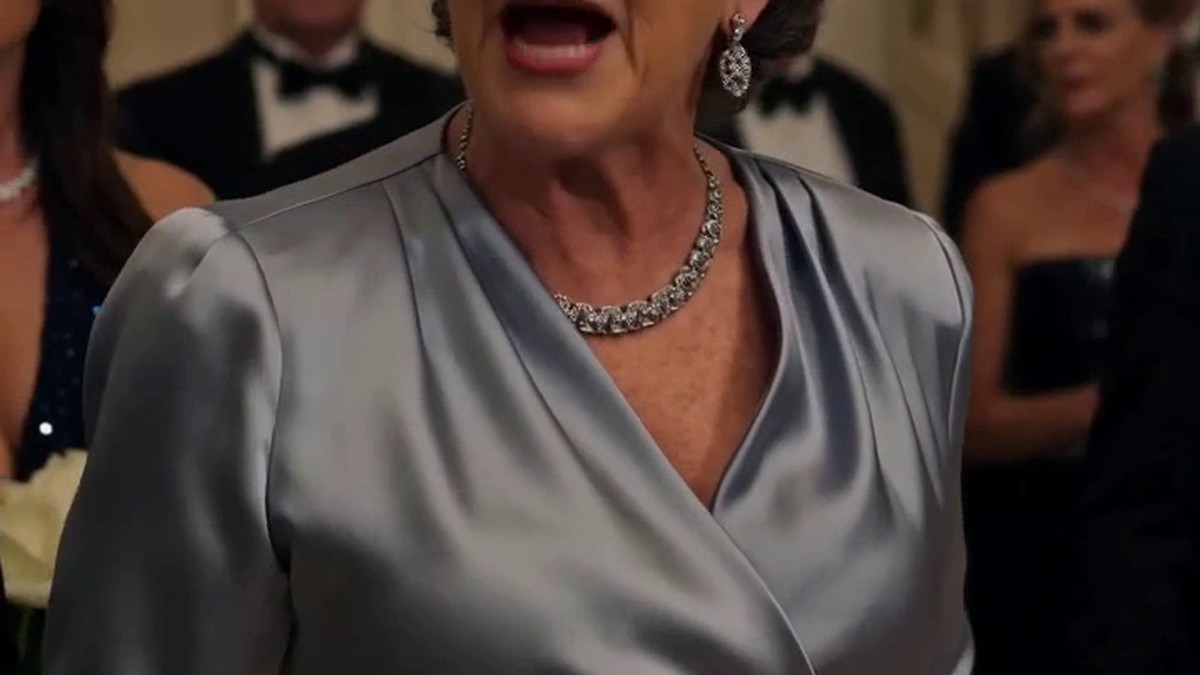
Cornelia was patting her silk gown, her face the color of cold oatmeal. “I had it right here on the console table. I took it off before my speech. Now it’s vanished.”
Her husband, Conrad Brooks, the kind of old-money brick wall who could silence a room with a single glance, stepped forward. “Nobody leaves this room.”
The ballroom doors thudded shut. Waiters backed against the walls. Eli’s heart began to drum against his ribs.
It took about sixty seconds for the stares to land on him. The kid in the faded windbreaker. The one with sneakers that left tiny gravel marks on the polished floor. The outsider.
“You,” Conrad said, pointing a thick finger. “Come here.”
Eli didn’t move. His tongue was stuck to the roof of his mouth.
“He was near the console table,” a woman in emeralds whispered loudly. “I saw him loitering.”
Maisy must have slipped inside when she heard the commotion, because suddenly she was pressed against his side, her small fingers digging into his sleeve. “What’s happening?” she breathed.
Before Eli could answer, Conrad Brooks’s head of security—an ex-cop with a shaved head named Rafferty—crossed the room in five long strides.
“Empty your pockets, son.”
“I didn’t steal anything.”
“Empty them. Now.”
Rafferty didn’t wait. He grabbed the front of Eli’s jacket and plunged his hand into the right pocket. The room held its breath.
He pulled out a glittering silver brooch shaped like a teardrop, studded with aquamarines.
Maisie’s whimper was the only sound.
Eli stared at the thing in the man’s palm. His brain refused to make sense of it. He’d never seen it before. It wasn’t there when he’d put his gloves in that pocket twenty minutes ago.
“Call the police,” Conrad Brooks said, his voice flat and final.
Maisie started to cry. Not a loud, messy crying—a terrible, shaking silence with tears cutting tracks down her dusty cheeks.
And then Eli saw him. Over by the kitchen door, half hidden behind a tower of champagne flutes, Conrad’s nephew Tripp was twirling a single lily between his fingers. A lily. From Eli’s centerpiece. The same one Eli had placed on the table not ten minutes before.
Tripp caught Eli’s gaze and smiled, slow and deliberate. Then he lifted the lily in a mock toast.
Eli’s stomach turned to ice. Tripp had done it. Tripp had slid the brooch into his pocket when Eli had bent down to adjust the table skirt. That must have been the moment—the little shove against his side he’d thought was just someone passing. And the lily was his sick little souvenir.
But saying it out loud would be worthless. Who would believe the word of a dirt-poor delivery boy against the nephew of Conrad Brooks?
“I’m telling you, officers,” Conrad was already on the phone, “we have the thief here in the ballroom. Yes, a juvenile. I want this handled.”
Maisie tugged at Eli’s arm. “They can’t take you, Eli. Tell them! Tell them about the flower guy!”
“He’s just a kid,” someone muttered, but without conviction. Most people looked away, embarrassed or satisfied.
Two uniformed officers arrived within minutes. They walked Eli toward the double doors, and that’s when Maisie broke free from a catering assistant who’d tried to hold her back. She darted into the center of the room, her pink sneakers sliding on the marble, arms waving.
“My brother didn’t do it! He’s telling the truth!”
Tripp sauntered out from behind the champagne tower. He’d tucked the lily behind his ear now, the smug twist of his lips turning into a public smirk. “Oh yeah? And how exactly are you going to prove that, little girl?”
The room went quiet. Even the officers paused, one hand still on Eli’s elbow.
Maisie didn’t flinch. She slowly raised her arm and pointed straight up, above the gilded double doors they’d just been about to walk through.
Everyone followed her finger.
In the corner of the ceiling, no bigger than a smoke detector, a tiny security camera blinked a steady red light.
“That camera,” Maisie said, her voice high and clear and trembling only a little, “has been recording everything since before we even got here. If we check the footage, you’ll see exactly who put that brooch in my brother’s pocket.”
A ripple of surprise went through the crowd. Tripp’s smirk flickered, just for a second.
Rafferty, the security man, frowned up at the camera, then at Conrad Brooks. “She’s… not wrong. The ballroom cameras are always on. And I’ve got the footage on a delay—should be accessible in the security office, or I can pull it up on my tablet.”
Conrad Brooks’s expression shifted from stone certainty to cautious confusion. “Do it.”
“Uncle, you can’t seriously believe this little—”
“Then you have nothing to worry about, do you?” Conrad cut him off, his eyes narrowing.
The next five minutes felt longer than the whole evening. Rafferty brought out a rugged tablet, tapped through some menus, and turned the screen so a small semicircle of guests could see. He scrubbed backward through the footage.
Eli stood frozen with Maisie’s hand gripping his, his heart hammering so hard he thought it might crack his ribs.
On the grainy feed, the ballroom was busy with pre-party chaos: waiters, florists, the quartet tuning up. There was Eli, carefully lowering the vase. There was the console table with the brooch gleaming under a small spotlight. Eli turned away to wipe his hands on his jeans. And there—clear as a movie—was Tripp. He strolled past the console, palmed the brooch in one fluid motion, and then shadowed Eli. As Eli bent to adjust a flower stem, Tripp’s hand dipped into the boy’s pocket, deposited the brooch, and withdrew, already reaching for the lily with his other hand.
Someone gasped. Another person let out a disgusted “Oh my God.”
Tripp bolted for the side door, but Rafferty was ready. He caught the man by the collar before he got three feet.
Conrad Brooks looked like he’d been punched in the gut. He walked over to Eli and Maisie, his face sagging. “I… I owe you a profound apology. What my nephew did is unforgivable. Whatever compensation you want, name it.”
Eli’s throat was too tight to speak. Maisie just shook her head. “We just want to go back to our mom.”
They walked out of the ballroom together, past the frozen string quartet, past the tables of untouched canapés, past the guests who suddenly couldn’t meet their eyes. The double doors swung open onto the cool Nashville evening.
Their mom, Nina, was standing by the van with a worried frown that melted into relief the second she saw them. “I heard sirens, what on earth—”
“It’s okay, Ma,” Eli managed, his voice croaky.
Maisie grinned up at her brother as they climbed into the back seat. The van smelled like roses and wet stems. She pointed two fingers at her own eyes, then toward his chest, mimicking the red camera light. “Told you.”
Eli let out a shaky breath that was almost a laugh. “Yeah, you did.”
The van rumbled to life. Through the window, they could see the lights of the Brooks mansion glittering behind them, growing smaller in the mirror.
Maisie leaned her head against Eli’s shoulder, her voice soft and certain. “The lens never lies.”