Jack froze inside the screen door.
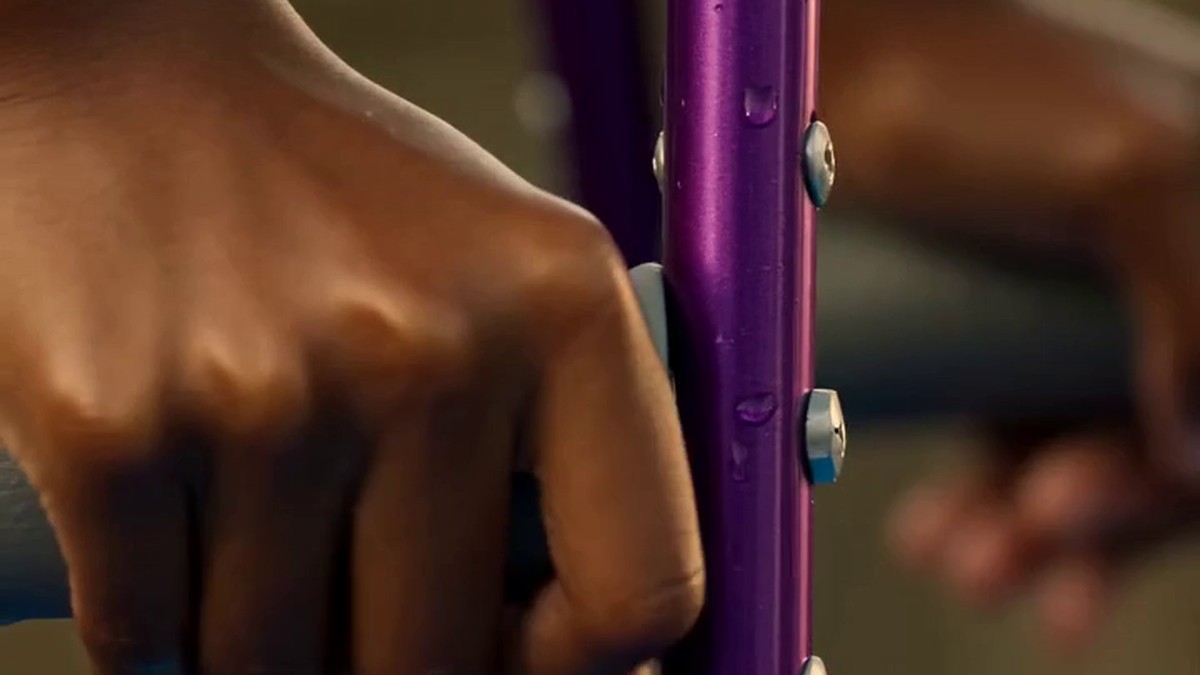
Through the warped mesh he saw his daughter standing upright in the blue plastic kiddie pool, the one Mrs. Velasquez had inflated last month. Lila’s pediatric forearm crutches were planted on the plastic rim, and her yellow sundress hem dangled in the water. She was trembling. Not from cold—the August sun was hammering the patio—but from the sheer effort of holding herself vertical on legs that had never, not once, borne her weight.
Beside her, Diego Velasquez crouched in the shallow water, his cartoon-taco t-shirt soaking wet. He had both hands wrapped around one crutch leg, stabilizing it. His eyes were wide and serious, the way kids get when they’re guarding a secret.
“Come on, just one more,” he whispered. “My mom said the water does half the work.”
Lila glanced toward the house. Jack instinctively flattened himself against the refrigerator. Her voice came out thin and urgent. “You can’t tell my dad. Promise?”
Diego crossed his heart.
Jack’s throat tightened. He should have stepped outside, should have demanded to know what the hell was going on. Instead he just stood there, not breathing, as Lila’s right foot lifted off the pool floor.
Time went thin. Her knuckles blanched on the crutch grips. Her calves quivered.
Then she put the foot down six inches ahead. *Plop.*
One real step.
The noise was so small it should have been nothing. To Jack it sounded like a thunderclap.
He backed out of the kitchen, eased the screen door shut without latching it, and walked straight to his truck in the driveway. He sat behind the wheel with the windows up and sobbed for the first time since Lila’s mother left.
—
The doctors had been clear from the start. Congenital hypotonia, they called it. Profound and nonprogressive. Basically, the nerves that should have told her muscles to fire were sending their signals through oatmeal. She’d sit, eventually. Maybe crawl. But walking? Weight-bearing ambulation? That was a long-shot prayer.
Nina, his wife, had absorbed that diagnosis like a physical blow and never recovered. When Lila was two, she’d packed a single suitcase and moved to Arizona. *I can’t watch her suffer*—the last thing she’d said. Jack hadn’t argued. Some part of him had already given up too.
But not the part that mattered.
He learned to lift Lila from the crib to the high chair, from the high chair to the car seat, from the car seat to the grocery cart. He got the job cleaning Oakdale Elementary at night so he could be with her during the day. He read every physical therapy manual he could check out from the library. He stretched her legs ninety times a day. He believed, or at least he pretended to. Mostly he just lifted her, again and again, until his lower back burned and his hands grew calluses in the shape of her small hips.
By age six, Lila could stand with support for about fifteen seconds. The purple forearm crutches arrived on her fifth birthday. She learned to pivot from the couch to the bathroom grab bar. But a real step—an unassisted, unsupported step—had never happened. A few months ago, the neurologist had used the word *plateau*.
Jack had nodded and said nothing. That night he’d thrown every baby photo album into the garage.
Then the Velasquez family rented the house next door. Diego was seven, loud, and apparently immune to awkwardness. Within a week he’d shown up at their porch with two half-melted popsicles and asked Lila if she wanted to see his pet turtle. Lila had been so startled by the directness that she’d said yes. Jack didn’t interfere. He was just glad someone finally saw his daughter instead of her crutches.
Mrs. Velasquez worked as a nursing aide at County General. One afternoon she noticed Lila’s legs and asked Jack a few careful questions. *Has she ever tried water therapy? Buoyancy takes off like seventy percent of body weight. I’ve seen it help with kids in the rehab unit. We have an old pool, the small kind. If you want I can set it up in the backyard.*
Jack had shrugged. *Couldn’t hurt.*
He figured it was just a way to cool off in the summer heat. He didn’t know.
—
After the first step, Jack started coming home early on Tuesdays and Thursdays. He told his supervisor it was a medical appointment. Every time, he parked down the block, crept into the shed, and watched through the dusty window.
He saw her second step. Then a third. One afternoon she took five, the crutches dragging uselessly behind her, Diego cheering in a frantic whisper. Jack’s chest ached with the effort of staying silent. He wanted to burst outside and grab her, but he understood the fragile alchemy of that backyard. This was a world she’d built without him, and if he broke it too soon, the spell might vanish.
He kept watching. Tuesday after Tuesday, his daughter’s body rewrote its own story. The leg that had never held her began to understand. The water caught her when she fell, and she fell a lot—face-first splashes, arms flailing, Diego hauling her back up by the armpits. But she always tried again.
Then came the day she walked the whole length of the pool.
Jack was in the shed, forehead pressed to the glass, when Diego let go of the crutch entirely. Lila took a breath, her ribs sharp against her soaked dress, and moved. One foot, then the other, a slow, deliberate shuffle. She made it four feet before her knees buckled, but she had done it—water or no water, she had moved upright through space without anyone holding her.
Diego howled. “Mr. Jack! Mr. Jack, come see!”
He was already running. Barefoot, across the lawn, no plan, no strategy. He hit the side of the pool so hard the water sloshed over the rim.
Lila looked up, her face a collision of terror and pride. “Daddy, I—”
“I know, baby.” His voice came out in pieces. He stepped over the plastic ring, shoes and all, and knelt in the tepid water. “I know.”
Her chin crumpled. She reached for him, dropped one crutch, fell forward, and he caught her. She was shaking harder than that first day, full-body sobs that had probably been dammed up for weeks. Diego fished the purple crutch out of the pool and laid it gently on the grass.
Jack held his daughter and soaked his jeans and didn’t say a single useful word. It didn’t matter.
—
They didn’t stop after that. The pool sessions became daily, then twice a day. Mrs. Velasquez brought over a larger ring, the kind with a built-in seat that they never used. Diego’s job shifted from co-conspirator to water-spotter. Jack took over the leg stretches. He’d stand in the pool for an hour after work, Lila gripping his forearms, her feet discovering the tiny adjustments of balance.
By late September, she could stand on the lawn for eight seconds without support. A month later, thirty seconds. The purple crutches began spending more time leaning against the fence than under her armpits.
On the last warm Saturday of October, Jack was raking leaves when Lila appeared at the backdoor. No crutches. She gave him a look he couldn’t quite decode—something between a dare and an offering.
He set the rake down.
From the porch, she took one step. Then another. Her arms floated out like tightrope walker’s, and her concentration tightened every muscle in her face. Diego had materialized on his side of the fence, stone-still for once. Mrs. Velasquez stood behind him, one hand over her mouth.
Jack didn’t move. He understood now that this was her show, and all he had to do was be there.
Step. Step. A wobble that made his stomach drop, but she recovered. Step. Step.
She crossed six feet of cracked concrete, stepped off the edge into the grass, and kept coming. The final yard she half-walked, half-fell, and he caught her, same as always, except this time he hadn’t needed to lift her. She had arrived.
Her voice was muffled against his flannel shirt. “I did it.”
“You did,” he said.
She smelled like dry leaves and the last of the sunscreen. He looked over her head at the empty purple crutches by the fence, at the deflated kiddie pool with its ring of dead grass underneath, at Diego hopping up and down on the other side of the chain link.
Jack pressed his face into his daughter’s hair and didn’t let go for a very long time.