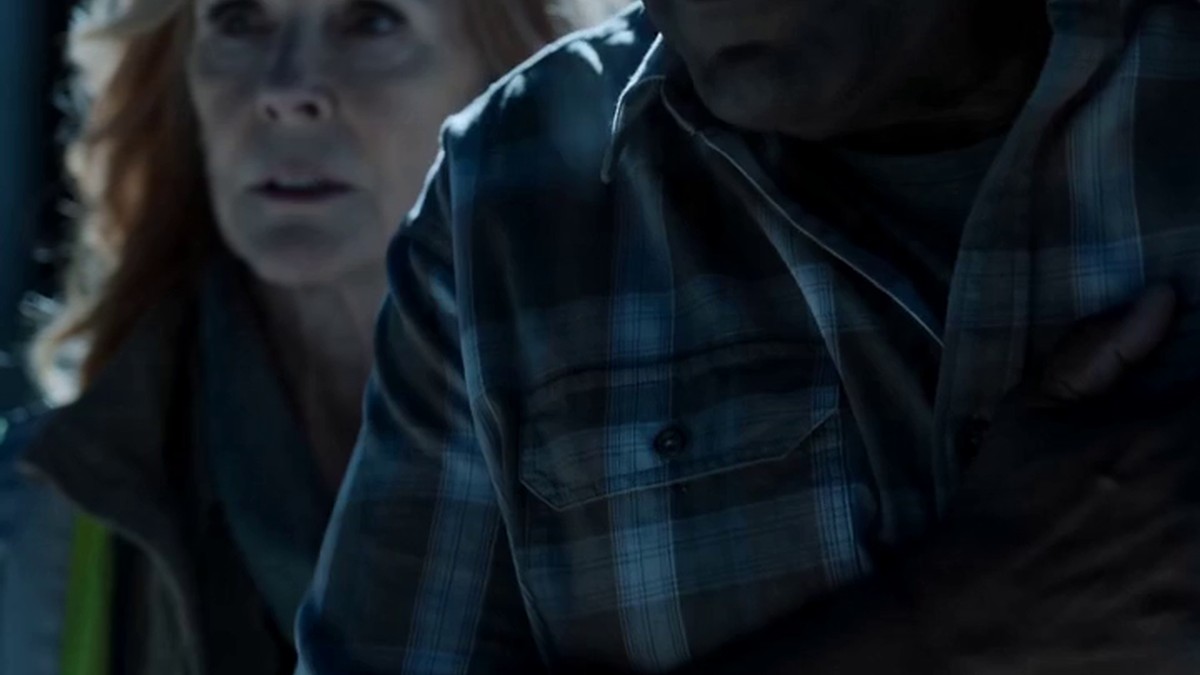
Diane had driven ten hours through Oregon rain and California sun, her hands stiff on the Outback's wheel, the passenger seat holding a Tupperware of cherry tomatoes from her garden. She hadn't called. A surprise, she told herself. Marcus had been complaining about restaurant food, and she knew he didn't eat vegetables. Spiteful, her therapist might call it. Diane called it being a mother.
The condo building on Valencia Street smelled like floor wax and someone else's dinner. Third floor. Her key turned. The door swung open on a kitchen island cluttered with two plates, two wine glasses, a crumpled napkin smeared with lipstick the color of a bruise.
She heard laughter from the bedroom. Female. Diane set the tomatoes on the counter next to the wine glasses.
Marcus emerged in boxer shorts, saw her, and his mouth went slack. Behind him, a woman in one of his button-down shirts padded barefoot across the hardwood.
"Mom. You should've called." His voice had the flat irritation of a man caught at nothing.
"I did." Diane's hand found the strap of her purse. She squeezed until the leather creased. "Three times. You were busy."
The woman crossed her arms. "You must be the mother. I'm Meredith. I've heard so much."
"No, you haven't," Diane said. "Because my son doesn't know how to talk about anything real."
She turned, opened the door, and left the tomatoes on the counter.
The drive home took ten and a half hours because she pulled over twice. Once at a rest stop south of Redding, where a vending machine offered her a Snickers and she just stood there, feeding quarters to the slot, listening to the rain on the roof. Once on the shoulder outside Medford, where the dashboard read 3:47 AM and the car smelled like wet hay because she'd left the window cracked.
Howard called her cell at 6:12 AM. She saw his name on the screen.
"What."
"Diane." His voice was huskier than usual, but then, he'd been smoking again despite the blood pressure. "I need you to listen to me. The will."
"I'm not talking about your will at six in the morning."
"I changed it." A pause. She heard paper crinkle. "Diane, I changed it last month. After I found out about the girl in San Francisco."
Diane's foot eased off the gas. The Outback slowed on the wet interstate. "You knew?"
"I've known. I didn't know if you did." Another pause. He coughed, and she heard the rattle deeper than bronchitis. "I put conditions in. Marcus gets fifty-one percent only if he commits. Five years at the company. Otherwise—"
"Otherwise what?"
"Otherwise it's yours. And you decide."
Diane pulled over to the shoulder. Her hands were shaking on the wheel. "You're telling me this now? At six in the morning? On the phone?"
"I'm telling you because I don't know how long I've got." The paper crinkled again. "I know I wasn't what you needed. I know that. But I built something. And I won't watch him take it to sell off for that woman."
"Where are you?"
"Site."
"Go to the hospital."
"I'm fine. Just—" His breath caught, a short hitch like a hiccup, then steadied. "Diane, don't let it go."
The line went dead. She called back twice. Both times it rang through to nothing.
She called 911 from the shoulder outside Medford. Told them where the construction site was. Portland. North Marine Drive. Near the rail yard. Then she called Hannah.
Hannah answered on the second ring, her voice blurry with sleep. "Diane? What's wrong?"
"Go to the kitchen. Now. Wake Grace."
"What's—"
"Do it."
Hannah did. Diane heard bare feet on the floor, then a light switch. Then Grace's voice, small and cross: "Nana? It's still dark."
Diane's hands were still trembling on the wheel, but her voice came out flat as stamped tin. "I need you to call Marcus. Tell him Howard collapsed at the site. Tell him I'm on my way home."
The line was quiet for a long moment. Then Hannah said, "Did you find her?"
Diane closed her eyes. "Yes."
"You weren't going to tell me."
"I didn't know how."
"He's my husband." Hannah's voice cracked. "You should've told me."
"Get in the car. Go to the hospital." Diane ignored the question. "I'll be there in four hours. Don't let him sign anything before I get there."
Hannah didn't answer. Diane heard Grace ask for Cheerios.
Four hours later, Diane walked into a hospital waiting room that smelled like floor polish and old coffee. Hannah sat in a plastic chair, Grace asleep in her lap, her thumb in her mouth. Hannah's eyes were red. Grace's crayon drawing of a house sat curled on the seat beside her—a house with a yellow door and a heart-shaped window, the kind of house Hannah had once pointed to on Market Street and told her daughter, *someday that'll be ours.*
"The doctor said it was a cardiac event. By the time the paramedics reached the site, there was nothing to do. The dispatcher told me the response time out there runs eighteen, twenty minutes on a good day."
Diane lowered herself into the chair next to Hannah. The seat was still warm from someone else's body. She stared at the muted TV in the corner—some morning show, a chef flipping pancakes too high.
"Where's Marcus?"
Hannah shook her head. "On his way from San Francisco. Should be here by noon."
"Did you tell him about Howard?"
"I told him his father died." Hannah's voice had a razor edge. "He asked about the will before he asked about the arrangements."
Diane didn't react. She'd known her son would do that. What she hadn't known was how it would feel to hear it from Hannah, who was just starting to learn what kind of man she'd married.
They waited. Grace woke up and asked for a vending machine orange juice. Diane gave her two crumpled dollar bills and watched her run off down the hall, socks slipping on the linoleum.
The will reading happened four days later, in a conference room at the construction company's office on North Vancouver Avenue. The walls were paneled in honey oak, and the smell of diesel wafted in from the equipment yard every time someone opened the door.
Marcus arrived late. He'd flown back from San Francisco the day before and gotten a hotel room downtown rather than stay with Hannah and Grace—a choice nobody mentioned but everybody noted. He wore a gray suit and no tie, and he exuded a kind of restless energy that Diane recognized from Howard's worst years: the energy of a man counting money in his head.
The lawyer, a thin woman named Carla Reyes, read the will aloud. Howard had been thorough. The house in Southeast Portland—the one Diane and Howard had lived in for thirty years—went to Diane. The truck, the equipment, the contracts—all to Diane. The cash reserves, estimated at $210,000, to Diane.
Marcus shifted in his chair. "So where's mine?"
Carla Reyes adjusted her glasses. "There's a provision for you, Marcus. Your father's fifty-one percent of the company—"
"Fifty-one percent?"
"—is contingent. You must serve as COO under the mentorship of Jim Halpern for a period of five years. If you complete the term, the shares transfer to you. If you decline, or if you fail to meet the terms, the shares are placed in a trust for Grace, with your mother as trustee."
Marcus's hands went flat on the table. He pushed back from it, chair scraping. "That's not legal. You can't put conditions on inheritance like that."
"You absolutely can," Carla Reyes said. She didn't look up from the papers. "Your father did."
"I'll contest it."
"What would you be contesting?" Carla asked. "The will is valid. Witnesses, notary, it's all here."
Marcus turned to Diane. In the fluorescent light, he looked like Howard—same sharp jaw, same mouth that had forgotten how to apologize. "Are you really going to do this? Cut me out?"
Diane raised her head. "I'm not cutting you out. I'm honoring what your father wanted. Take the job. Five years. Keep your marriage. Keep Meredith in San Francisco—"
"It's not that simple."
"Oh, it is." Diane's voice didn't rise. She had spent eleven years learning to speak evenly to a man who couldn't hear her. "You wanted nothing to do with the company when your father suggested law school. You got your own way. Now you want the money without the work." She paused. "There's a third option. Renounce the shares. Sign them over to the trust for Grace. Walk away with nothing and go do whatever you want with Meredith."
Marcus stood. His chair fell over behind him. "You don't get to do this. You and Howard—you were miserable together. You stayed for the money, and you know it. Don't pretend this is about principle."
Diane's fingers wrapped around her purse. She felt the worn leather, the same strap she'd squeezed in San Francisco. Inside the purse was a folded piece of paper—the funeral program, still creased from the service. She hadn't thrown it away yet.
"You're right," she said. "I stayed for a lot of reasons. Money was one of them." She opened the purse, took out the funeral program, and smoothed the crease with her thumb before setting it face-down on the table. "You were another. I don't regret it." She held his gaze without blinking. "Howard left you a choice. Make it."
Marcus's jaw worked. He looked at Hannah, who sat in the corner with Grace's crayon drawing of the house on Market Street in her lap. Hannah didn't look back.
"I need time," Marcus said.
"You have seven days," Carla Reyes said. "After that, the shares automatically go into the trust. It's written in."
Marcus picked up his chair, set it upright. He walked to the door, stopped with his hand on the handle.
"You know what he was?" He didn't turn around. "He was a bully who loved the company more than he loved anybody. You just didn't want to see it."
He left.
Diane sat in the conference room for a long moment. The diesel smell had faded. The fluorescent light hummed. Hannah hadn't moved.
"He wasn't wrong," Hannah said. Her voice was small. "About Howard."
"I know." Diane swallowed. "But he loved the company because it was the only thing he could control. And he loved you and Grace by leaving you something. That counts as something, doesn't it?"
Hannah didn't answer. She folded the crayon drawing in her lap—the house with the yellow door and the heart-shaped window, the one on Market Street.
Diane's phone buzzed. She looked at it. A text from Meredith.
"Marcus told me everything. He's going to fight it. You should know, we're not going anywhere."
Diane typed back: "Good. Then you'll both lose together."
She deleted it.
Instead, she texted Carla Reyes: "Draft the trust papers. And prepare the deed transfer for the Market Street house. Hannah's name."
Carla's reply came three minutes later: "The one Howard put in your name eleven years ago? $418,000 assessed. You want to transfer it to Hannah outright?"
"Yes."
"That's Hannah's to do with as she pleases?"
Diane looked at Hannah, who had set the drawing down and was now tracing the outline of the heart-shaped window with her fingertip.
"She'll know when the time comes."
Six days later, Marcus arrived at the law office to announce he'd decided. He hadn't slept—Diane could tell by the dark crescents under his eyes, by the way his shirt was wrinkled, by the to-go cup from Dutch Bros he kept turning in his hands.
"I'll take the job," he said. "Five years. I'll do it."
Diane reached into her purse. She pulled out the deed, already notarized, folded in a cream-colored envelope with Hannah's name written on the front. She set it on the table between them.
"That's good," she said. "Because the job starts tomorrow. Jim's expecting you at 7 AM at the North Marine Drive site. Wear boots."
Marcus looked at the envelope. "What's that?"
"The Market Street house. Your father put it in my name eleven years ago, back when he still worried I'd need somewhere to go. I'm transferring it to Hannah."
His face went through three emotions—confusion, then anger, then something that looked almost like hurt. "That's not half of the community property. That's a separate asset."
"It was mine to give. I can do what I want with it."
"You're giving her the house and I'm working five years for a company that might not even be worth anything by the time I get control of it?"
"Then the trust gets it." Diane's voice stayed level. "That's the choice you made by taking the job. Work the five years. Save your marriage. Or walk away and the shares go to Grace. Those are the only two paths on the table."
Marcus's hand opened and closed on the Dutch Bros cup. The plastic lid popped off, and coffee splashed on the table—light brown, smelling of burnt sugar. He didn't move to wipe it up.
"So that's it. You've managed to tie everything to my marriage. To Hannah. Who won't even look at me."
Hannah was sitting in the corner again, same chair as the will reading. She'd brought Grace's drawing again, but this time it was rolled up like a little scroll. She didn't say anything.
"Your marriage," Diane said, "is the only part of your life that hasn't been for sale. Don't make it about leverage."
Marcus stood. He looked at Hannah. "You could stop this anytime. You know that."
Hannah's voice came quiet as rain on a windshield. "No, Marcus. I couldn't."
He walked out. The coffee soaked into the papers on the table, smearing the ink on Carla Reyes's notes.
Hannah unrolled the drawing and signed her name on the bottom corner with a pen from her purse. Then she wrote something else beneath her signature, small and careful: the address on Market Street, the one with the yellow door, the house she'd shown Grace from the sidewalk a dozen times before either of them knew it would ever really be theirs.
The next morning, Diane woke before the alarm. She sat at the kitchen table with her coffee—black, no sugar—and watched the neighbor's dog, a Portie named Banjo, chase a sprinkler across the lawn at exactly 4:30 AM. The dog barked three times, then lay down in the wet grass, tongue out.
Diane's phone buzzed. A text from Jim Halpern, the COO: "Marcus showed up. 6:58. Boots on. He's walking the site with the foreman. Didn't say a word to anybody. We'll see."
Diane set the phone down. She looked at the photo on the fridge—a snapshot of Howard at a job site, arms crossed, hard hat pushed back. She'd taken it eleven years ago, back when she still thought she could want him and hate him in equal measure and call it a marriage.
The drain in the kitchen sink gurgled—one more thing she'd meant to fix. The disposal still made that grinding noise, the one that set her teeth on edge. She'd told Howard about it once. He'd said, "I'll get to it." He never did.
Diane got up, opened the cabinet under the sink, and pulled out the small wrench she kept there. She knelt on the cold tile and tightened the connection where the pipe met the disposal. It wasn't a fix. It was just something to do with her hands.
Then she washed out her mug, left it on the drying rack, and went to wake Grace.
She had a drawing to take to the office. The one with the heart-shaped window, now signed by both of them.