We Left Our Old Dog Behind for Five Years. When We Came Home, He Looked Straight Through Us—and a Stranger Had Changed Everything.
The gravel crunched under the tires as Tom pulled the rusted Subaru to a stop. Maggie was already out the door before the engine died, her eyes sweeping the property. For a long moment, neither of them spoke.
The gate was new. The split-rail fence had been mended and stained a deep cedar, and the flower beds along the driveway burst with black-eyed Susans and cosmos. Rows of tomato plants stood staked and heavy with fruit. The old boathouse down by the lake had fresh shingles.
“Someone’s been living here,” Maggie whispered, her voice tight.
Then they saw him.
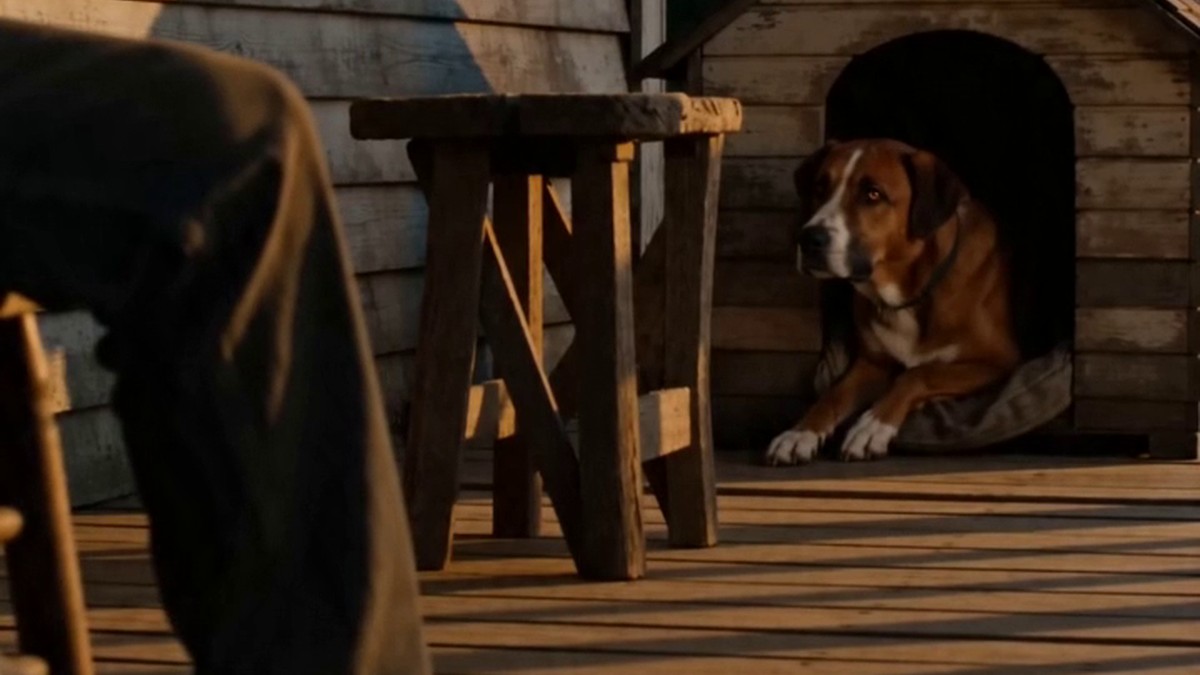
Hank lay on the porch of the cabin, his grizzled muzzle resting on his paws. He was a liver-spotted hound mix, thirteen years old now, the white of his face spreading like frost. He lifted his head, and his amber eyes settled on them—blank, unblinking. No tail thump. No lopsided grin. Just a steady, almost suspicious gaze.
“Hank? Hey, buddy.” Tom took a cautious step forward.
The old dog’s ears twitched. He didn’t move.
“Hank, it’s us,” Maggie tried, her voice cracking. “Come here, boy.”
The dog yawned, deliberately, and looked away toward the lake as if they were nothing more than a shift in the wind.
Five years earlier, they’d packed their lives into six suitcases and flown to London. Tom’s tech startup had offered a relocation package, and after years of scraping by in upstate New York, it felt like the break they’d been praying for. The cabin on Lake Henry was their sanctuary, but it couldn’t pay the bills. They’d promised Hank—then eight, stiff in the hips but still chasing geese—that this was temporary. A year, maybe two.
Carla, a neighbor two miles down the road, had taken the envelope of cash and the spare key. “I’ll look after him like he’s my own,” she’d said, patting Hank’s head. She’d smiled and waved as they drove away.
For the first few months, Maggie called weekly. Carla always sounded chipper: Hank was eating well, the cabin was fine, no worries. Then the calls got shorter. Then she stopped answering altogether. Their emails bounced. The guilt sat in Maggie’s chest like a stone, but London was a machine that chewed them up—endless work hours, visa stress, the slow death of the startup. They were broke and exhausted when their work permits finally expired, and with the last of their savings, they bought tickets home, certain they’d find the cabin in ruins and Hank long gone.
Instead, the place was immaculate.
Tom pushed open the cabin door. It swung easily, the hinges oiled. Inside, the pine floor was swept clean. A cast-iron pot sat on the woodstove, half-full of stew that still smelled of rosemary and lamb. There was a cot in the corner with a neatly folded wool blanket, a stack of firewood by the hearth, and jars of preserved peaches on the windowsill. On the rough-hewn table, under a chipped coffee mug, lay a folded piece of paper.
Maggie opened it with trembling hands. The handwriting was a careful, blocky print:
*Hank is your dog, but he earned better than what you gave him. He’s been fed, loved, and kept warm. Don’t expect him to remember you. — Ellis.*
“Who the hell is Ellis?” Tom snatched the note, reading it twice.
Outside, Hank hadn’t budged. He let out a low, rumbling sigh and closed his eyes.
They drove into town and stopped at the Lakeside General Store, where an older woman named Brenda was arranging jars of honey. When Maggie showed her the note, Brenda’s eyebrows rose.
“Ellis? You mean the hermit up by Hemlock Creek? Strange bird. Keeps to himself. But I’ve seen him hauling bags of dog food down your road for years. Most folks thought he was some kind of hired caretaker.”
“Does he have a phone? An address?” Tom asked.
Brenda shrugged. “Just follow the creek past the old logging trail. You’ll find a shack. He’s probably there.”
The path was narrow, spongy with moss. After twenty minutes, they came to a small, listing cabin with smoke curling from a stovepipe. The yard was tidy, with a chopping block and a neatly stacked cord of wood. Before they could knock, the door opened.
Ellis was lean and weathered, somewhere in his fifties, with eyes the color of slate and hands cracked from years of outdoor work. He wore a faded flannel and didn’t seem surprised.
“You found the note,” he said, not a question.
Maggie stepped forward, clutching the paper. “We wanted to thank you. And… we want to understand. Why did you do all this?”
Ellis considered them for a moment, then gestured inside. The shack smelled of pine resin and coffee. He poured three cups without asking, then sat heavily on a wooden crate.
“I moved up here after my wife and daughter died,” he said, voice flat. “Car accident. I couldn’t stomach the city anymore—the noise, the pity. Granddad left me this place, so I came to be alone. That was six years ago.”
He took a sip of coffee. “About four, four and a half years back, I was hiking and heard whining near your place. Found Hank tied to the porch, ribs showing, water dish bone-dry. I checked with that Carla woman down the road—she told me you’d paid her, but she’d stopped coming months before. Said the dog wasn’t her problem.”
Maggie’s face crumpled.
“So I started bringing him scraps,” Ellis continued. “Then winter hit, and I couldn’t stomach the thought of him freezing, so I built him a shelter. Figured I might as well fix the fence while I was there. Then it seemed a waste not to plant the garden. Hank followed me around like a shadow. He was all I had, and I was all he had. That kind of thing doesn’t happen overnight, but it sinks in deep.”
Tom stared at the floor. “We thought… we thought she would take care of him. We wanted to come back sooner.”
Ellis set his cup down, the clink sharp in the silence. “You left him. You told him he was family, then you disappeared for five years. You came back to a pretty garden and a healthy dog, and you think you deserve gratitude?”
Maggie opened her mouth, but no words came.
“We’re sorry,” Tom said, his voice raw. “We were stupid and scared and broke. We want to make it right. Whatever you’ve spent, we’ll repay you. Please.”
Ellis shook his head slowly. “I don’t want money. I want you to understand that the dog sleeping in that kennel out there isn’t the same one you left. He mourned you. For months, he waited at the gate. Then he stopped waiting. I’m the one who held him through thunderstorms. I’m the one he trusts. You’re strangers to him now.”
A sob escaped Maggie. Ellis’s expression didn’t soften, but he exhaled through his nose.
“You want to make it right? Don’t leave him again. But don’t expect him to forgive you on your schedule. He’ll decide.”
They walked back to the cabin under a sky streaked with violet. Hank was still on the porch, watching. When Maggie crouched and held out her hand, he rose, circled away, and settled under a pine tree twenty feet off.
The weeks that followed were a quiet sort of penance.
Every morning, Tom sat on the back steps with a cup of coffee and spoke to the dog as if he were a confessor. He talked about the tiny London flat, the loneliness, the way he’d stare at photos of Hank on his phone and feel his throat close up. Maggie cooked the foods Hank used to love—chicken livers, beef stew, rice with a little gravy—and set the bowl down, then retreated to the porch swing to give him space.
Ellis came by daily. He never knocked, just appeared at the fence line with a bag of carrots or a coil of rope, and Hank would explode into a frenzy of wagging and spinning, pressing his whole body against the man’s legs. The contrast was a blade in Maggie’s ribs, but she said nothing.
One evening, as Ellis was patching a loose board on the woodshed, Tom walked over.
“Stay for dinner,” Tom said.
Ellis hesitated, then nodded once.
Dinner became a routine. Then breakfast, too. They’d eat on the screened porch while the lake turned gold and frogs chorused from the shallows. Hank always lay at Ellis’s feet, but after a few weeks, something shifted. During a quiet meal, the old dog rose, shuffled over to Tom, and sniffed his hand. Tom held his breath. Hank gave a single, deliberate lick and nudged his knuckles. It wasn’t ecstatic. It was a question.
A few nights later, Maggie woke to the click of claws on the wooden floor. Hank stood in the doorway, silhouetted against moonlight. He crossed the room, circled twice, and settled beside the bed with a contented grumble.
In the morning, she found her hand resting on his ribs, his breathing slow and even.
One afternoon in October, Ellis mentioned that his shack’s roof was leaking and the insulation was shot. “I’ll board it up for the winter, maybe head south,” he mused, more to himself.
Maggie and Tom exchanged a glance.
“Move in here,” Maggie said. “We’ve got the guest room. It’s warm. There’s a bathroom. And Hank would be miserable without you.”
Ellis stared at her as if she’d suggested he fly to the moon. “You’d do that? After everything?”
“You kept our dog alive for five years,” Tom said. “You gave him a life when we gave him a grave. You’re family now, whether you like it or not. Please.”
Ellis’s jaw tightened. He looked down at Hank, who was leaning against his shins, tail sweeping the floorboards. For the first time since they’d met him, something broke behind his eyes—not anger, but a raw, disbelieving hope.
“All right,” he said quietly. “I’ll try.”
That evening, as the first frost silvered the grass, the three of them sat on the porch with mugs of cider. Hank was sprawled across the threshold, his head resting on Tom’s boot. He sighed in his sleep, and one paw twitched, chasing rabbits in a dream.
Forgiveness didn’t arrive with a parade. It came in the small hours, in the nudge of a nose against a palm, in the slow thaw of a broken trust. The cabin wasn’t just filled with the scent of stew and pine anymore—it held the quiet miracle of second chances.
And the old dog, the one they’d abandoned and almost lost, finally closed his eyes knowing everyone he loved was under one roof.