The Dog Who Learned to Forget
Melanie Harper dropped her suitcase in the dirt and froze at the gate. The old farmhouse sat bathed in the hazy Vermont afternoon light, its roof intact, its windows clean. None of that registered yet. All she could see was the dog.
Jasper lay on the porch, blocky and massive, a brindle coat now flecked with heavy gray around his muzzle. His amber eyes tracked hers without a flicker of warmth. No tail thump. No scramble of paws. Just a flat, unblinking stare.
"Jasper, baby… it’s us." Her voice cracked halfway through.
Travis set his own bag down, the weight of five lost years pressing on his shoulders. "Jasper. Come on, boy. Look."
The dog turned his head deliberately toward the locked front door, as if guarding something far more important on the other side. He didn’t growl. He didn’t need to. The silence was louder than any bark.
Five years earlier, Travis had gotten the call from his brother in Toronto. Construction work was booming. Great pay, benefits, a clear shot at residency for the whole family. They’d been drowning in medical debt after Melanie’s surgery, and the offer felt like a lifeboat. They’d sat at their tiny kitchen table, running the numbers, and every column ended in the same cold truth: it made sense.
Jasper was already pushing nine. His hips were stiff, his face a road map of silver hairs. Travis imagined the cargo hold of a plane—the roar, the pressure, the cold, the terrified old dog locked in a plastic crate among suitcases.
"He won’t survive the flight," Travis had said, the words tasting like ash.
Melanie had nodded, not meeting his eyes. "Probably not."
They’d made arrangements with Travis’s aunt, a retiree named Donna who lived a few towns over and had always doted on Jasper. They left her six months’ worth of cash, spare keys, a prepaid phone card, and a typed list of Jasper’s medications. Donna had hugged them at the airport, squeezed Jasper’s collar, and promised to drive out every other day.
"We’ll be back in a year," Travis had whispered, scratching that sweet spot behind Jasper’s ear. "Two at the most. You be good, old man."
Jasper had licked his hand, tail sweeping the driveway gravel, and watched the car disappear with the innocent trust that only dogs possess.
Toronto was a punch to the gut. Travis’s brother had exaggerated. The work was piecemeal, the winters brutal, the basement apartment they rented a claustrophobic tomb. The kids struggled in school, their American accents marking them as outsiders. Melanie cleaned office buildings at night. Travis hung drywall for cash under the table. Their visas lapsed, then expired. They slipped through the cracks, invisible.
Melanie called Aunt Donna religiously for the first four months. Donna answered, breezy and reassuring. *Jasper’s fine, hon. Eating like a horse. I’ll send a photo.* The photo never came. The calls got shorter. Donna stopped answering entirely around month eight. Melanie left voicemails that went unreturned, then the number was disconnected. They had no other family back home.
"Maybe she’s just… busy," Travis had offered weakly. "Or her phone broke."
Melanie had stared at the ceiling all night, her jaw clenched.
Five years blurred into survival. When Travis’s last contractor gig vanished and their expired documents left them one worksite raid away from disaster, they packed everything into two duffel bags and caught a Greyhound south across the border. They told themselves they were going home. Home was the old Harper farmhouse on ten wooded acres, bought by Travis’s grandparents and passed down half-heartedly through the family. No one else had wanted it. It was all they had left.
"Jasper’s probably gone," Melanie had whispered on the bus, somewhere near Albany. "He was old five years ago."
Travis hadn’t answered. He’d braced himself to find a grave, maybe to dig one and say a prayer over it, to close a chapter he’d been too ashamed to face.
But the gate didn’t sag. The fence didn’t lean. The gravel path was raked. Rows of tomato plants, staked and watered, ran straight along the south side of the house. The apple tree by the barn had been pruned with clean, professional cuts. A solid wooden doghouse—new, insulated, roofed in cedar shingles—sat in the shade. Next to it, a steel bowl held the remnants of what looked like beef stew, still faintly warm.
"Someone’s been living here," Melanie said, her voice barely a whisper.
Travis pushed the gate. It swung soundlessly on oiled hinges. They walked to the house. The front door was unlocked. Inside, the kitchen was spotless. A cast-iron pot on the stove held lentil soup. A sleeping bag lay folded on a simple cot in the corner, a stack of worn paperbacks acting as a nightstand. Mason jars of preserved peaches lined the counter. On the table, a loaf of sourdough, a dish of butter, and a folded piece of paper under a chipped coffee mug.
Travis’s hand trembled as he unfolded it. The handwriting was deliberate, blocky, written with a heavy hand in pencil.
*The dog is yours. But he deserves better owners than the ones who left him. — Eli.*
Melanie read it over his shoulder and pressed her hand to her mouth. "Who the hell is Eli?"
They didn’t sleep inside the house that night. It felt like trespassing. They unrolled their sleeping bags on the porch. Jasper ignored every call, every whistle, every offering of jerky from their travel rations. He slept in the doghouse—Eli’s doghouse—and in the morning, when Melanie tried to approach him with a bowl of water, he rose stiffly and walked to the far corner of the property without looking back.
At dawn, Travis hiked down the road to the nearest neighbor, a birdlike widow named Mrs. Applegate who had lived there since before the Harper kids were born.
"Eli?" she said, squinting at him from her screen door. "Eli Vance. Lives up in the hollow past Beaver Creek. Keeps to himself. Does odd jobs, carpentry mostly. Sweet man, but private. Only person he ever talks to is that dog of yours. Been lookin’ after Jasper since the first winter you all left."
Travis found the trailhead she described—a narrow path carved through blackberry brambles, clearly walked regularly. He and Melanie followed it half a mile into the deep woods until the trees opened into a small clearing. A saltbox cabin stood there, its logs chinked with fresh mortar, a neat woodpile stacked against one wall. A man sat on a stump, shaping a axe handle with a drawknife. He looked to be in his early fifties, with a dark beard streaked gray, steady hands, and eyes the color of creek stone.
"You found the note," he said. Not a question.
"We wanted to thank you," Melanie started, stepping forward. "And to ask… why?"
Eli set down his knife and motioned them inside without ceremony. The cabin was sparse but warm. He poured strong black tea into enamel mugs and settled onto a hand-hewn bench.
"I was married once," he said, staring into the steam. "Had a son, a house in Burlington, a desk job processing insurance claims. A life so normal it bored me senseless. Then my wife met someone else. The divorce gutted me. She got the house, the savings, full custody. I got supervised weekend visits, and then my son stopped wanting those. I just… drifted off the map. Came here because it was the only property my grandfather left that no one cared enough to sell."
He paused, rubbing a knot out of the wood grain of the table. "I found Jasper about three months after you left. November. First frost. He was chained to the porch post, no shelter, his water frozen solid, ribs showing. I talked to Mrs. Applegate. She told me about the aunt who was supposed to be caring for him. She’d stopped coming by October."
Melanie’s hands curled into fists. Her voice came out raw. "We… we didn’t know. The phones stopped. We were stuck. I—"
"I’m not telling you this to shame you," Eli said, his tone flat but not cruel. "I’m telling you because you asked. I brought him food. Then I built him that house. Then it was spring, and your garden was dead, so I turned the soil. Figured the land shouldn’t go to waste. Jasper followed me everywhere. Guarded me while I worked. Slept on my feet." His voice finally cracked, just a hair. "He… made it easier. Being alone."
"Five years," Travis said, the weight of it crushing him. "You did this every day for five years."
"Most days." Eli shrugged. "After a while, it wasn’t a chore. It was just… my life. Him and me."
Melanie leaned forward, her chair scraping the wood floor. "We want to pay you, Eli. Please. Whatever you’ve spent, whatever your time is worth—"
"No." The word was quiet but absolute. "Money’s not what I’m after. Besides…" He looked past them, out the small window toward the distant Harper roofline. "You two seem like you’re still scraping bottom. I’ve been there. Doesn’t feel right."
Travis dropped his head. "Then at least come have dinner with us. Breakfast, coffee, anything. You’re part of this now."
Eli shook his head. "I don’t think I am."
"Why not?"
"Because that dog chose me when no one else was there. And now I’ve brought you back to him. To Jasper, that’s not a gift. That’s a betrayal." He held Travis’s gaze, not angry, just sad. "You told yourselves he wouldn’t survive the plane ride. So instead, he survived five winters alone. Waiting. He’s not going to forgive that just because you showed up with soft voices."
The silence that followed was a physical thing. Melanie covered her face. Travis’s jaw worked soundlessly, his eyes glassy.
"What do we do?" Melanie finally managed.
"Stop leaving," Eli said. "That’s it. Be steady. He’ll either forgive you, or he won’t. Dogs don’t forget. But sometimes, they choose to start over."
The next weeks ground by in a slow, painful rhythm. Jasper ate the food they put out, but he slept in Eli’s doghouse every night. He greeted Eli with wild leaps and whimpering joy, tail a blur, a performance of pure love that stabbed Melanie’s heart every time. With her and Travis, he was a ghost. Polite. Distant. He’d take a treat from Travis’s palm and then walk away, as if the transaction was complete and nothing more was owed.
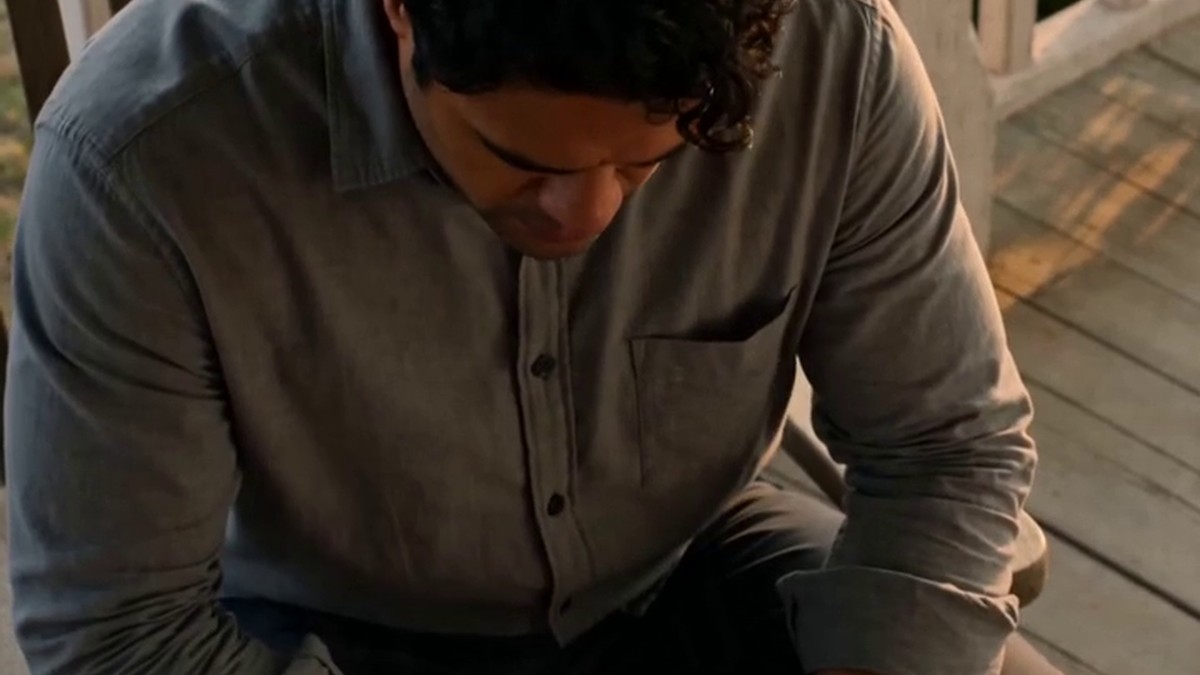
Travis started a ritual. Every morning at sunrise, he’d sit on the porch steps with a mug of coffee, not touching the dog, not calling him, just talking into the cool morning air. He told Jasper about Toronto. About the basement apartment that smelled like mildew and fried onions, about the boss who yelled at him in a language he barely understood, about the nights he lay awake staring at a water stain on the ceiling, hating himself. He told Jasper how he’d picturing the old farm, the smell of cut grass, the sound of the creek. How he’d imagined walking this land with a brindle dog at his side, and how the fantasy had kept him going when everything else felt like drowning.
Jasper would lie ten feet away, head on his paws, ears swiveling. He never reacted. Except, slowly, he stopped walking away.
Melanie cooked. She stewed chicken livers with rosemary, baked sweet potato rounds, fried little patties of ground beef and oatmeal that she left cooling on the porch. She never hovered, never tried to force contact. She would just set the plate down, whisper "good boy," and retreat.
A month passed. Eli visited every few days, and those visits were excruciating and necessary. They watched Jasper fall over himself with joy for this quiet man who had, in their absence, become the center of his universe. But Eli was patient, too. He’d sit with Travis, drink tea, and gradually, haltingly, they learned about each other. About loss. About failure. About the fragile, terrifying act of starting over.
One morning, as Travis lowered himself onto the porch steps, Jasper didn’t stay at his usual distance. He rose, stretched his aching hips, and walked closer. Not all the way. Maybe five feet. But he looked at Travis. Really looked. And let out a small, gruff *woof*.
Travis held his breath. He extended his hand, palm up.
Jasper took a step. Then another. Then he closed the distance and pressed his cold, wet nose into Travis’s waiting palm. A great shudder ran through the dog’s body—not fear, just release. He didn’t wag his tail. Not yet. But he lay down with a groan, his warm flank pressing against Travis’s thigh, and closed his eyes.
From the kitchen window, Melanie watched, her hand pressed flat against the glass. A sob she’d been holding for five years finally broke free.
By the time the leaves turned, Eli’s visits had melted into something like permanence. He’d arrive for breakfast and stay through dinner, fixing a broken gutter or patching the barn roof while Jasper shadowed his every step. The dog had found a new equilibrium: wild, joyous adoration for Eli, and a quieter, deeper, slowly healing bond with Melanie and Travis. It wasn’t the same as before—it would never be the same—but it was real.
One evening, the three humans sat on the porch in the twilight, citronella candles flickering against the mosquitoes. Jasper lay at their feet in a complex sprawl, touching all three of them at once. Eli cleared his throat.
"Winter’s coming," he said. "My cabin’s drafty, and the road washes out past the creek. I was thinking… maybe I could build a small workshop in your back field. Stay seasonally. Help with the garden in spring."
Melanie and Travis exchanged a look. Then Melanie leaned forward and said, "Eli, why don’t you just move into the spare room? Permanently. We have the space. We’ve talked about it."
Eli looked stunned. "You don’t even know me. Not really."
"We know you kept our dog alive when we failed him," Travis said. "We know you walked through the snow with stew bones when you could’ve stayed warm in your own bed. We know Jasper loves you, and honestly, we trust his judgment more than ours at this point." He let out a shaky breath. "We’re trying to do right. To fix what we broke. And part of that is admitting we need help, too."
Eli stared at the warped wood of the porch floor for a long, heavy moment. Then he nodded once. "Okay. We’ll try it. If it doesn’t work, I’ll head back to the hollow. No hard feelings."
Jasper lifted his leonine head and looked from Eli to Travis to Melanie. His tail stirred against the floorboards. Then, for the first time since they’d come home, it rose and wagged—slow, deliberate, and entirely on purpose.
Forgiveness doesn’t arrive with parades or grand apologies. It arrives on a cold morning when you least deserve it, when an old dog who has every reason to turn away decides, instead, to rest his head on your knee. It arrives in the quiet trust of closed eyes and a heavy sigh. It arrives when you finally stop running, and stay.