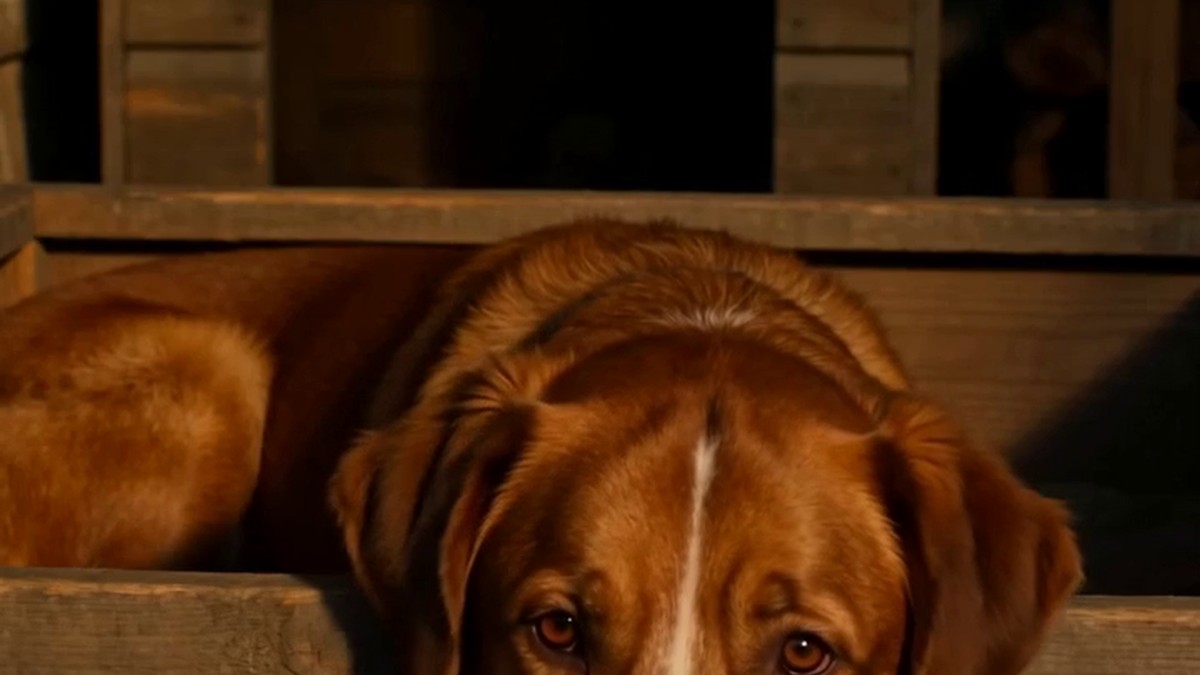
They Left Their Old Dog at the Lake House for Five Years. When They Came Back, Nothing Was as They Expected.
The crunch of gravel under the tires stopped, and the engine ticked into silence. Claire Russell didn’t move. She stared through the bug-splattered windshield at the cabin, her hand frozen on the door handle.
Gus sat on the porch like a monument. The old golden retriever’s muzzle was almost white now, his amber eyes fixed on the car with a stillness that hollowed her out. No tail wag. No trembling recognition.
“Gus?” she whispered, stepping out.
He didn’t shift. His ears flicked once, catching the sound of her voice, but his gaze held the same flat appraisal you’d give a stranger.
Her husband Tom came around the car, his duffel bag dragging in the dirt. “That can’t be him.” Then, softer, “Gus? Come on, buddy.”
The dog turned his head away and stared at the heavy wooden door of the cabin, as if guarding something invisible inside.
Five years back, Tom’s sister Phoebe had called from Munich with an offer that felt like a life raft: a project manager role at a biotech firm, a visa, a subsidized apartment. Their bank account was bleeding, and two kids meant private school they couldn’t afford. The numbers added up.
But Gus was already twelve. Hip dysplasia had stolen the bounce from his stride, and he slept most afternoons with a rhythm of pain they’d learned to read. Flying him in cargo across the Atlantic in a crate, in the dark, amid the roar of engines — Tom said aloud what they both already knew.
“The trip would kill him.”
Claire nodded, not meeting his eyes. They made arrangements with Tom’s cousin Diane, who lived an hour away. Handed her a fat envelope of cash, a spare key, a feeding schedule. Diane promised to drive out twice a week.
The day they left, Tom crouched and scratched behind Gus’s ear. “We’ll be back before you know it. A year, tops.” Gus licked his wrist. The retriever had no way of knowing it was the last human touch he’d feel for a very long time.
Munich was not the postcard they’d imagined. The apartment was cramped, the language barrier a daily bruise, the contract extensions a series of thin financial ice. Every month Claire called Diane, and every month the answer was the same: “He’s fine. Eating. Runs in the yard.” Then after six months, Diane stopped answering altogether. Calls went to voicemail. Texts went green.
“Maybe she changed her number,” Tom said one night, while Claire lay awake counting ceiling cracks. She said nothing.
The evisceration came slowly. After five years, when Tom’s company downsized and the visa renewal stalled, they piled their lives back into suitcases and flew home on the last of their savings. On the plane, Claire whispered, “Gus is probably gone by now.” Tom pressed his lips together until they whitened.
When their rental car pulled up to the lake house, the sight that met them was impossible.
The split-rail fence was mended, gate swinging on lubricated hinges. A flagstone path, swept clean, led to the porch. The dock down by the water showed fresh boards. A vegetable garden sat in neat rows — tomatoes, beans, lettuces — all weeded and watered. Beside the porch stood a new doghouse, insulated, roofed with fresh shingles. Next to it, a metal bowl with the dregs of cooked oats.
“Someone’s been living here,” Claire breathed.
Tom pushed the door. It swung open without a sound. Inside, the cabin smelled of pine soap and broth. A pot of cold soup sat on the stove. A cot in the corner, a folded wool blanket, rows of jam jars on the table. And a torn piece of brown paper under a mug, in handwriting she didn’t recognize:
_Your dog is yours. But he deserves better people. — Martin_
Claire pressed her palm against her mouth. Tom slumped into a chair, the note trembling in his fingers.
That evening, Gus wouldn’t come to them. He slept in the strange doghouse. When Claire approached with a strip of chicken, he rose stiffly and walked to the far end of the property, into the trees.
At dawn, Tom trudged up the path to the Henderson’s place, their only neighbor. Mrs. Henderson, a laconic woman in her seventies, squinted at the name.
“Martin? Martin Ford. He’s got that old hunting shack back past the spring. Hermit type. Keeps to himself. The only soul he ever spoke to was your dog. Took care of him all these years, I think.”
Tom and Claire walked through the birch grove that afternoon, following a footpath carved by a single set of boots and paws. The shack was small and warped, but the woodpile was stacked with precision, and the yard was swept. A man in his late fifties stepped out. Gray-streaked beard, hands like burlap, eyes the color of the lake under storm clouds.
“You found the note,” he said. Not a question.
“We want to thank you,” Claire started, her voice cracking. “And we want to understand.”
Martin led them inside and poured tea into mismatched cups. He stared at the window for a long moment before he spoke.
“I used to have a whole life in Albany. Engineer. Marriage. House. Then the divorce came, and the court gave her everything. All I had left was this shack from my grandfather. So I moved out here. Felt like the world had erased me.”
He took a sip of tea. “I found Gus about two months after you left. I was mushroom hunting, and I heard this low whimpering. He was at your gate, ribs showing, water bowl dry as bone. Asked around. Neighbors said the owners went overseas, and a cousin was supposed to feed him, but she’d stopped showing up months before.”
Claire’s knuckles went white. Tom looked at the floor.
“I started bringing him scraps,” Martin went on. “Then I thought, winter’s coming. Built him a shelter. In spring, I figured the land would go wild, so I planted a garden. Gus followed me everywhere. Guarded me. I… I needed someone. And he needed someone.”
“For five years? Every day?” Tom’s voice was thick.
“Almost every day. It became something to hold onto. He’s a good dog.”
Claire pulled an envelope from her pocket. “We’ll pay you anything. Name a number.”
Martin shook his head, a sad flicker of something in his face. “I didn’t do it for money. And frankly, you don’t look like you have any to spare.”
“Then please, come for dinner,” Claire said. “Let us repay you somehow.”
“I can’t. Gus won’t let me.”
“What do you mean?”
Martin exhaled. “Because I gave you back to him. But he didn’t want you back. He wanted me. From his perspective, I’m the one who betrayed him.” He paused. “You thought the trip would kill him. But the five years waiting by a gate almost did.”
The silence that followed felt like a bell struck underwater.
That night, Claire sat on the porch steps and let the cold seep through her jeans. She found her phone and dialed Diane’s old number. It rang once, twice, and a man’s voice answered, gruff: “If you’re calling about Diane, she moved to Arizona three years ago. Don’t call again.” The line went dead. Claire didn’t cry; her body was too tired to produce tears.
The next days were a slow, painful geography. Gus would eat the food they put out, but he retreated to his doghouse before dusk. He walked himself through the woods, returning after dark with mud on his paws. Tom started a ritual: every morning, he’d sit on the grass near the doghouse, close enough to be present but far enough not to threaten, and he’d talk. About the years in Germany, about the shame that sat in his chest like a stone, about how he used to imagine Gus’s tail thumping on the kitchen floor when he couldn’t sleep. The dog lay with his back turned, but he didn’t leave anymore.
Claire cooked the things Gus used to love: beef shank, chicken livers, soft scrambled eggs. She’d set the bowl down and walk away ten steps, never crowding him. She did this every evening.
A month passed. One morning, as the sun broke over the lake, Gus didn’t look away when Tom sat down. He lifted his head, blinked slowly, and made a low sound in his throat — not a bark, a question.
“Gus?”
The old dog stood. One paw forward. A pause. Another. Then he closed the distance and pressed his cool nose into Tom’s palm.
Tom didn’t dare breathe. “You forgive us, boy?”
Gus didn’t answer, except to lower himself onto the grass and rest his gray muzzle on his paws. His tail gave one tentative swish, not joyful, not whole, but a start.
Martin began to visit that week. First for coffee, then for dinner. Gus would erupt when he saw him — leaping with a strength neither Claire nor Tom had ever been given, whining, licking the man’s face as if he’d returned from the dead. With them, he remained reserved, but slowly the ice broke into pieces. He’d sit at Claire’s feet while she chopped vegetables. He’d nudge Tom’s hand during long evenings on the porch.
One night, after Gus had fallen asleep on the braided rug inside, Martin set down his fork and said, “The shack won’t hold another winter. I was thinking of putting a trailer up on the east end of the lot, if you don’t mind. I could help with the garden, the dock repairs.”
Claire and Tom exchanged a glance that held the weight of five years. Then Claire reached across the table and said, “What if you just moved into the spare bedroom? For good?”
Martin looked up, startled. “Why would you want that?”
Tom answered, his voice raw. “Because you kept our dog alive when we didn’t. Because Gus loves you like you earned the right to be loved. And because we’re ashamed, and we want to do one thing right.”
Martin stared at his plate. Then he nodded once, the way a man does when he’s handed a chance he’d stopped believing in.
Gus, who had been dozing by the stove, lifted his head and looked at the three of them. And then, for the first time since Claire could remember, his tail wagged — a full, sweeping arc, as if to say, _Now you understand._
Now, mornings start with the weight of an old dog’s head on Tom’s chest. Gus sleeps on a wool mat by the fireplace, his dreams twitching with rabbits. Martin’s room is down the hall; the smell of fresh coffee ties the house together. On summer evenings, the three of them sit on the dock, and Gus lies across their feet, his breathing deep and easy.
Forgiveness doesn’t arrive with a parade. It comes quietly, in the dawn, when an old dog places his head on your knee and closes his eyes — trusting you again, even when every instinct told him not to. It’s a fragile, stubborn thing. And once you’ve been given it, you guard it with everything you have.