The steel door closed behind him with the kind of sound that lives in your teeth. Dominic Ryan stood in the center of the room, his orange jumpsuit sagging off shoulders that had shrunk two sizes since the trial. His wrists rested in cuffs chained to a leather belt, and his ankles were shackled so tight the skin above them had gone pale and hairless. The fluorescent lights overhead buzzed at a frequency that made the fillings in his back molars ache. In three hours and change, the State of Texas would put a needle in his arm and call it justice.
His last request had been one line on a prison form: *I want to see my dog.*
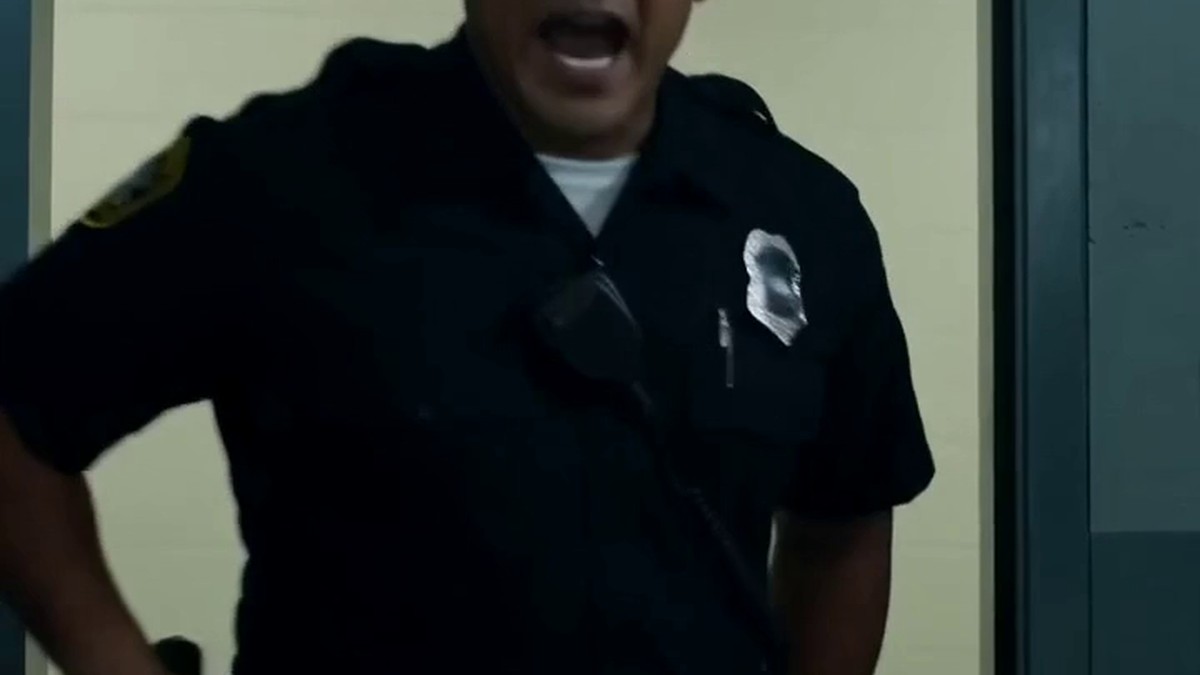
The room was a hollow box of cinderblock and Plexiglas. Normally the observation area behind the glass held a few stone-faced witnesses—lawyers, a chaplain, maybe a reporter if the case was loud enough. Today it was empty except for a single correctional officer, an older woman with a gray braid coiled beneath her cap, who stood with her hands clasped in front of her like she was already half an apology. A second guard, Rodriguez, leaned against the wall by the door, chewing cinnamon gum. He was the kind of man who complained when the chow hall ran out of hot sauce, but right now he wasn't saying a word.
Dominic's lawyer had fought for this. A washed-up public defender from Lubbock who drove a '98 Camry and still believed in things. She'd argued that the dog, Koda, was the only family Dominic had left—his parents were dead, his ex-wife had moved to Oregon with their daughter years ago and changed her last name. The warden, a man who kept a Bible on his desk and a bottle of Maker's Mark in the bottom drawer, had signed off after three weeks of deliberation. Something about a man's last hours, something about mercy.
When the side door opened and Koda walked in, Dominic's body forgot how to stand.
The dog was a Belgian Malinois, eleven years old, her muzzle an archipelago of white fur against tan. Her back legs had a hitch in them now, a slight sideways sway with each step, and her ears—once twin radar dishes—drooped at the tips. But her eyes had not aged a day. She paused just inside the threshold, lifted her nose, and sampled the air. Then she made a sound, low in her throat, not a bark and not a whine, something between them, and crossed the room.
Dominic went down on his knees so fast the chain between his ankles yanked tight and bit into bone. He didn't care. He leaned forward, wrists straining against the cuffs, and pressed his forehead to hers. Koda set one paw on his knee and then the other on his chest, and she pushed her head into the hollow of his throat and stayed there, her whole body trembling.
"You found me," Dominic said. His voice had rust in it. "You old girl. You still found me."
Rodriguez looked at the floor. The female officer, whose name tag read *M. Beckett*, turned toward the Plexiglas and stared at her own reflection, shoulders set stiff.
For a long minute, that was the whole world: a man and his dog, breathing the same air. Koda licked the salt from Dominic's chin. Her tail swung in a slow, deliberate rhythm, the way it used to in the back of the patrol car, after a long shift, when they'd stop at the Whataburger drive-thru and he'd feed her half his fries. Dominic cupped her face in his hands—as much as the cuffs allowed—and said things nobody else could hear, things that didn't need to be heard.
Then Koda's body changed. Her ears snapped up—not all the way, but enough. She pulled back from Dominic's chest and turned her head toward the far corner of the room, by the floor drain near the base of the wall. A sound began in her chest, a soft, urgent whimper, and she started toward the corner with her nose skimming the concrete.
"Hey," Rodriguez said, pushing off the wall. "Get the dog back."
Koda ignored him. She reached the drain, circled once, twice, and then began to scrape at the tile with her front paw, claws clicking frantically against the grout. The sound was unnerving—a hard, determined scratching, like she was trying to dig through six inches of cement.
"Ma'am," Rodriguez said, louder now. "Control your animal."
"She's not—" Dominic started, then stopped. He knew that posture. He'd seen it a hundred times on the job, back when he and Koda worked K-9 together for the Amarillo PD. She'd been trained in narcotics detection, but her real gift was tracking. She could find a shell casing in a cornfield at midnight. She could pinpoint a missing child's scent beneath two feet of snow, and she had, once, up near Dalhart, while the whole department held its breath. Koda didn't make mistakes. If she was digging at that corner, something was there.
Beckett stepped through the observation room door into the main space. "Sir, I need you to step back."
Dominic didn't move. "There's something under the floor. She's pointing."
"This is a death-row visitation room," Beckett said. "There's nothing under the floor."
Koda's paw caught the edge of a tile, and the whole square shifted, a quarter-inch of give that shouldn't have been possible. Her whimper turned into one short, sharp bark. Rodriguez's hand went to his belt. Beckett froze mid-step.
"What the hell?" Rodriguez said.
"Get the warden," Dominic said. His voice had changed. It wasn't rust anymore—it was steel. "I'm serious. Get the warden. Get my lawyer. Now."
Beckett looked at Rodriguez, who looked at the floor, at the displaced tile, at the dog still scratching with a focus that bordered on violence. Then Rodriguez turned and hit the intercom, and his voice came out tighter than he wanted.
—
Fourteen people gathered in that room over the next hour. The warden in his brown suit, clutching a styrofoam coffee cup he never drank from. Two maintenance workers with crowbars. A representative from the DA's office who kept checking his phone. Dominic's lawyer, Caitlin, who arrived out of breath and didn't bother to fix her hair. And Koda, lying at Dominic's feet, her job done, her tail giving one lazy thump on the floor every few seconds.
The maintenance crew pried up three tiles. Underneath, in a shallow pocket of dirt and dust that should not have existed in a sterile concrete facility, lay a ziplock bag yellowed with age. Inside the bag was a burner phone, a folded piece of paper, and a ring. The ring was gold, with a diamond chip so small it was barely visible, but Dominic recognized it anyway. It was the ring his wife had been wearing the night she was murdered—the night he was convicted of killing her.
The letter, when the warden unfolded it with gloved hands, was written in a cramped, frantic hand. It was a confession. The real killer—a man named Everett Cole, a drifter with a record of break-ins who'd died of liver failure in a Dallas VA hospital three years prior—had hidden the evidence in the one place no one would think to look: the room where he'd been brought for questioning after the arrest, during a chaotic hour when security protocols were loose and a maintenance shift had left the floor partially unsealed. He'd meant to retrieve it. He never got the chance. The letter named the right date, the right time, details that had never been released to the public, and the location of the actual murder weapon, buried under a shed in Randall County.
Caitlin read the letter three times. Then she sat down on the floor next to Dominic and started making phone calls.
The execution was stayed at 7:43 p.m., seventeen minutes before the scheduled time.
—
It took eight months to undo what had been done in three days of a rushed trial. Dominic walked out of the Ellis Unit gates on a Thursday morning in October, wearing jeans that didn't fit and a button-down shirt that Caitlin had bought at a Walmart on her way down from Lubbock. The air outside tasted like diesel and dust and everything he'd forgotten.
Koda was waiting in the backseat of Caitlin's Camry. When Dominic opened the door, the dog lifted her head, blinked sleep out of her eyes, and made that same low sound in her throat. He climbed in beside her, shut the door, and they sat like that for a while, not going anywhere.
"She's got arthritis in both hips now," Caitlin said from the driver's seat. "And some kind of kidney thing. The vet said it's manageable, but it's not cheap."
Dominic scratched behind Koda's ear. "How much?"
"For quality care? A few thousand a year, with the meds. Maybe more, long-term."
He nodded. He'd spent eleven years in a cell, but his police pension had been frozen, not forfeited. The money sat in a credit union account in Amarillo, untouched, accruing interest. $47,321.53, as of the last statement Caitlin had shown him.
"Take us to the vet," he said.
—
Canyon Animal Hospital was a low building with a tin roof and a sign that flickered even in daylight. Dominic walked in without an appointment, still in his too-big Walmart shirt, and asked for Dr. Massey. The receptionist started to say something about scheduling, took one look at his face, and picked up the phone.
Dr. Massey was a tall man with a quiet way of moving, the kind of person who listened before he spoke. He laid out the treatment plan on the exam table: monthly injections, a prescription diet, physical therapy sessions that could extend Koda's mobility by years. The estimate, printed on clinic letterhead with an itemized list, came to $12,880 for the first year.
Dominic pulled out his wallet and unzipped the coin pocket where Caitlin had tucked his ATM card that morning. He asked the receptionist for a pen. Then he signed two things.
The first was a payment authorization for the full $12,880, upfront, with a note in the memo line: *Koda—Year One*.
The second was a document he'd drafted by hand in the car on the back of a gas station receipt. It was a transfer of ownership and a trust, simple and binding under Texas law. In the event of his death or incapacity, all remaining funds in his account—the $47,321.53, after the vet bill—would go to a designated trustee for Koda's lifelong care, with Dr. Massey named as the executor. The trust was irrevocable. He named it the Koda Ryan Canine Trust, and he signed his full name with a steady hand.
Dr. Massey looked at the paper, then at the dog, then at the man. "You sure about this?"
Dominic crouched down. Koda leaned her weight against his knee. "She found me when I was buried," he said. "Least I can do is make sure she's never buried herself."
He picked up the clinic pen again and wrote one more thing on the bottom of the estimate: a secondary contact—Caitlin's name and number—with the words *Call her if I miss an appointment. She'll know why.*
Then he stood up, clipped Koda's new leash to her collar, and walked out into the desert sun, the dog at his side, the paper trail of everything he owned now carrying her name.