The dog’s name was Tuman—a big, shaggy creature the color of December slush. For eight years he had lived in the Zorin family’s yard, tethered to a drafty kennel by the woodshed. He was a courtyard dog, a working animal. Guard the gate. Bark at strangers. Pace the fence line. Nothing more was expected of him. He had arrived by accident: Viktor Stepanovich found a sodden cardboard box by the road, five puppies inside, only one still breathing—a trembling gray scrap. Viktor meant to drop him off at the farm, but his wife Nina Pavlovna pleaded to keep him. So he stayed. He grew into a silent, powerful dog who rarely barked without cause, who blocked the yard from intruders but greeted his own people with a slow thump of his tail against the packed earth. He was fed regularly, never lavished. A bowl by the porch, morning and evening. At night they unclipped his chain and let him roam the yard. Nobody petted him on purpose. They said his name the way you mention a shovel—Tuman, just Tuman. And he never asked for more, just lay beside his kennel, watching the house, waiting for someone to step outside.
That year, the Zorins rang in the New Year with a crowd. Children arrived from the city, grandchildren, in-laws. The house heaved with noise: pans sizzling, a goose bronzing in the oven, crystal bowls packed with salads. The air swam with the scent of pine needles, tangerines, and sizzling onion. The guests spilled in by midday. In the scramble, Nina Pavlovna whirled between stove and table, shouting orders. Viktor hauled jars of pickles from the cellar, and every time he passed the window, a gray shape was moving by the porch. But there was no time.
Tuman sat beside the empty bowl, snow piling on his back in fat, wet flakes. He didn’t shake them off. He stared at the lit windows, the shadows moving inside, the laughter and the clinking glasses filtering out. His tail tapped the snow whenever someone crossed the light. His bowl had been empty since lunch.
In the chaos, Nina Pavlovna forgot him. The goose needed basting, the grandkids darted underfoot, her son-in-law kept asking for things. She had been on her feet since dawn. Viktor, red-faced and unbuttoned, was toasting and arguing about fishing. Warmth, noise, people—it was good. Little Kolka, six years old, tugged his grandmother’s sleeve. “Where’s Tuman? Can we show him the tree?” “Later, later,” she waved. “Eat your food.” And Tuman dissolved from memory again.
Midnight. The clock struck twelve. Outside, fireworks cracked and sizzled, the sky bloomed red and green. Tuman flinched, ears pressed flat, but he didn’t leave his post. He sat, a snow-blurred sentinel, staring at the glowing house. By two in the morning the guests had collapsed into bedrooms and couches. One by one, the windows went dark. And the bowl on the porch stayed empty.
The blizzard hit before dawn. The wind shrieked, plastering snow against the glass, heaping drifts against the porch. The temperature plunged well below zero. Nina Pavlovna woke first, as she always did, groggy and heavy-headed. She shuffled into the kitchen, put the kettle on—and remembered. Tuman. Her heart lurched. She rushed to the window, jerked the curtain aside.
The yard was a blank white page. The kennel half-buried. No gray shape by the porch. Nothing.
She threw a fur coat over her nightgown, shoved her feet into felt boots, and stumbled outside. The cold bit her face. She circled the yard, peered into the kennel—empty. She called into the howling wind. “Tuman! Tuman!” Only the storm answered. Her throat tightened. He’d frozen to death. They’d left him to the merciless cold, forgotten like an old tool, after eight years of faithful service. The guilt was a physical blow. She was turning back when she saw the tracks.
They led from the porch not toward the kennel, but around the corner, toward the root cellar. The snow there was trampled and dug up. She followed, heart punching. Behind the house, sheltered from the wind by the wall of the lean-to, lay Tuman. He was curled on a bed of old straw against the low cellar window. And he was not alone.
Under the curve of the dog’s body, tucked into his warmth, was Kolka. Still wearing his pajamas, a thin jacket thrown over them, no hat, boots on bare feet. Alive. Dazed with cold, but alive. Tuman had wrapped himself around the boy, breathing heat into him. Nina Pavlovna’s scream shattered the morning.
Later, when Kolka was finally warm again, wrapped in blankets and sipping hot tea, they pieced it together. The boy had woken in the night, wanting to see the stars. He’d crept out through the mudroom without waking anyone. The door had swung shut behind him, the latch dropping into place. A six-year-old couldn’t open it from outside. He was trapped in the yard. In the killing cold. And no one inside heard his knocking, his cries, because every adult was sleeping off the feast. Kolka had hammered on the door until his hands went numb. He’d wept, terrified. And then Tuman had come. The dog had tugged him by the sleeve, pulling him away from the door, around the corner where the wind broke against the wall and a roll of straw lay. He had lain down, and the boy had pressed against him. All night, the dog had given him heat.
Viktor Stepanovich stood in the yard, coat thrown over his shoulders, and couldn’t speak. He stared at the frost on Tuman’s gray fur, at the dog’s weary, patient eyes. He remembered the cardboard box, the rain, the one tiny survivor. He remembered how he’d almost taken him to the farm. All those years, he’d walked past the kennel without stopping. He’d fed him, watered him, and given him nothing else. And this dog—this animal they’d treated like a piece of yard equipment—had saved their grandson while they slept, full and drunk.
Nina Pavlovna held Kolka, bundled in a blanket, tears sliding unstopped down her face. The boy poked his nose out. “Grandma, Tuman kept me warm. He’s good. He was cold too.” She looked at the empty bowl on the porch, the one that had been empty since the day before. She wiped her eyes with a trembling hand.
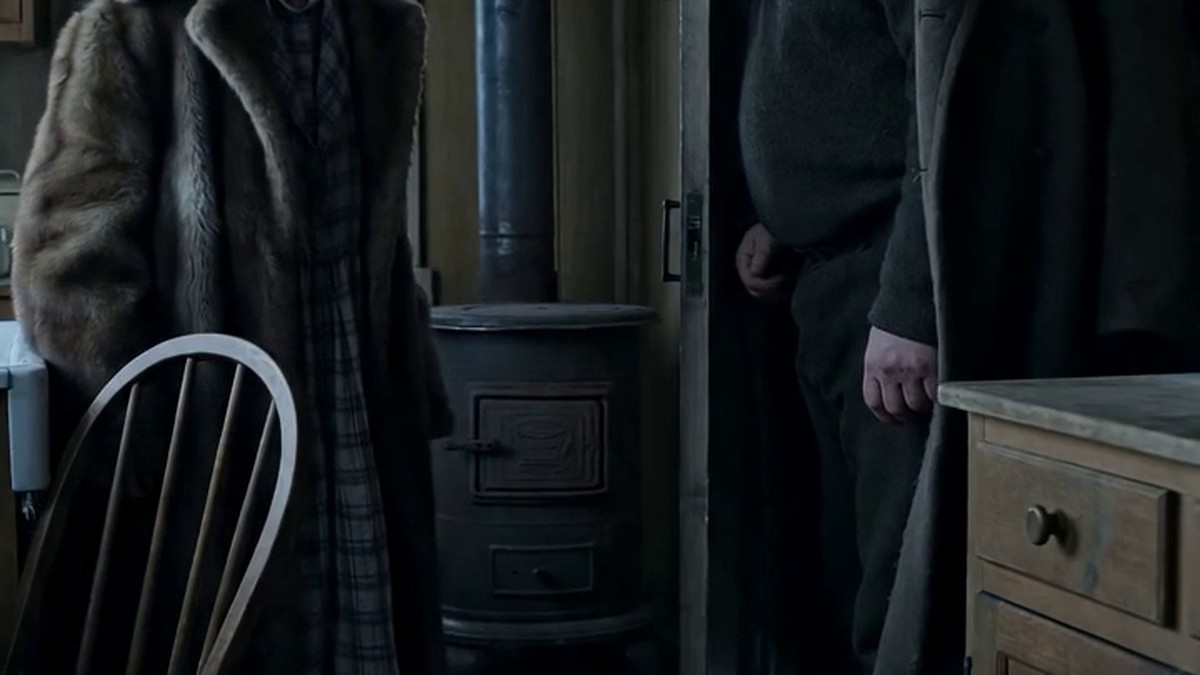
That day, Tuman was invited inside for the first time in his life. He moved across the clean floor like a trespasser, head low, glancing back as if expecting to be thrown out. They settled him on an old blanket by the stove. Nina Pavlovna herself carried a dish of food to him, right to his blanket, loaded with that same holiday roast goose. The dog ate slowly, eyes flicking up at the people around him. Kolka sat on the floor beside him, stroking his thawing fur.
Viktor sat on a stool near the stove, watching the dog, saying nothing. A man of few words, raised to keep his feelings locked away, he didn’t know what to do with the weight inside his chest. He just reached out and laid a palm on Tuman’s head. The dog closed his eyes. They sat like that—the man and the animal—and for the first time in eight years, there was something between them beyond duty.
The guests left subdued. At the gate, the father-in-law paused, looked back at the lit window where a gray head rested by the stove, and shook his head. “You’re lucky with that dog, Stepanovich. Damn lucky.”
Years unspooled. Tuman grew old. He no longer raced the fence; he slept more. But now he slept inside, on his blanket by the stove, and no one shooed him away. In winter, he wasn’t locked in the mudroom. In summer, he sprawled on the sunny porch, and when Kolka arrived on school breaks, the boy ran straight to him.
The story of that night spread through the village. Some came to see the dog. Some didn’t believe it. Viktor Stepanovich never bothered to convince anyone. Once, the son-in-law, out of habit, tried to shoo the dog off the couch where he lay next to Kolka. Viktor’s voice was quiet, but it cut. “Leave him. He’s earned that spot more than you have.” The son-in-law didn’t touch him.
Tuman’s bowl now stood inside, by the kitchen door, and Nina Pavlovna made sure it was never empty.
Another New Year’s Eve came. The Zorins gathered again, the house full of goose and tangerines and crystal salad bowls. But when midnight struck and the sky exploded with fireworks, Tuman didn’t sit alone in the snow. He lay by the stove, warm, with Kolka’s hand on his gray back. The dog flinched at the noise, but the boy whispered into his ear and stroked him until he settled.
Nina Pavlovna, pouring tea for the guests, stole glances at the old gray dog. *Forgive us, old friend. We took you in too late.* Tuman lifted his head from the blanket, looked at her with calm, ancient eyes, and lowered it again to his paws. He was warm. His bowl was full. He needed nothing more.