Jamila Reyes parked her ten-year-old Mustang under a flickering streetlamp. The engine ran on for a second after she pulled the key, a deep rattle she’d been ignoring for six months. February in Detroit. The air bit her face before she even shut the door.
She grabbed her bag from the passenger seat — leather worn slick at the handles, a gift from her father when she’d passed the State Department exam twenty-three years ago. The main parking lot at the Townsend Hotel in Bloomfield Hills was a glacier of black luxury SUVs and freshly salted pavement. She didn’t bother locking her car. The driver’s-side door handle was already broken on the outside. Anyone who wanted in was doing her a favor.
The lobby was all marble and soft jazz. A woman in a cream suit glanced at Jamila’s dark slacks and cardigan and looked away. Jamila had chosen the cardigan because it had actual pockets. She could keep her phone close and look like she didn’t have one.
She’d said yes to this job because it was ten grand for the day. She’d said yes because her last contract — a corporate training session in Ann Arbor — had canceled at nine p.m. the night before, and she’d already bought the workbooks. Her property tax bill sat on the kitchen table, unopened but not forgotten.
A man in a slim-cut suit appeared at the registration table. He held a clipboard like it was a weapon.
“You the translator?”
“Arabic. Twenty years. I’m Jamila Reyes.” She offered her hand.
Derek checked his phone. He scanned her from the flats to the gray-streaked bun, and his mouth flattened. “Okay. Follow me.”
—
The ballroom was a production. Fifteen round tables with centerpieces that cost more than Jamila’s mortgage payment. Three flag stands at the front — U.S., Saudi Arabia, and the company’s own logo. The main table was built for ten: six executives from a Michigan-based automotive design firm, four from the Saudi investment group. The deal sat triple-stamped in a leather portfolio at the CEO’s place setting.
Derek walked Jamila past all of it. Past the photographers checking light rigs. Past the finance people in matching navy suits. Past the young man with a set of $3,000 audio monitors, adjusting a microphone on a stand.
He stopped at a table shoved against the far wall, half hidden by a service door. A busboy was laying out butter knives.
“Right here,” Derek said. “You’ll be backup. We have our own interpreter.”
“I was told lead.” Jamila didn’t sit.
“Change of plans.” He was already tapping at his screen. “She’s younger, more… current. The delegation from Riyadh appreciates modernity. If the mics cut out, you’re here. Otherwise”—he waved a hand toward a tray of water glasses—“just stay out of the way.”
He was gone before she could tell him she’d interpreted for the Saudi Ministry of Commerce at the G20 in Brisbane. She’d negotiated engine-part tolerances in Riyadh and, once, a $340 million contract in Jeddah that had gone from hostile to signed in under four hours. She’d been in the room when men who controlled billions in sovereign wealth changed their minds mid-sentence, and she had been the bridge.
Jamila pulled out her chair. The busboy gave her a little half-smile, like they were in this together.
At the main table, the company interpreter was practicing. Zoe, according to the placard they’d set out before they’d realized the placard should have read Jamila. Zoe couldn’t have been more than twenty-six. Blond, sharp heels, red lipstick. She had a tablet open to a glossary and was mouthing vocabulary under her breath.
“Derek?” Zoe called, a thin edge of panic in her voice. “What’s *ijtihad* again? It’s in the term sheet.”
Derek didn’t slow down. “It’s fine. Work around it.”
Jamila’s thumb found a frayed edge on her book. *Ijtihad* — interpretive legal reasoning. The root word shared a lineage with *jihad*. In the context of a Sharia-compliant investment vehicle, it was the mechanism by which a board of scholars validated a novel financial structure. Say it wrong, and you’re not just sloppy — you’re asking men of faith to sign a contract that violates their moral law. She could have explained that to Zoe in forty seconds and saved the entire room from a disaster no one had warned them about.
Instead, Derek had said *work around it*.
The CEO, Gerald Vance, arrived with an entourage of four. He looked like a former football player who’d discovered Italian tailoring in middle age. Broad shoulders. Cufflinks shaped like gear shifts. He walked the room shaking hands, practicing his few phrases of Arabic — *as-salaamu alaykum* — with a fierce pride. He did not glance at Jamila’s table.
Neither did anyone else, until one person did.
—
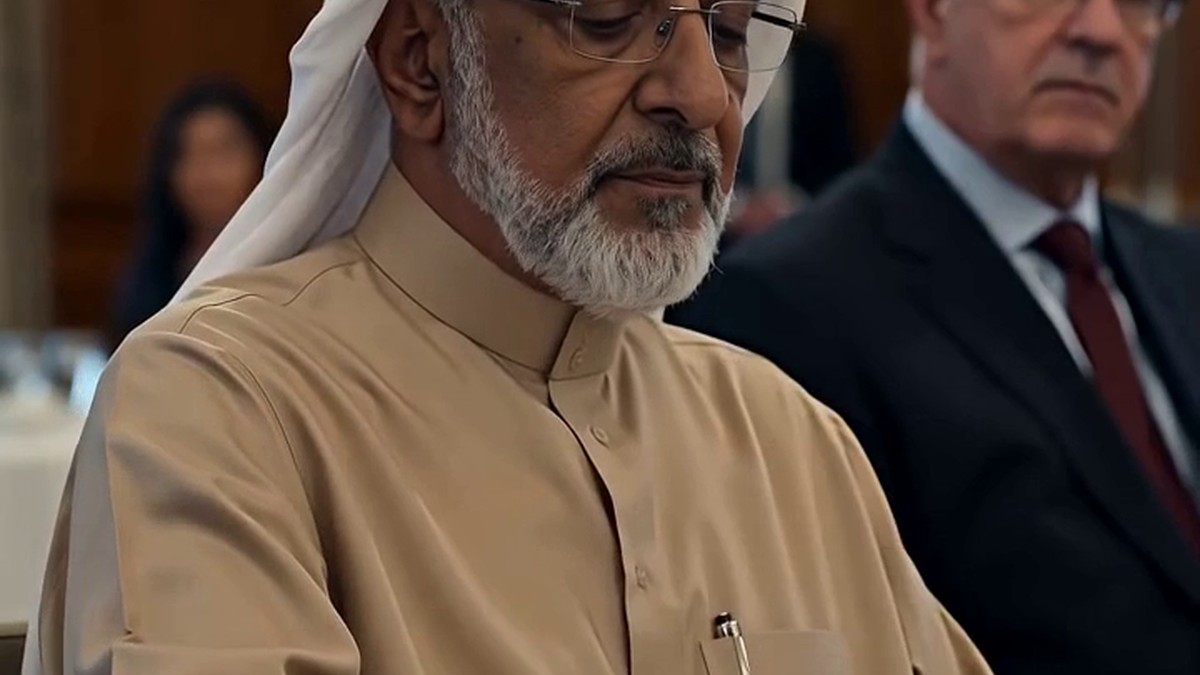
The delegation entered just after one-thirty. Three black Escalades, a quiet, efficient security team, and then Sheikh Tariq Al-Rashid. He was a lean, composed man with a short white beard and glasses that caught the light. He didn’t smile. He didn’t perform arrival.
Gerald stepped forward, big hand extended, booming his Arabic greeting. The Sheikh returned it softly. He gestured to an aide, a young man in a dark suit holding a tablet of his own, preloaded with the contract’s annexes.
Zoe sat beside the aide. Derek, standing behind her, gave a tight nod — *performance time*.
For the first ten minutes, the room was a ballet of polite nothingness. Coffee. Dates. Gerald said something about Michigan’s “global spirit.” Zoe translated it as “the great soul of the world.” The Sheikh’s aide blinked once, and Jamila, from across the room, took a slow, deep breath.
Then Gerald decided to get serious. He leaned forward, elbows on the white tablecloth, and launched into the financial architecture of the deal. Profit-sharing ratios. Liability windows. Early-withdrawal penalties in a joint venture where one side was bringing an entire electric-vehicle battery prototype and the other was bringing oil money seeking a green-tech foothole.
Zoe began to struggle before the end of his first sentence.
The trouble came when Gerald said *musharaka*. It was a cornerstone term in the contract, the basis of the whole arrangement: a form of partnership where profits are shared at a pre-agreed ratio and losses are borne according to equity contribution. Gerald said the word like he’d memorized it phonetically — *moo-SHA-rak-a*. Then he waited.
Zoe’s voice was small. She scanned her glossary. She tried a sentence that didn’t quite parse. The aide tilted his head, a tiny motion of non-comprehension. A junior VP at the next table looked up sharply.
Jamila set her book down on the linen. She had been translating *musharaka* deals before Zoe was old enough to hold a learner’s permit.
Gerald, trying to help, said it again, slower and louder. *Moo. Sha. Rak. A.* Like volume was the problem. Zoe’s second attempt was worse. The aide’s face went smooth and unreadable in the way of well-briefed staff who’ve just lost confidence in everyone at the table.
The Sheikh said nothing. He looked at Gerald. Then, calmly, he picked up his water glass and set it down again, a gesture Jamila recognized. It was the beginning of a polite exit strategy.
From the far table, Jamila spoke.
Not loud. Across the room and under the murmur of fifteen people pretending not to panic, her voice cut with the precision of a person who knows exactly how much air a sentence needs.
Arabic. Classical. The first line of a poem by Al-Mutanabbi — a poet any educated person in the Arabian Peninsula has known since childhood. She said it low, toward the busboy who’d just set down a tray of butter, but the acoustics of that ballroom carried the consonants to the main table like a bell.
The Sheikh’s head turned.
Sheikh Tariq Al-Rashid stood up.
Not a tall man, but the room rearranged itself around him. He held up a hand, and Gerald stopped mid-sentence. Derek’s face went the color of cold oatmeal.
The Sheikh walked the length of the ballroom. Past the finance table. Past the sound engineer, who killed his levels out of sheer instinct. He stopped in front of Jamila’s table, the one by the service door, the one with the bread baskets and the view of the kitchen.
He spoke to her in Arabic, quiet, almost amused.
“You read Al-Mutanabbi.”
“At university. Beirut, thirty years ago.” Jamila answered in Arabic that had none of Zoe’s tremble. Clean. Precise. The accent of someone who’d lived the language in boardrooms and hospitals and government halls.
The Sheikh studied her for a long moment. Then he turned and looked back at Gerald. Derek was frozen behind Zoe’s chair, one hand half-raised like he could pause reality.
In English, carefully, the Sheikh said, “Who is she?”
Gerald looked to Derek. Derek opened his mouth. Nothing came out.
Jamila answered for herself. “The backup translator.”
The Sheikh’s eyebrow rose maybe half a millimeter. He glanced meaningfully at the table she’d been seated behind — the one wedged between a swinging kitchen door and the PA system.
“Then you are in the wrong chair,” he said. He gestured toward the main table. “Sit with me.”
—
Walking across that ballroom floor felt like crossing from one life into another. Derek’s face — Jamila caught it in the corner of her eye — was a slideshow of calculation: what this would cost him with Gerald, what it would cost him if he tried to stop it, and how fast he could spin the story afterward. Zoe’s lips were pressed together, and she had the good grace to look ill. Smart girl. She knew she’d just been exposed, and she knew it wasn’t her fault.
Jamila took the seat beside the Sheikh. The aide had already cleared a space.
“His Highness would like to understand the profit-sharing clause as written,” she said to Gerald without being asked. “Specifically, the allocation of losses under Michigan corporate law when applied to a Sharia-compliant structure.”
Gerald stared at her for two seconds, then glanced at Derek with an expression Jamila couldn’t read — maybe anger, maybe relief. Then he nodded. “Let’s go.”
For the next three hours, Jamila did what she’d done for two decades. She translated not just the words but the intent behind them — the caution in Gerald’s hedging, the quiet authority in the Sheikh’s questions. When Gerald said “flexible timeline,” she said “a schedule subject to mutual agreement, not unilateral delay.” When the Sheikh raised an eyebrow at a liability provision, she gave Gerald the eyebrow before giving him the translation.
Halfway through, the Sheikh asked her — in Arabic, a side comment — where she’d learned the dialect of the Najd.
“Riyadh,” she said. “Two years. My children were small. It was not easy.”
He looked at her then with something warmer than respect. Recognition. The word for a woman who’d done hard work in a hard place was not *translator*. It was something closer to *survivor*.
By four o’clock, the contract was marked up, initialed, and set for final signing in thirty days. Gerald, who’d spent the last hour watching Jamila navigate a conversation that would have cost him forty-seven million dollars, looked like a man waking up from a strange dream.
The Sheikh rose to leave. He shook Jamila’s hand.
“You will come to Riyadh for the closing,” he said. Not a question.
“If my schedule permits.”
“It will.”
—
After the delegation pulled away and the room began its slow deflation — hotel staff clearing coffee cups, crew wrapping mic cables — Gerald walked over to Jamila.
He didn’t say anything at first. He just looked at Derek, who was hovering near the dessert cart, pale and useless.
“That man,” Gerald said quietly, “is no longer coordinating anything.”
Jamila shrugged into her cardigan. “That’s a personnel matter.”
“You knew *musharaka* before she knew what site her glossary was on. Why didn’t you say something?”
Jamila picked up her book, her bag, the three empty water bottles the busboy had forgotten. “I did,” she said.
She walked back through the lobby, out into the February dark. Her Mustang started on the second try. The heater coughed warm air that smelled like old coffee. She drove away from the Townsend without checking the rearview mirror.
When the full payment landed in her account four days later, she noticed that Gerald’s office had added a fifteen percent bonus. No note. No explanation.
She paid the property tax online. Then she bought a new driver’s-side door handle and a copy of Al-Mutanabbi’s collected works — not the old, yellowing edition with the torn spine. A hardcover, from a bookstore in Chicago, shipped straight to her door in Dearborn.