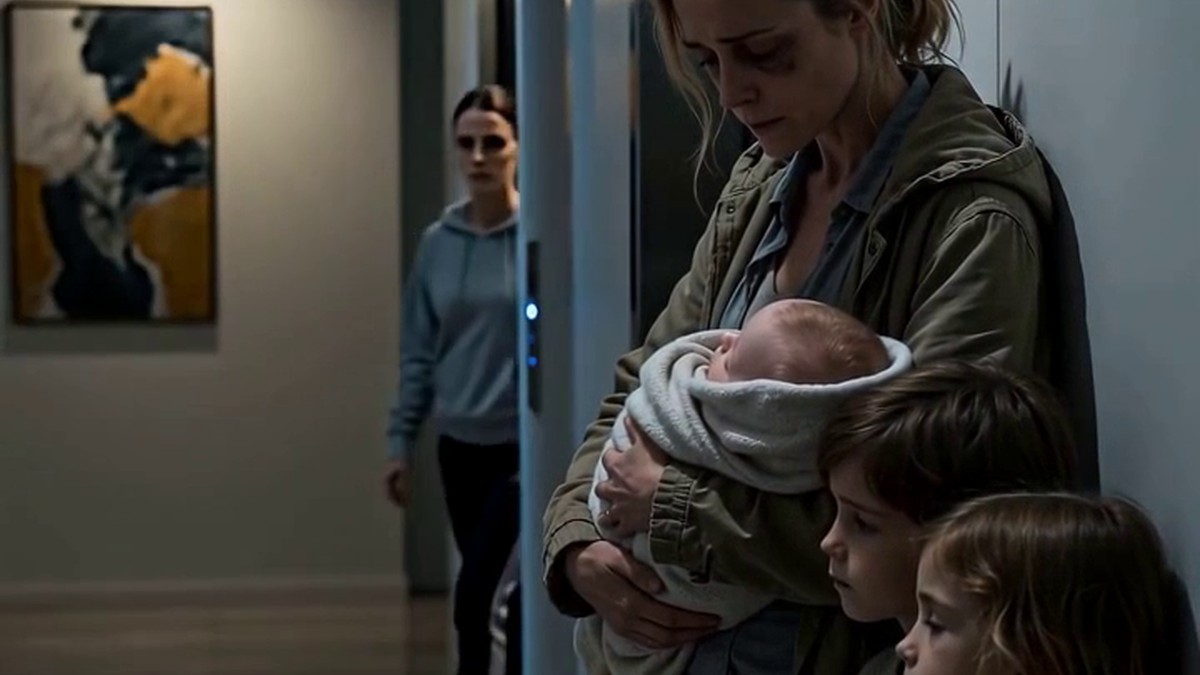
I remember the sound of the cab driving off, the exhaust ghosting around my ankles, and the way Lily kept shifting her weight from one foot to the other because she had to pee. Noah was half asleep on the suitcase, his head propped against a duffel bag, and Benny was a dead weight in my arms — three years old and drooling onto the collar of my jacket.
The lobby of my sister’s building smelled like industrial carpet cleaner and burnt coffee from the security desk. Rick, the night guard, barely looked up from his phone. He’d seen us before — a few years ago when I’d stayed for “just a night” and ended up camping in Rachel’s guest room for two months. He probably figured I had a key.
I did. My mother had slipped it to me two afternoons earlier in a Ziploc baggie, like it was prescription medication. “Rachel gave it to me for emergencies,” she’d said, pressing the fob into my palm. “Sarah, this is an emergency.”
It never occurred to me to call Rachel first. Calling would’ve meant letting her give me a list of questions I didn’t have answers to. I figured if I just showed up, she’d be annoyed, sure, but she wouldn’t turn her own sister away at one in the morning with three kids. That’s not how family works.
So I walked up to the lobby elevator, fob in hand, and held it to the reader.
Nothing. I tried again.
Nothing.
My stomach dropped straight through the floor.
Rick cleared his throat. “Key not working?”
“It’s fine,” I told him, my voice too quick. “My sister’s expecting us.”
She wasn’t. And when Rachel stepped off the elevator two minutes later — wearing sweatpants and an expression I’d never seen in her eyes before — I knew something had shifted permanently.
“That fob doesn’t open anything anymore,” she said.
The lobby was so silent I could hear the hum of the vending machine by the mailboxes. My mother, who’d driven over to “help,” froze mid-step. I tightened my arm around Benny and felt Lily press herself into my hip.
“What’s that supposed to mean?” I snapped.
“I reported the fob as lost this afternoon. Building management deactivated it. Every copy linked to it is dead, including the one Mom took without my permission.”
My first thought wasn’t about the fob. It was about the boxes of our stuff — three months of unpaid rent, the eviction notice taped to my old door, and the terrifying math that told me if David found out we were homeless, he’d haul me back into family court so fast my head would spin.
Rachel just stood there, blocking the entryway, one hand in her pocket like she’d been planning this. I wanted to scream. Instead I pushed out something I thought would work.
“I have three kids, Rachel. It’s one in the morning.”
“I know.”
“So move.”
She didn’t flinch. “No.”
That “no” landed in my chest like a rock. I was so used to her caving. Rachel had been the buffer my whole life — the one who covered my shifts when I vanished for a weekend, the one who gave me her savings when my car got repo’d, the one who let me take over her guest room without asking because I was “the sister who needed more.” She always caved.
But not that night.
Our mother stepped between us, her voice pitched high with the nervous authority she’d perfected over decades. “Rachel, this is ridiculous. Those are my grandkids out here.”
Rachel looked at her with a calm that was way more unsettling than anger. “And I’m your daughter.”
Mom blinked. Something in her face twitched.
I laughed, but it came out brittle. “Wow. Seriously? You’re making this about you now?”
Rachel turned to me. “No. You made it about me the second you decided my condo was your emergency shelter.”
“It’s just for one night.”
“Last time it was one night, I couldn’t get my closet back for two months, you changed the kids’ school address to mine, and you ordered a futon without asking.”
Heat crawled up my neck. I shot a look at Mom, but she’d gone very still.
“That was different,” I muttered. “I was leaving David. Everything was falling apart.”
Rachel didn’t blink. “And now everything’s falling apart again. Except this time I didn’t get a call, an apology, or even a warning. You just showed up with a key you never should’ve had.”
Benny started squirming, and the crying began — that thin, exhausted wail that pierces through everything. Lily sat down on the biggest suitcase. Noah put his hands over his ears. For one brutal second I wanted Rachel to see exactly how much I needed her, so she’d feel like the monster she was being.
But Rachel was already taking an envelope from her bag.
“I booked you a family room at the Hilton near O’Hare,” she said. “Two nights, paid for. It’s under your name.”
My mouth opened before my brain caught up. “You *booked a hotel*?”
“As soon as I got the text.”
“What text?”
Rachel’s eyes narrowed. “The one from Lily’s iPad at 6 p.m. saying you guys were on your way.”
I whipped around to look at my daughter. Lily, nine years old and far too clever, had her face buried in her sleeve. She’d sent the message from the backseat somewhere near Aurora, I realized later — a few words typed out in emoji-littered English: *We r coming aunty Rachel. Mommy says we can stay at ur place forever.*
My own kid had ruined me.
Rachel was still extending the envelope. When I didn’t take it, she said, “I already knew you were coming, Sarah. You walked in here with a stolen fob and a rehearsed lie about missing a flight to Portland, and it was dead before you opened your mouth.”
The heat in my neck turned to ice. I’d spent days practicing that story, assuming once we were inside, Rachel wouldn’t have the stomach to kick us out. I hadn’t even felt guilty constructing it, because in my head, Rachel’s life was the surplus. She had a big condo in Lincoln Park, a tech job that let her work remotely, no kids, no husband to argue with about custody. I, on the other hand, was drowning. Seemed like a fair trade.
I didn’t realize until that moment how long I’d been telling myself that same story.
Rachel added, “The hotel shuttle runs all night. Rick can call you a cab.”
“And after two nights?” I shot back. “What then?”
“That’s your problem.”
The words hit me like a slap. I’d heard her say plenty of cutting things over the years — Rachel had a way of making her boundaries sound like insults — but this was different. She wasn’t trying to make me feel bad. She just… wasn’t responsible.
I turned to Mom, desperate for rescue. She’d been silent too long, her knuckles white around the strap of her purse. “Say something,” I hissed.
Mom looked at Rachel, then at the useless fob still clenched in my hand, then at the kids. “Sarah, maybe we should talk about this privately?”
“There’s nothing private about it,” Rachel said. “You gave her my fob. You decided I should take her in. So now you can handle it.”
“What’s that supposed to mean?”
“She’s not staying with me. She’s staying with you.”
I choked on air. “Mom’s place? Mom lives in a two-bedroom walk-up in Bridgeport with her hip replaced last year.”
“I have my own life, Sarah. And it’s not a spare key you can copy every time you crash. The only difference is I’ve had enough of being the fallback plan.”
Mom’s face drained of color. I’d seen her angry, disappointed, and even grieving, but I’d never seen her look at Rachel like she was a stranger. She lowered herself onto the lobby bench, her hand braced on the armrest.
“I can’t take in three kids,” she said.
“You told me she’s your daughter.”
“I mean— I’m sixty-seven.”
“And I’ve spent the last six years paying off debts that weren’t mine, covering your bills when Dad got sick, and watching you bend over backward every time she lit another fire. This time, it’s your turn.”
The silence that followed wasn’t peaceful — it was the kind you feel in your teeth. Noah started sniffling. Lily tugged my sleeve and said, in a voice that carried too far, “Mom, you said Aunt Rachel would let us stay until we found a new place. You said she wouldn’t mind.”
Mom’s head swiveled toward me. “What is she talking about?”
I closed my eyes. For one cowardly second I thought about blaming the kids, the stress, anything. But the jig was up.
“We lost the apartment,” I said. “About two weeks ago.”
“Two *weeks*? Why didn’t you tell me?”
“Because I knew you’d call Rachel and she’d say no.”
Rachel crossed her arms. “How much rent did you miss?”
“Three months.”
“So you’ve been driving around with three kids and no address for two weeks, burning gas and using our mother’s house as a pit stop, waiting to ambush me.”
“I didn’t *ambush* you, I—”
“You showed up at 1 a.m. with a stolen fob and a lie about a missed flight to Portland. I got Lily’s text at six. The lie was dead before you opened your mouth. Yeah, Sarah. That’s an ambush.”
I opened my mouth — and nothing came out. Because she was right.
Lily walked over to Rachel, her backpack on one shoulder, and tugged the hem of her aunt’s sweater.
“Are you mad at us?” she asked.
Rachel’s whole posture changed. She crouched down, eye-level with my daughter, and said, her voice low, “No, sweetheart. I’m not mad at you. I’m never mad at you.”
“Then why can’t we go upstairs?”
Rachel glanced at me — just a split second — and I saw something in her face that wasn’t cruelty. It was grief.
“Because your mom didn’t ask, Lily. And that’s something I needed her to understand, okay?”
That was the moment I understood she wasn’t punishing me. She was drawing a line that should’ve existed thirty years ago. And I hated her for it in the most honest, broken way possible.
Mom, still on the bench, cleared her throat. “They can stay with me for two weeks,” she said at last. “But no longer.”
I spun around. “Two weeks? With three kids and thirty-seven stairs to your front door?”
“Then you’ll carry the stroller yourself.” Her voice had an edge I’d never heard directed at me. It was the edge she usually saved for Rachel. The world had tilted. “And you’ll look for a job every single day. No sleeping past eight. No leaving the kids without asking. And you’ll call David and tell him the truth.”
A fresh wave of panic detonated in my chest. “I can’t call him — he’ll use it against me in court.”
“Then you should’ve paid the rent,” Rachel said.
Those five words sat in the air like a verdict.
The cab arrived at 1:47 a.m. Rick helped load the suitcases into the trunk while I buckled Benny into his car seat. Mom climbed in first, stiff and silent. Rachel stood in the lobby doorway still holding the hotel envelope. I snatched it from her hand — not to use, but to prove I’d rather take her charity than admit I’d been wrong.
I didn’t say goodbye. Neither did she.
All the way to Bridgeport, with Noah’s feet pressed against the back of my seat and Lily staring blankly out the window, I composed a dozen cutting texts to Rachel in my head. I never sent any of them. The one I kept returning to wouldn’t type out.
The next two weeks at my mother’s house were a series of startling new rules. She hung a chore chart on the fridge. She enforced quiet hours after 9 p.m. She handed me a list of temp agencies and said, “You’re not a guest. You’re my daughter who needs to get back on her feet.”
On the third morning, I slept through my alarm. Mom let me. I woke at ten to a note on the fridge: *Temp agency called. They gave the slot to someone else. Try again tomorrow.* I sat at the kitchen table and shredded the note into a hundred pieces. Then I got dressed and walked to the agency in person, my face still hot with sleep.
The first job interview came three days later, at a dental office in Oak Lawn. I wore Mom’s blouse, arrived early, and sweated through every question. They called the next day to say they’d gone with someone else. I locked myself in the bathroom and cried, then came out and dialed two more agencies.
She also called David before I could stop her. That conversation was legendarily ugly — I nearly hung up three times — but it ended with a temporary custody agreement where he took the kids on weekends and resumed direct payments for their school supplies and medical bills. It wasn’t a win. It was a ceasefire.
Rachel, in the meantime, didn’t call. She sent me a screenshot of a family law attorney’s number, three job listings for receptionists at medical offices, and the link to a state program for single mothers. No greeting. No lecture. Just resources, arriving like care packages you don’t want but desperately need.
I got a job at a dermatology clinic in Oak Lawn, three weeks and four rejections later. I found a two-bedroom apartment above a dry cleaner’s, forty minutes from Rachel’s condo, and signed the lease on a Tuesday afternoon in November. The first time I unlocked the door, I stood in the empty living room with the key in my palm, and I took out my phone and took a picture of my hand — just my hand holding the key against the blank white wall. I texted it to Rachel with a caption: *I asked the landlord before I came in.*
She replied five minutes later. *Not a bad start.*
Three words. But they were enough to make me sit down on the cold linoleum floor and cry like an idiot.
The real apology happened in March, at a park near the Garfield Park Conservatory. Rachel was already sitting on a bench with two cups of coffee when I got there. We watched Lily push Benny on the swings while Noah chased pigeons.
“I was so angry at you,” I said.
“I know.”
“Some days I still am.”
“I know that too.”
I squeezed the paper cup until the lid popped. “But if you’d let me in that night, I would’ve stayed until you forced me out.”
“Probably.”
“And then I would have hated you.”
“Also probable.”
I looked at her — really looked — and saw the sister who’d given up her university plans when our father got cancer, who’d sat through chemo on her own because I was “too busy,” who’d been the foundation of a family that asked her to hold everything up and never said thank you.
“I’m sorry,” I said. “For the key. For using the kids. For every single time I acted like your life mattered less just because you didn’t have any.”
Rachel set her coffee down on the bench. “Thank you.”
“Do you forgive me?”
The pause was honest. “I’m working on it.”
That was more than I deserved.
The first time I took the kids back to Rachel’s condo — properly, with a phone call two days in advance and a text from the lobby — was the following June. We rode the elevator up in silence, and when the doors opened, Lily had a small wooden sign she’d painted herself at the kitchen table the night before.
*Welcome to Aunt Rachel’s Home,* it read in slightly lopsided lettering. *Enter with invitation and love.*
Rachel read it out loud, and then she did something I hadn’t seen her do in years. She laughed — a real, unguarded laugh that shook her shoulders — and hung the sign right by her front door.
That night, we ate spaghetti in her dining room. The kids slept in sleeping bags on her living room floor, and Rachel and I stayed up until two in the morning, not fighting, but talking about things we’d never said out loud. The resentment. The exhaustion. The gnawing, corrosive guilt of being the sister who always took.
She said, “I don’t regret deactivating that fob.”
I said, “I know.”
And I didn’t add a “but.”
The next morning, the sign still hung by the door. I touched the painted letters once on my way out.