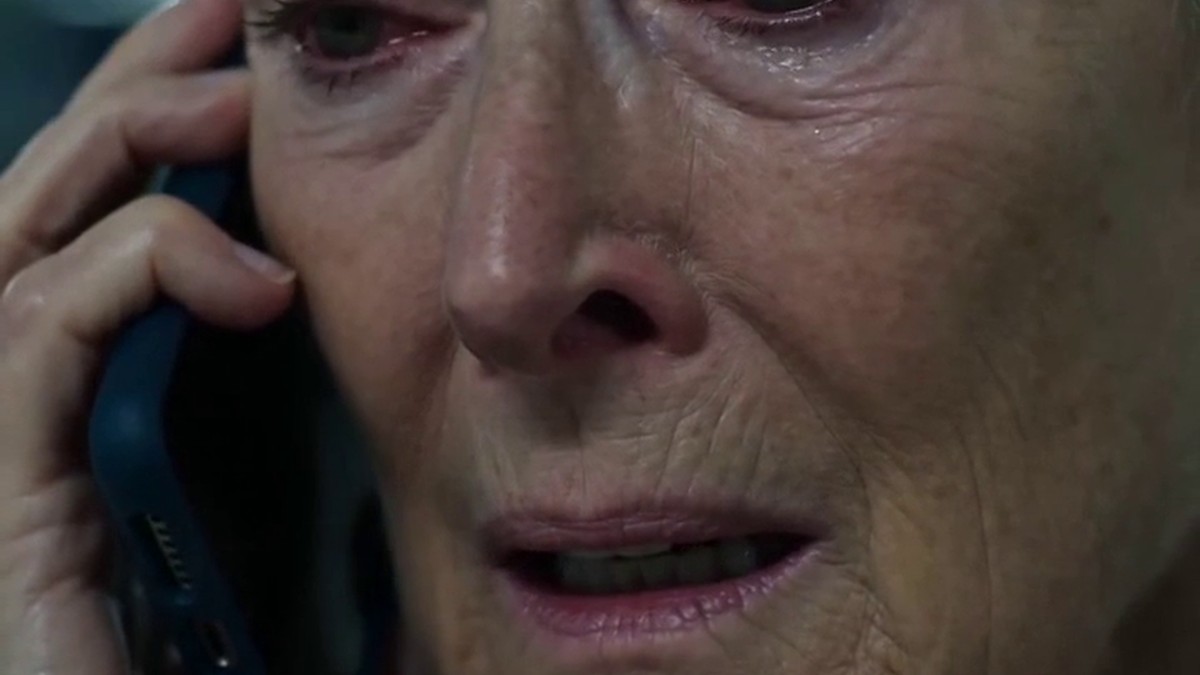
The call connected as the baggage carousel stuttered to a halt. Two a.m. in Portland, drizzle tracking through the security lights outside, and my son Brian’s voice hit me before I could get a word out.
“Take a Lyft, Mom. We’re buried here.”
I’d been awake for three days. My husband William’s body had been lowered into frozen Montana ground forty-eight hours earlier, and I was standing in an airport terminal wearing the same blouse I’d worn to the graveside, my carry-on sagging off one shoulder, waiting for a suitcase that never made the connection in Salt Lake City. The air smelled of stale Stumptown coffee and wet wool.
“Brian, I haven’t slept since—”
“Look, I’m not your grief counselor.” In the background I heard Emily’s laugh, my granddaughter’s, then a crash. “Tell Kate Gramps’s toolbox is mine!”
My throat tightened around something I couldn’t swallow. “Your father’s been in the ground two days.”
“Which is exactly why we’re trying to get things sorted. You’re a grown woman. Figure out the ride yourself.”
The line went dead. I lowered the phone to my lap and watched a young couple collapse into each other at the arrivals gate, the guy lifting his girlfriend off the floor. The bench I was sitting on had a cracked armrest that pinched the skin of my forearm every time I shifted. I sat there long after the airline agent told me my bag was still sitting on a runway in Utah and they’d deliver it “whenever it turns up.”
I called Kate. She was William’s favorite, or used to be, before she stopped calling except when she needed the babysitter money or the co-sign on a Subaru lease. “You knew Dad was sick, Mom. It wasn’t exactly a surprise. We can’t just drop everything because you decided to fly out to his hometown alone.”
“You’re saying you won’t pick me up.”
“I’m saying you can call a taxi.”
I thumbed through old contacts until I found the name Alicia Torres, a producer at KGW who’d called the week before William died. She had wanted to do a profile on him, something about local unsung heroes. I’d said no then. He was a private man, I’d told her, someone who folded his hands at the dinner table and never raised his voice, not even the night he told me our kids were treating us like furniture.
“They walk right past us,” he’d said that last autumn, watching Brian’s truck pull away after borrowing three hundred dollars. “They only see us when they need a key or a check.”
“They’re still our children,” I’d told him. He’d pressed his lips together and said nothing. William never argued with me. Not once in forty-one years.
Outside the terminal, a Lyft driver in a Prius tapped his window when he saw me standing there with no luggage. “No bags, ma’am?”
“No bags.”
I gave him the address of our house out in Lake Oswego. He started talking about the rain and the potholes on Macadam Avenue, and I just watched the city scroll past in smudges of neon and black river water and thought about Henry—William—and about the small sealed envelope he’d tucked into his shirt pocket every single morning of our marriage before heading to his accounting office. “Bills,” he’d always said, patting the spot. “I’ll drop them at the post office.” I’d never asked what was inside. Over four decades, never once.
Twenty minutes later, I stood in my own driveway. The porch light was on, the living room curtains glowing. I could hear Emily’s music thumping faintly through the front wall.
When I opened the door, I saw them first: small bright-yellow Post-it notes, the super-sticky kind, plastered to everything I owned.
*KATE* was stuck to the rocking chair my mother had painted by hand when I was pregnant. *BRIAN* dangled from the handle of William’s antique oak toolbox. *EMILY* clung to the glass face of my jewelry cabinet.
My daughter walked out of the kitchen with a dish towel over her shoulder and looked at me like I was a delivery she hadn’t ordered. “Finally. What took you so long? We had to make dinner ourselves.”
I didn’t answer. I picked up my carry-on and walked past her toward the stairs.
“Oh, real mature, Mom. That’s healthy.”
Upstairs, I shut the bedroom door and sat on the edge of the forty-one-year-old mattress. William’s flannel shirt was still folded on his pillow, right where I’d left it before flying to Billings. I held it to my face. Then I pulled out my phone and called Alicia.
“Mrs. Harrington,” she said on the second ring. “I heard. I’m so sorry.”
“You called me last week,” I said, steadier than I expected. “You said you wanted to tell William’s story.”
A pause. “The offer stands. It always did.”
“I’ll come to the station. Six o’clock. I’m bringing his papers. Everything’s in his study. I have the key.”
“I’ll send a car.” Then, softer: “Mrs. Harrington, your husband came to see me three months ago. He asked me to wait until you were ready to call.”
My hand tightened on the phone. “He what?”
“He made me promise to explain everything in person. But he wanted you to know—he asked us to be a wall between you and anyone who tried to take something from you after he was gone.”
I looked at the rain battering the window. “Then show exactly what he wanted people to see. Don’t edit a thing.”
At four-thirty a.m., I crept downstairs in the dark, using the flashlight on my phone. In William’s study, I unlocked the bottom drawer of his desk—the one he’d always kept locked, saying it was just old tax returns. Inside was a leather ledger I’d never seen before. I opened it under the desk lamp.
His handwriting, neat as always. One entry stopped my breath.
March, three years ago. $25,000 transferred to Doernbecher Children’s Hospital. In the margin, those same careful letters: *Forgiven—Brian’s debt.*
My son had told me he’d “worked out a payment plan” for the gambling hole he’d dug. All that time, his father had quietly erased it.
I closed the ledger, tucked it under my arm, and walked through every room on the ground floor, pulling back the curtains. Alicia had said the crew would film the exterior at sunrise for the opening shots. I wanted every window wide open to whatever was coming.
Nobody noticed I was gone. The house still smelled like the pork roast they’d eaten without me.
By six p.m., the whole family was parked in the living room, plates balanced on knees, the local news humming through the flat-screen. Brian had already claimed William’s recliner—a Post-it with his name was still stuck to the armrest. “After we sort the truck title,” he was saying, “we should list Mom’s Tahoe and split the cash.”
“Fine by me,” Kate said around a mouthful of salad. “Providing I get my cut for the two years I handled Dad’s doctor appointments.”
I ate slowly and said nothing. Emily, my fifteen-year-old granddaughter, was the only one watching my face. “Grandma, you want some water or something?”
“No, honey. Thank you.”
The anchor shifted to a special segment. The screen filled with an image of me, sitting in Alicia’s studio that morning, my hands folded over the ledger.
Emily’s fork clattered against her plate. “Grandma?”
Brian yanked his feet off the ottoman. “What the hell is this?”
On the screen, my recorded voice spoke. I talked about William leaving the house every day with an envelope in his pocket, about all the mornings I never asked what he was really mailing. Then Alicia’s voice took over, calm and surgical.
“Over the last thirty years,” she said, “William Harrington secretly funded cancer treatments for four local children. He sent six veterans to trade school. He paid off the mortgage of a widowed neighbor. He established a scholarship at Portland Community College under a name that wasn’t his. And three years ago, he cleared a six-figure debt for an unnamed family member without once asking for a thank-you.”
Brian’s face drained of color. “Turn that off.”
Nobody moved.
The segment shifted to exterior shots of our own house, filmed in the early morning light. The Post-its gleaming on the furniture. Brian’s handwriting stuck to my jewelry cabinet, Kate’s on the rocker. An entire city was watching the labels my children had slapped onto a life they couldn’t wait to dismantle.
“Last fall,” Alicia’s voice continued, “Mr. Harrington visited this station with a single request: that the story of his giving be broadcast only when his wife was ready to tell it—and that we stand between her and anyone who tried to take what he’d built.”
Kate’s salad plate tipped off her lap. “Mom, the inheritance—did you just throw it away on television?”
Brian was up now, pacing. “There’s an addendum to the will, isn’t there? What did he do?”
I set my own plate on the end table. “William left everything to a foundation in his name. It was finalized the morning of his funeral. I’m the sole trustee.”
Brian stopped pacing. “You planned this.”
“No,” I said. “I just wanted someone to pick me up at the airport.”
Kate’s mouth opened and closed. “We didn’t know you needed us.”
“He was afraid of what would happen after he was gone,” I said. “He prayed he was wrong.”
I opened the ledger to the marked page and held it toward Brian. “Three years ago,” I said, “when you came to your father begging for help, he didn’t hesitate. He wrote a check for twenty-five thousand dollars and never said a word about it. Not the day he paid it, not the day you pulled into the driveway with a new truck, not the day you stopped calling him except when you needed money.”
The room had gone completely still. Brian’s jaw worked but no sound came out.
“He never guilted you,” I said. “He never brought it up. Because whatever kind of son you were, you were still his son.”
Kate stared at her brother. “You never told me.”
“Neither of you showed up at his funeral,” I said. “Neither of you held his hand while he was dying. You were too busy labeling his life.”
I stood up. Emily was crying quietly, one hand pressed to her mouth. I touched her wrist, then walked straight through the kitchen to the back door.
I didn’t return that night. I drove William’s old Ford to the foundation’s office downtown, the one Alicia had helped me set up, and I sat in the dark until sunrise.
A month later, I sat at William’s old desk in the small office on Hawthorne, a stack of scholarship applications in front of me and a mug of black coffee cooling by my elbow. Alicia had stopped by earlier with a bag of pastries from the bakery down the street and hadn’t needed to ask how I took my drink. She’d just set the mug next to the stapler and left.
My phone buzzed. Emily’s name lit up the screen, with a single question beneath it: *Can I come stay with you this weekend?*
I pulled the foundation’s checkbook from the drawer. On the top voucher, I wrote the name of a nursing student from Gresham, a young woman who’d been accepted to OHSU with a full ride for tuition but nothing for books. In the amount line, I wrote $5,000, signed my name, and tore the check out cleanly.
On the memo line, I added: *In honor of the man who never stopped mailing the envelopes.*
Then I slid the check into an envelope, sealed it, and picked up my phone. I typed the word I should have said more often when William was still here to hear it.
*Yes.*
I placed the envelope in the outgoing mail tray, picked up my coffee, and was still holding it, still smiling a little, when Emily’s reply lit up the screen: *I’ll bring Dad’s truck back full of gas. The one he never said thank you for.*