The chime above the door had barely finished its silver note when the whole boutique went silent. Not the polite, hushed silence of patrons considering six-figure pieces, but the abrupt, sucking silence of a room holding its breath.
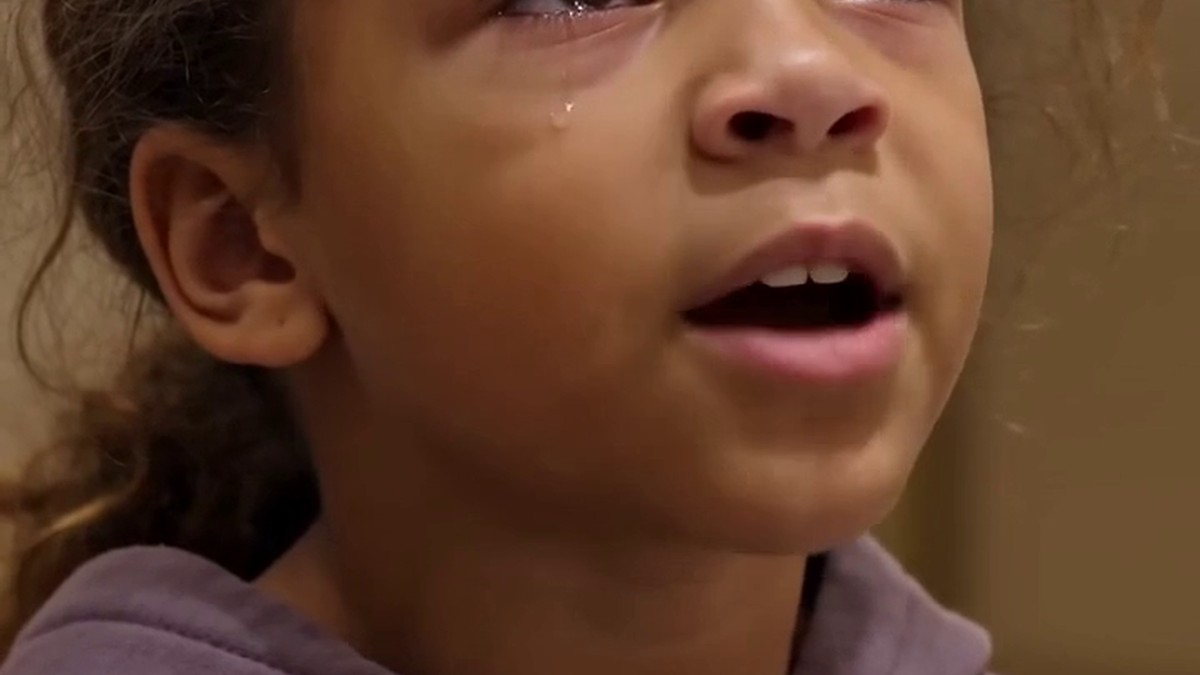
The girl couldn’t have been older than eight. Her sneakers left faint smudges of dried mud on the cream wool runner as she crossed straight to the main display counter. She wore a thin purple hoodie, one sleeve frayed, her hair escaping its elastic in wild brown spirals. In one grubby hand she clutched something that looked like crumpled paper. Her eyes were wet but hard.
She stopped in front of the glass and smacked her palm flat against it. Hard. A diamond bracelet inside shivered on its velvet pedestal.
Two saleswomen stiffened. A man in a cashmere blazer glanced toward the security guard, already reaching for his phone. Celeste Montgomery, the owner, who had been reviewing a custom setting with a client from Beacon Hill, turned with the slow, deliberate grace of a woman who had spent forty years perfecting the art of being undisturbed.
She was tall, silver-blonde, in a charcoal shift dress that cost more than the laptop the girl’s mother probably didn’t own. Her voice was cool and flat.
“Young lady, you need to leave. This is not a playground.”
The girl didn’t move. Her chin came up and her lips parted, but for a long moment nothing came out except a caught breath. Then she whispered, “My mom cried because of that ring.”
She was pointing at the sapphire.
It sat in its own case, third shelf from the left, under a tiny halogen spotlight. A three-carat Ceylon sapphire in a vintage platinum setting, surrounded by seed pearls. Everything in the store was for sale, but that piece had a small brass plaque that read *Legacy Collection – Not for Resale*. Celeste had placed it there herself thirty years ago when she opened the store, a nod to something she never talked about.
Her stomach tightened.
The client turned to look. The saleswomen exchanged glances. The security guard took a half-step forward. Celeste raised a hand, stopping him. She walked around the counter, heels clicking loud in the quiet, and stood directly in front of the girl, close enough to smell the fabric softener and something like stale bus seat.
“What’s your name?” Celeste asked.
“Tessa.”
“Tessa, my ring doesn’t make people cry. It just sits there. Why would your mother cry about a piece of jewelry she’s never seen?”
The girl’s face scrunched, then went still. She uncurled her fist and held up the crumpled thing, smoothing it carefully against the glass. A photograph. It had been torn in half long ago, then taped back together with aged, yellowing Scotch tape. Two young women stood in front of a sagging farmhouse porch, arms around each other, beaming. One wore a light blue sundress, the other a yellow blouse with the sleeves rolled up. Both had dark hair and the same sharp, mischievous jawline.
Celeste didn’t need to squint. She’d seen that photograph before. The last time was in a trailer kitchen in rural Kentucky, seconds before she’d ripped it in two and thrown it on the linoleum.
Tessa’s voice came out high and shaky, like a child reciting something she’d practiced too many times. “That’s you in blue. My mom’s in yellow. She said you took Grandma’s ring and you said you never wanted to see her again. And she’s been crying for two days because she thinks she’s gonna die before you even say sorry.”
The boutique stayed frozen, but for Celeste the world contracted to a pinpoint. She heard the distant churn of the old air conditioner, felt the phantom ache in her knuckles—the same knuckles that had once gripped the steering wheel of a secondhand Ford Fiesta as she drove away from that trailer, from her sister Maggie, from every cheap, small, desperate thing she’d ever been.
She grabbed Tessa’s wrist, too tightly.
“Where’s your mother?”
—
In the back office, the girl sat on a leather chair that swallowed her whole, knees pulled up to her chin. Celeste closed the door, locked it. She poured water from a carafe into a heavy crystal glass and set it on the desk without offering it.
“How did you get here? From Kentucky to Boston, by yourself?”
Tessa shook her head. “Bus. I told the driver my aunt was meeting me at the station. I saw your store in a magazine at the hospital. Mom keeps it under her pillow. The one with you on the cover.”
Celeste remembered the issue of *Jewelry Today* from two winters ago. She’d given an interview about surviving the recession, about building an empire from nothing. She never mentioned the nothing had a name.
“What do you mean, hospital? What’s wrong with Maggie?”
“She has the cancer thing,” Tessa said, as if it were an everyday word. “Back in her bones now. The doctors said we gotta call somebody, but Mom said there’s nobody left to call. So I came.”
Celeste sat down slowly in the opposite chair. The sapphire on the counter upstairs had been their grandmother’s. The old woman had promised it to both of them, a sentimental impossibility that curdled into resentment. When their parents died, Maggie wanted to stay on the farm, raise chickens, marry the boy from the feed store. Celeste wanted to buy a one-way plane ticket and sell the ring for seed money. She’d always been the one with sharp elbows and big plans. She saw the ring as a ticket out; Maggie saw it as the tether that would keep the last shred of the family together.
The night they fought, Maggie had said, “You’d sell her soul if you didn’t have one of your own.” Celeste had grabbed the photo—that very photo—off the fridge and ripped it clean across, right between their two faces. She threw the half with her own image onto the floor, pocketed the half with Maggie, and walked out. A week later, she sold the sapphire to a dealer in Lexington for six hundred dollars. She bought her own ring back ten years later, when her first store turned a profit, and put it on display as a monument to never needing anyone again.
Tessa watched her with unnerving patience, a small child who had already seen too many adults fall apart.
“She wants the ring back?” Celeste asked. “Is that why you’re here?”
“No.” Tessa’s voice cracked. “She wants you to come. She said I shouldn’t bother, but I saw your face in the magazine.” She pulled at a loose thread on her hoodie. “You look like her when you’re not making that mean face. She makes that mean face too.”
Celeste stood so abruptly the chair rolled back and hit the wall. She pressed her palms against the cold steel of the filing cabinet, feeling the thin vibration of the building’s heating system. Outside the door, someone’s phone buzzed. The world kept going. Inside her chest, a knot she’d cinched tighter for three decades finally snapped.
She turned back, jaw set.
“What hospital?”
—
Roosevelt Medical Center smelled like bleach and warm cafeteria rolls. Celeste had changed out of her charcoal dress into jeans and a sweater she bought at a Target across the street, a deliberate shedding of armor. She followed Tessa up to the third floor, past a nurses’ station where a familiar name—Margaret Aldridge—glowed on a whiteboard in dry-erase marker.
Maggie’s room was small, the window overlooking an air shaft. The woman in the bed was thinner than Celeste remembered, her hair cropped short and gray, but the jawline was still sharp, still hers. She was asleep when they came in, but as if some frequency only sisters share had sounded, her eyelids fluttered open.
She saw Tessa first, then tracked slowly to the woman standing at the foot of her bed. Recognition, disbelief, anger, and a terrible, raw hope cycled through her face in less than three seconds.
“You brought her,” Maggie whispered, looking at her daughter. “You crazy little thing, I told you—”
“You told me nobody’s left to call,” Tessa said. “So I called the one you wouldn’t.”
Celeste stepped forward, hands empty. She had no gift, no apology prepared, no righteous defense. She just pulled the sapphire ring from her coat pocket. She’d taken it from the case herself, the glass sliding back with a hiss that felt like exhalation. She set it on the bedside tray, beside a plastic cup of water with a bent straw.
Maggie stared at it. “I don’t want that. I never wanted the damn thing.”
“I know.” Celeste’s voice was hoarse, stripped of its polish. “You wanted me to stay. And I wanted to go so badly I tore us apart literally. I’ve been waiting for you to call and you’ve been waiting for me to come back and we both should’ve known neither of us would blink first.”
A long silence fell. Tessa climbed onto the edge of the bed, her grimy sneakers dangling. A nurse passed by with a squeaking cart.
Maggie’s hand, thin and mapped with IV bruises, reached out and picked up the ring. She turned it under the fluorescent light. “You bought it back.”
“Ten years after I sold it. Put it on display like a trophy. Never told a soul where it came from. Figured if I could look at it every day and feel nothing, I’d won.” Celeste sat down on the hard hospital chair, close enough now that her knees almost touched the bed rail. “I didn’t feel nothing. I felt like someone who owns a very expensive piece of proof that she’s a coward.”
Maggie shook her head slowly. “I said terrible things to you that night.”
“So did I.”
“I named my daughter after that forsaken farm,” Maggie said, glancing at Tessa. “Her middle name is Clover. You remember the patch behind the barn, the one the bees loved?”
Celeste let out a sound halfway between a laugh and a sob. “I thought of that place every time I made a big sale. Stupid. I was in a penthouse suite in Manhattan last year, closing a deal, and I suddenly remembered how the light hit the clover at six in the evening in July.”
Maggie shifted, making room, and Celeste—Celeste Montgomery, who had not hugged her own sister since she was twenty-two years old—leaned forward and put her head on the thin hospital blanket, near Maggie’s shoulder. Her shoulders shook. Tessa slid off the bed and quietly found a chair, giving them space.
They stayed like that for a long while, the machines beeping softly, the air shaft outside carrying the faraway rumble of the city. Maggie’s fingers came to rest on the back of Celeste’s head, stroking the silver-blonde hair exactly the way their mother used to.
No one said “I forgive you.” No one said “I was wrong.” The words were too small and forty years too late. But the photograph, the torn one Tessa had carried all the way from Kentucky, lay now on the bedside tray beside the sapphire ring, and neither sister reached to put it away.
Finally, Maggie spoke, her voice thin but holding a new note. “You’re gonna have to teach this one about jewelry,” she said, nodding at Tessa. “She’s got the eye. Walked right into your store and picked the most important thing in the room.”
Celeste lifted her head, wiped her cheek with the back of her hand, and looked at Tessa. “You want a job? I need someone who’s not afraid to slam their hand on my counters.”
Tessa grinned—the same sharp, mischievous grin from the photograph—and said, “I want health insurance and a bus pass.”
Celeste laughed, a real laugh, rusty from disuse. “Done.”
Outside the window, a stray pigeon landed on the ledge, cooing into the gray afternoon. The light shifted. Somewhere in the boutique across town, the Legacy Collection had an empty spot in its case, but for the first time in three decades, the owner didn’t care.