The Cat Who Led Me Back to Life
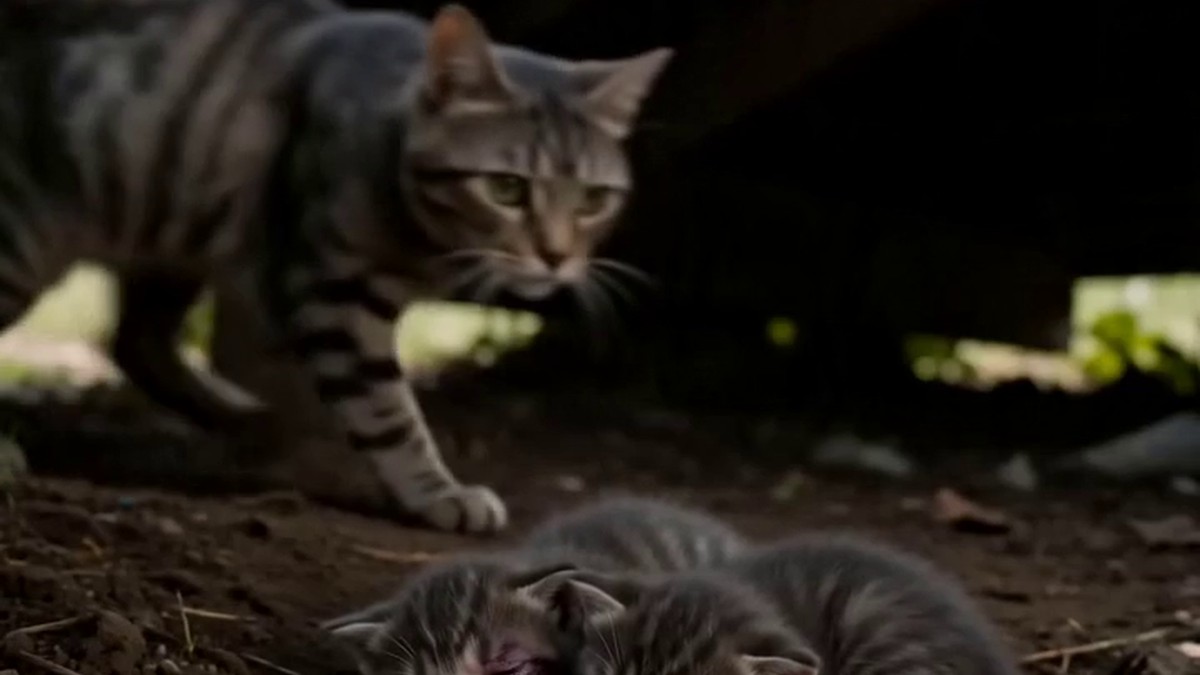
Maggie O’Connell had been alone in the old farmhouse for six years, ever since Frank’s heart gave out in the middle of chopping wood. The silence had become a living thing—thick, heavy, and hungry. So when she swung open the shed door that May morning and heard a faint rustle, her heart stuttered. Sunlight sliced through the dusty air and fell on a gray tabby crouched on a stack of mildewed canvas drop cloths. Three blind, wriggling kittens nosed against her belly. The cat lifted her chin and stared at Maggie with eyes the color of moss after rain. No hiss, no flattened ears. Just a steady gaze that said, *I had nowhere else to go.*
“Well, I’ll be,” Maggie breathed, her hand still on the latch. She should chase them off. At seventy-four, with arthritis gnawing her knuckles and a fixed income that barely covered firewood, she couldn’t afford more mouths. But the kittens were so small, their mewling thin as spider silk, and the mother’s ribs showed through her matted fur. Maggie set down her trowel and trudged back to the kitchen. She filled a chipped ceramic bowl with milk and flaked half a can of tuna onto a saucer.
That evening, the cat ate while Maggie watched from the porch. The tabby darted glances between mouthfuls, making sure the kittens were still there. A week passed, and the shed became Maggie’s sanctuary. She’d sit on an overturned bucket, talking to them. The kittens opened their eyes—two gray like their mother, one a patchy calico. Their mother’s coat grew glossy, her wariness softening into a slow blink of trust. For the first time since Frank’s funeral, Maggie felt needed. Not by a phone call from her daughter in Boston that lasted twenty minutes, but by a living creature who depended on her right now.
On the tenth day, the cat vanished.
Maggie came out with breakfast to find the kittens crying and crawling over each other in a desperate heap. The milk from the night before sat untouched. She waited until dusk, calling *here, kitty* until her voice cracked. Nothing. The next morning, fear coiled in her stomach. She’d heard coyotes yipping in the far pasture. With a shaking hand, she boiled water, sterilized an old eyedropper, and began feeding the kittens drop by drop, just as she’d done for a stray Frank had brought home thirty years ago. The calico was the weakest; she held it against her chest for warmth, murmuring, “Don’t you give up on me.”
A week later, the kittens lapped from a saucer. Maggie moved their box to the sunporch. Her neighbor, Dolores, stopped by with a jar of pickled beets and planted her hands on her hips. “You planning on running a cat orphanage? Take ’em to the shelter in Montpelier.”
“Their mama’s probably dead on the highway,” Maggie said, not looking up. “I won’t abandon them twice.”
“You’re not young, Margie. You can’t save every stray that wanders into your yard.”
Maggie said nothing. But Dolores was right about one thing: in four weeks, her grandchildren would visit, and both were allergic. She didn’t have the stamina to chase after three cats, much less the vet bills. “I’ll find homes,” she muttered. “There’s a rescue that’ll take ’em.”
That night, sleep refused to come. She lay in her narrow bed, listening to the wind rattle the windowpanes, to the clock on the mantel marking each empty second. She missed the noise of a full house—Frank’s snores, the kids’ giggles late at night, the patter of the old dog’s nails on the floor. Now there was only the clock. And the breathing of three tiny creatures in a cardboard box.
At sunrise, she shuffled to the door and pulled it open. Her breath caught.
The gray tabby sat on the front step. She was filthy, her coat clumped with burrs, one ear nicked and bloody. Beside her, pressed close, was an orange kitten twice the age of Maggie’s three—four months, maybe. His right hind leg dragged, the paw swollen and oozing. His ribs were a ladder under his skin. The tabby meowed once, a sharp, commanding sound, and started toward the gate. She stopped, looked back, and meowed again.
“You’re alive,” Maggie whispered. The cat took a few more steps. The orange kitten hobbled after her, trembling. Maggie grabbed her worn flannel robe and followed.
The tabby led her down the gravel lane, past Dolores’s pumpkin patch, to the crumbling Wentworth place. Old man Wentworth had died three winters ago, and the house had been rotting ever since—porch sagging, windows like dead eyes. Underneath that porch, amid a scatter of rusted cans and wet leaves, huddled two more kittens. They were skeletal, eyes crusted with yellow gunk, too weak to run. The mother cat rubbed against Maggie’s shin, then turned and gazed at her. No begging. Just a quiet, businesslike certainty. Here they are. Take them.
Maggie’s throat tightened. “I can’t,” she said, her voice cracking. “I can’t take all of you.”
She walked home alone. The kittens in the sunporch squeaked for their breakfast. She fed them, then sat at the kitchen table and buried her face in her hands. The cat had crossed two acres, remembered the one human who offered milk, and brought her a stranger’s injured kitten. Not her own—a stranger’s. And then she’d shown Maggie the others, as if to say, *You helped me. Help them.*
By noon, Maggie had unearthed Frank’s old cat carrier, a tattered beach towel, and a can of wet food. The tabby was waiting at the Wentworth gate. Maggie crawled under the porch, her knees protesting, and scooped up the two sick kittens. They didn’t struggle. She tucked the orange one into the carrier on the way back, and the mother cat walked beside her, limping slightly, as if to say *we’re in this together now.*
Back home, she transformed the sunporch into a makeshift infirmary. Six little bodies, one exhausted mother, and an old woman. Maggie fed them, dabbed antibiotic ointment on weeping eyes, and wrapped the orange kitten’s leg in a clean strip of cotton. The gray tabby ate slowly, pausing after every few bites to count her charges—one, two, three, four, five, six—before settling into a corner with a deep, rattling purr.
Dolores came by with zucchini bread and nearly dropped the plate. “Lord have mercy. Six? You’ve lost your mind.”
“Only temporarily,” Maggie said, avoiding her eyes. “I’ll nurse ’em and find them all good homes.”
But the days stretched into weeks. She posted on the town Facebook group, asked her granddaughter to spread the word. A young couple took the two from the Wentworth place. The calico kitten went to a little girl down the road who’d been begging for a pet. The orange kitten, whom she’d named Pumpkin, wouldn’t leave the gray tabby’s side, and the mother—now called Ember for the fire in her eyes—groomed him as thoroughly as her own. Maggie’s plan to give away the remaining four kept hitting walls: a man who smelled like whiskey, a teenager who rolled his eyes, a woman who wanted only “perfect” cats. Each time, Maggie’s gut said *no*.
A month later, four kittens and Ember were still there. Maggie sat on the porch swing, Pumpkin purring in her lap, Ember washing the last gray kitten’s ears. And she realized she hadn’t felt lonely in weeks. The house was no longer silent—it was alive with the skitter of claws, the rustle of play-fights, the soft thud of bodies landing on her bed at night. Ember had done more than bring her strays. She’d dragged Maggie back into the world.
Then her daughter Claire called from Boston. Claire’s voice was crisp, full of checklists. “Mom, I’ve been worried. You’re out there alone in that drafty house. I found a wonderful retirement community in Concord—it’s safe, there’s a chef, and you won’t have to haul firewood.”
Maggie’s hand tightened on the phone. “I’m not moving, sweetheart. I have responsibilities here.”
“What responsibilities? The place is falling apart. And I heard from Dolores you’ve got a barn full of cats.”
“They’re not in the barn. They’re on the porch. And they need me.”
A long pause. “I’m coming up this weekend. We need to talk.”
Maggie knew what *talk* meant. Claire had that tone Frank used when he’d already made up his mind. After the call, she sat on the floor and let Ember crawl into her lap. “I won’t let her take this,” she whispered into the cat’s fur. “I won’t.”
That Friday, Claire’s SUV crunched up the gravel drive. She stepped out in designer flats, her nose wrinkling at the whiff of litter box. The cats scattered except for Ember, who planted herself in the doorway, tail flicking. Claire sneezed twice.
Inside, the argument started before Maggie could pour the tea. “Mom, this is insane. Five cats? Your pension barely covers your medication. What happens when one of them gets sick? Or you get sick? Have you thought about that?”
“I’ve thought about a lot of things,” Maggie said, her voice steady. “Like how this house used to be full of laughter. Now it’s quiet. Until they came. Ember brought me back, Claire. Can’t you see that?”
“They’re animals, not therapy. I’ve already talked to the community director. You can move in next month. We’ll sell the cottage. There’s a no-pet policy, but we can—”
“No.”
Claire’s eyes flashed. “Mom, be reasonable. I’m trying to take care of you.”
“No,” Maggie said again, louder. “You’re trying to manage me. Like one of your corporate projects. This is my home. These cats are my family now. I’m not leaving.”
The argument spanned two days, a cold war of stony silences and loaded comments. On Saturday night, the sky turned a bruised purple, and a storm rolled in off the Green Mountains. The wind screamed, rain lashed the windows, and thunder shook the foundation. Maggie woke at two a.m. to the sound of frantic mewling. The sunporch door had blown open. Rain gusted in, drenching the box where the kittens slept. And Ember was gone.
Panic seized Maggie. She threw on her slicker and plunged into the night, flashlight beam wobbling. “Ember! Ember!” The cat wasn’t on the porch or in the shed. Then she heard it—a thin, desperate mew from across the yard, near the old well. She found Ember huddled in a ditch, body shielding a terrified Pumpkin and the gray kitten. A fallen branch had trapped the orange kitten’s bad leg, and Ember was licking his head, yowling into the storm for help.
“I’ll get you out,” Maggie sobbed, dropping to her knees in the mud. She heaved at the branch, its bark biting her palms. Behind her, a flashlight beam cut through the rain. Claire, hair plastered to her face, reached down and grabbed the other end. Together, they lifted the branch, and Maggie scooped Pumpkin into her arms. Ember staggered up, bleating, until all four kittens and their mother were accounted for. Soaked and shaking, they stumbled back to the house.
In the kitchen, Maggie wrapped the cats in towels while Claire built a fire. Neither spoke for a long while. Then Claire knelt beside her mother, watching the kittens nurse, Ember’s purr like a little engine. “I’m sorry,” Claire whispered. “I just wanted you safe. I miss Dad, and I don’t want to lose you too.”
Maggie put an arm around her. “I know, honey. But you can’t lock me away to keep me safe. This is my life. These creatures—they’re why I get up in the morning. Ember didn’t just save those kittens. She saved me.”
Claire wiped her eyes. “Then I guess we’ll just have to buy some allergy meds. And maybe fix that drafty sunporch.”
The next morning, Claire helped Maggie bring the cats to the vet for a round of checkups. Pumpkin’s leg was splinted properly, and the gray kitten, now named Stormy, was declared healthy. Before she left for Boston, Claire hugged her mother tight. “I’m proud of you, Mom. You’ve still got more fight than I do.”
Maggie stood on the porch, Ember in her arms, the kittens playing at her feet. The house no longer felt empty. It brimmed with life, with chaos, with love that asked no questions. And she knew that sometimes the family you’re meant to find shows up at your door on four paws, leading you straight to the home you thought you’d lost.