My mother’s heart medication comes by way of a same-day courier service called SwiftCourier. I know the logo—a little blue bird clutching a package in its talons—because I see it on my doorstep twice a week. So when a woman walked into the Grand Aurora Hotel’s ballroom with that exact logo stitched to her jacket, I stopped polishing the pint glass in my hand and took notice.
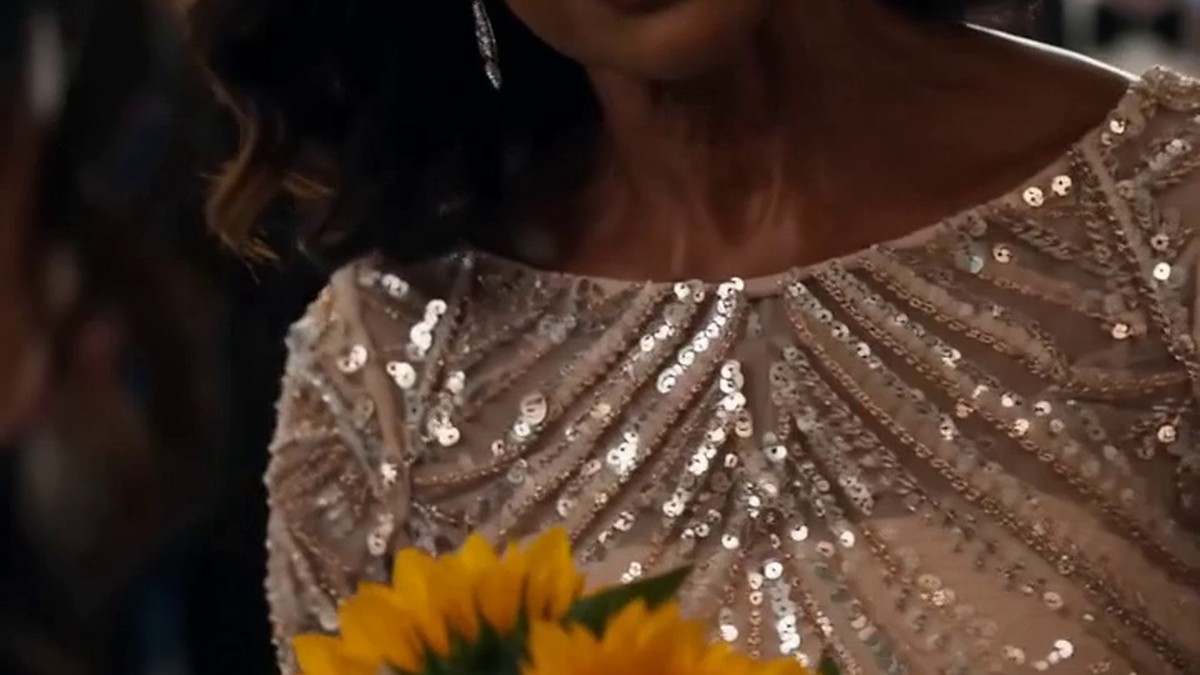
The event was an innovation showcase, some technology award for young entrepreneurs. I’d been bartending at the Aurora for five years, and I’d learned that the bigger the pretense, the smaller the tip. This bunch was all ironed shirts and stiff handshakes. The woman in the delivery jacket didn’t fit. She clutched a bouquet of sunflowers wrapped in brown paper, and her eyes searched the room until they landed on a man near the stage—Chris Tanner. He was the prodigy of the night, the one everyone kept toasting with sparkling water because he didn’t drink.
I was close enough to hear his mother, Linda, before I saw her. She stepped into the woman’s path like a crossing guard stopping traffic.
“You can’t be here,” Linda said, her voice low but sharp. “Not in that.”
“I’m just dropping off flowers,” the delivery woman replied. “I’m not staying.”
“People are watching. A courier handing my son a bouquet makes it look like we can’t afford our own arrangements.”
The woman’s name tag read *Eva*. Her face flickered—a tiny wince—but she held out the flowers anyway. “Chris asked me to come.”
Linda snatched them, and I watched her fingers crush a sunflower stem. Chris approached then, and I saw his shoulders were hitched high, the way men do when they’ve already decided to be cruel and are just waiting for the right excuse.
“This isn’t a good time,” he said to Eva.
“You told me the ceremony started at three. I finished my shift early.”
He reached into his jacket and pulled out an envelope. I’ve seen that move a dozen times: a man settling a tab with a woman who thought she was a partner. He pressed it into her hand. “This should cover what you loaned us. For the rent. Mom’s surgery. All of it.”
Eva didn’t open it. “I don’t want your money, Chris.”
“Please don’t make a scene.” His voice cracked, but not with sorrow—with impatience. Linda was already steering him back toward the stage. “We’ll talk later,” he said over his shoulder.
*Later* never means later. Anyone who’s ever been handed an envelope in a crowded room knows that. Eva stood there with the check flapping against her leg, her eyes glassy. I almost poured her a drink on the house, but my manager was watching, and I needed the shift. So I stayed behind the bar and watched her walk out, the bouquet left on a side table like a thing already dead.
The award went to Chris. Applause. Handshakes. A standing ovation from the investors. I went back to pouring gin and tonics and thought about my mother’s medication, and how the courier who brings it sometimes asks me how my day is going, and I realized I’d never tipped him more than two bucks.
Two hours later, I was taking my smoke break on the plaza behind the hotel. The rain had turned the pavement into a dark mirror. That’s where I saw Eva again. She was on her knees, one hand pressed against the wet concrete, the other still holding that unopened envelope. Her delivery scooter was tipped onto its side a few feet away.
A black sedan pulled up—the kind of car that costs more than my apartment. A man in a charcoal coat stepped out, his shoes immediately flooding with rainwater. He knelt beside her and draped his coat over her shoulders. I heard him say, very quietly, “Eva. Your father’s been waiting five years. Come home.”
She looked up at him and said something I couldn’t catch. He helped her stand, and she let him. The coat swallowed her, and the jacket with the little blue bird disappeared underneath. He guided her into the sedan, and the car pulled away. I finished my cigarette and went back inside, because that’s what you do when you’re a bartender and you see someone’s entire life capsize: you pour another drink.
Three months later, the Aurora hosted another event. This one was for Avery Holdings, a giant in the energy sector. The whole ballroom had been transformed—gold tablecloths, ice sculptures, a string quartet. I was working the bar again, because the tips were good and my mother’s prescription premiums had gone up.
The Tanners arrived early. Chris wore the same jacket I’d seen at the awards night, and Linda had a new dress, the price tag still creased at the collar where she’d probably tucked it back in. They stood near the stage, scanning the crowd.
“If I can just get five minutes with the new executive director,” Chris was telling his mother, “maybe she’ll see the value in the project. Avery Holdings pulled their investment, but if I can explain personally—”
“Don’t look desperate,” Linda cut in. “You’re a promising inventor. Remind them of that.”
The lights dimmed. A tall, gray-haired man I recognized from the business channels—Richard Avery—took the stage. He talked about legacy, about his daughter who had stepped away from the family empire to understand the world. “Tonight, she returns not just as my child,” he said, “but as a leader who understands the lives our decisions affect.”
The silhouetted figure beside the stage stepped into the light, and my hands stopped moving. I nearly dropped a bottle of chardonnay. The woman in the silver gown, her hair swept up, was Eva. The same Eva whose scooter I’d seen tipped on its side, whose sunflowers had been crushed. She wore a silver watch on her wrist—the kind of thing a delivery driver might buy with a month of tips.
She spoke. “I spent five years working in a world my family’s name never touched. I delivered packages, I paid rent on a one-room apartment, I sat in hospital waiting rooms with families who had to choose between medicine and groceries.” Her eyes scanned the crowd and passed over the Tanners without a flicker. “I learned that intelligence doesn’t care about your zip code, and that character doesn’t show up on a résumé.”
Linda’s hand locked onto Chris’s arm. His face had gone the color of old milk. I saw his lips move: “That’s her. That’s *Eva*.”
The applause nearly drowned him out. I poured myself a club soda and watched the show.
After the speech, Chris pushed through the crowd toward the side of the stage, where Eva stood with the man from the plaza—the same charcoal coat, now tailored into a tuxedo. This time, his name was on the program: Julian Cross, Chairman of Northpoint Dynamics. I didn’t know the details then, but I later pieced together that Northpoint had been Chris’s biggest backer until something went sideways.
Chris planted himself in front of Eva. “Please. I need to explain.”
Julian moved half a step forward, but Eva touched his arm. “It’s okay. Let him.”
“My mother lied to me,” Chris said. “She told me the money was coming from older men. She made me believe you were—that you were selling yourself to cover our expenses. I didn’t know.”
“You didn’t ask,” Eva said. “Not once. In five years, you never asked where the money for your mother’s surgery came from. You just assumed the worst and used it as your exit.”
“I was embarrassed by you,” he admitted. “I’ll admit that. But you hid being an Avery. How was I supposed to—”
“I hid nothing. I told you I came from money and that I’d walked away because I wanted to be seen for who I was, not what I could write a check for. You called it ‘rich girl guilt’ and never brought it up again.”
Linda pushed forward, her face streaked. “Eva, what I said to you was unforgivable. But you can’t blame Chris for listening to his mother.”
“I don’t blame him for that.” Eva’s voice stayed level. “I blame him for the way he winced every time I showed up in my uniform. For introducing me as a ‘family friend.’ For handing me that check in front of a room full of people without ever looking me in the eye.”
Julian spoke for the first time. “The investment was withdrawn because Northpoint’s board reviewed the terms of your original agreement and found several ethical violations—including your attempt to sell our proprietary process to a shell company.”
Chris swung toward him. “That shell company was *your trap*. You set me up.”
“No. We offered a competing contract with significantly better terms. You signed without reading the fine print, without consulting a lawyer, and without notifying Northpoint. That took about forty-eight hours. We simply watched.”
“You ruined me.”
“You chose a bigger number over a signed agreement. That was your decision.”
Chris looked back at Eva, and I saw the exact moment he realized no one was going to save him. Not his mother, not his charm, not even the ghost of the girlfriend he’d thrown away.
“I have nothing left,” he said.
“You have your prototype,” Eva replied. “The patent is still partially yours. You know how to fix things. Maybe start there.”
She turned. Julian offered his arm, and they walked toward the exit. Linda started to cry, the kind of crying that makes other guests turn away. Chris just stood there, staring at the space where Eva had been.
I never saw him again, not really. I quit the Aurora six months later to care for my mother full-time. The tips had been good, but I’d saved enough, and a medical assistant’s salary didn’t make sense when I was already doing the work.
One afternoon in November, I was walking home from the pharmacy with a fresh round of prescriptions when I noticed a repair van parked outside the old Roseland apartment complex on 105th. A man was kneeling beside the furnace intake, his tool belt sagging with wrenches and a voltage tester. I almost walked past, but then he turned his head.
It was Chris Tanner. He had a different face now—leaner, less rehearsed. His shirt said *Second Wind Heating & Cooling*. There was grease on his knuckles.
He didn’t recognize me. Why would he? I’d been just the bartender. I watched him for half a minute as he twisted a valve and wiped his forehead with his sleeve. A repairman. Not a CEO, not a prodigy. Just a guy who finally learned how to fix something and ask for nothing in return.
I heard later, from a former coworker who still sent me industry gossip, that Eva Avery and Julian Cross had married. Their wedding photo made the business section, and Eva had launched a grant program for first-generation students entering the trades. She’d included a clause that every recipient spend one afternoon a month volunteering in their own neighborhood. I wondered if Chris ever applied.
I never told anyone that I’d seen it all—the sunflowers, the check, the rain, the gown, and the furnace on 105th Street. But sometimes, when I’m sorting my mother’s pills into the little plastic cups, I think about how close I came to handing Eva a free drink that night, and how she might have smiled and thought I was just being kind.
I wasn’t. I was just a witness. And a witness knows that some stories are too sharp to carry, so you set them down somewhere and walk away.