Lillian Whitfield’s ear was pressed to the oak study door when the champagne flute slid from her hand. It hit the marble floor with a pop that should have brought the house down, but the voices inside never paused.
“…last warning, sweetheart. Sign the paper before you walk down that aisle, or your mother’s rehab bills leak to the press. Every. Last. Receipt.”
Harrison Whitfield’s tone was polished brass. The same voice he used to fire entire floors of salesmen while offering them a “generous severance.”
Then a smaller voice, shredded. Avery.
“Please. I just need another week. The patents are all my father has left.”
“You have twenty minutes.”
Lillian’s fingers found the brass handle. She was already turning it when a hand closed over hers.
Mason.
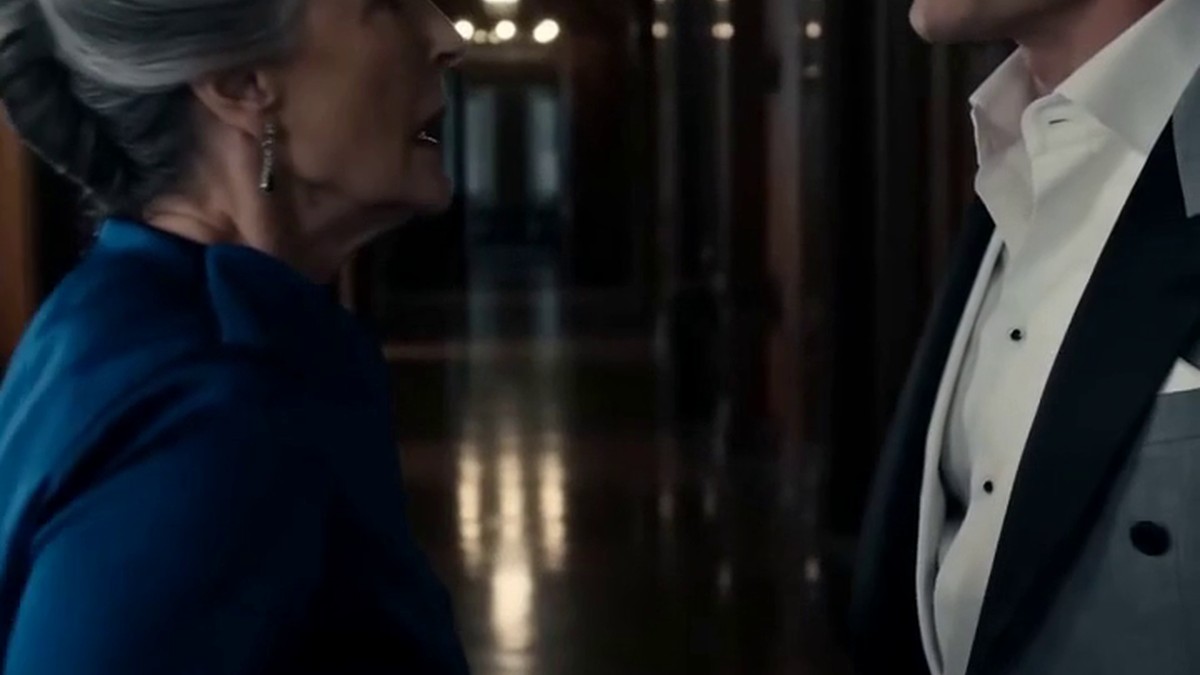
He stood there in his dove-gray tuxedo, no tie yet, top button undone. His face was a slab of granite she’d never seen on her son. She tore her hand free.
“Your father is in there… with your bride!” The words came out a hot whisper.
Mason’s gaze barely flicked toward the door. “I know.”
“Then stop this wedding *now*!”
Downstairs, the string quartet had just finished their sound check. Charleston’s afternoon sun was turning the lawn into a postcard. Two hundred guests were already sipping mint juleps under the live oaks of Whitfield Hall. The bridal suite was swarming with stylists, and the scent of magnolia and salt marsh drifted through every open window.
Mason didn’t move.
“Not yet.”
Lillian stared. “You *knew* he was threatening her? That girl is in there crying, and you’re just going to — what — walk her down the aisle like livestock?”
He took her elbow and steered her five doors down, into the empty library. The books smelled of leather and old secrets. Once the door clicked shut, he finally looked at her. And under that cold surface, she saw something raw.
“Avery and I have been working on this for six months,” he said. “She came to me first. Did you know that? Not to the police, not to a lawyer. To me. Because she thought I might be different from him.”
Lillian’s chest tightened. “What are you talking about?”
“The Sinclair patents are worth forty million. Dad’s been trying to swallow that company for two years. When Arthur Sinclair refused to sell, Dad planted a mole in his office, leaked the patent filings, and bankrupted their whole R&D division. Then he offered a ‘merger’ through marriage. My marriage. A perfect cover for a hostile takeover. And to make sure Avery played along, he had her mother investigated. The woman’s been in and out of addiction treatment since 2011. Dad bought the records.”
Lillian sank into a wingback chair. Her husband had always been ruthless, but this was predation dressed up as a wedding. And she had helped him tie the bows on the pews.
“So what is this?” she asked, her voice smaller now. “Some kind of trap?”
Mason pulled out his iPhone. On the screen was an audio recording app, a waveform still pulsing. “Every word he just said to Avery? It’s already on the cloud. The study has four hidden mics. My laptop in the groom’s suite is synced. The moment he threatened her mother, we had him for blackmail, wire fraud, corporate espionage — enough to put my father away for a decade.”
He said “father” like it was a tooth he was finally spitting out. Then he reached into his jacket and produced a small black fob, no bigger than a car key. “This is wired to the chapel’s PA system. When the minister gets to ‘speak now or forever hold your peace,’ I press the button. The recording plays over the speakers. Every guest, every reporter, every business partner hears it. The board will have no choice but to push him out. And a family friend at the FBI has had the full file for a week — two agents are already on the property, waiting for the signal.”
“And the wedding?” Lillian whispered.
“The ceremony is the trigger. Afterward, they’ll take him in. The SEC will be opening an investigation before the reception would have started.”
Lillian’s mouth opened, but nothing came out except a shaky breath. Mason knelt in front of her, and for the first time in years, he looked like the little boy who used to hide from his father in this very room.
“Mom… I know I should have told you. But I couldn’t risk you defending him. Not this time.”
She thought of all the dinners where Harrison’s temper had iced the conversation. The way he’d congratulated Mason on the engagement as if he’d just closed a deal. The way Avery’s smile never reached her eyes.
“I’m not going to defend him,” Lillian said. She sounded older than her fifty-seven years, but certain. “What do you need me to do?”
Mason’s shoulders dropped half an inch. “Just walk me to the altar. And when the recording plays, don’t look away.”
—
The chapel at Whitfield Hall had stood since 1842, and its stained-glass windows bled gold and rose across the congregation. Lillian sat in the front left pew, her silk dress suddenly feeling like armor. The brass clock on the wall read 3:47.
The bridal march began.
Avery came down the aisle on her father’s arm — Arthur Sinclair, a man so broken by debt he looked like he’d aged a decade in one year. Avery’s gown was Vera Wang, simple and expensive, and her bouquet of white peonies trembled as she walked. She was a portrait of composure, but Lillian now saw the thin line of her jaw, the way her knuckles were white around the stems.
When Avery reached Mason, they exchanged a look. Not the look of a couple in love — something deeper. Co-conspirators. Two people who had been holding their breath for months and were about to finally exhale.
The minister began. The readings came and went. Lillian’s heart was a drumline.
Then: “If any person can show just cause why this couple may not be joined together, speak now or forever hold your peace.”
A three-second pause stretched into eternity. Mason’s right hand slipped into his pocket.
Then the speakers crackled.
Harrison’s voice, viscous and southern, filled every corner of the brick chapel: *“You have twenty minutes.”*
A collective gasp. Some guests looked up at the vaulted ceiling as if God had decided to testify. Others turned to the back, where Harrison Whitfield stood in his tailored navy jacket, suddenly the color of old bone.
The recording played in full. Every threat, every whisper of “rehab receipts,” every casual destruction of a family’s dignity. By the time it ended, four journalists were already typing on their phones, and Arthur Sinclair had risen so fast that a hymnal slid off his lap and slapped the stone floor. His fists were clenched, his mouth clamping and unclamping like he’d swallowed something too large to spit out.
Harrison took two steps toward the altar, but Mason raised a hand. “Now,” he said, flat. “Escort Mr. Whitfield to the foyer.”
Two men in plain suits materialized from the side doors. Lillian recognized one of them — a retired agent Mason had kept on retainer since the summer, the same man who’d been briefed to coordinate with the Bureau. The agents flanked Harrison, whose polished mask finally cracked. He looked at his son, then at Lillian, as if waiting for her to plead his case. She met his gaze and slowly shook her head.
He was led out.
The chapel hummed with chaos. Mason turned to the minister, who was clutching his Bible like a life raft. “You can dismiss everyone,” Mason said gently. “There won’t be a wedding today.”
Then he took Avery’s hand, and together they walked not down the aisle, but through the side door to the garden, where the day’s last light was threading through the wisteria.
Lillian followed them outside. The three of them stood in the quiet, the noise of the emptying church a distant roar. Avery’s veil was pushed back, and her hair had come loose from its pins. She was crying again, but this time she let out a long, shuddery breath that fogged a gardenia leaf, and her shoulders dropped like she’d just set down a suitcase she’d been carrying for miles.
“What happens now?” Lillian asked.
Mason looked at Avery, and she met his eyes. He reached over and gently pulled a bobby pin from the mess of her hair, and the corner of her mouth twitched — not a smile, but a promise of one.
“Now,” he said, “we go get a pizza. And tomorrow we’ll watch the board clean house.”
Avery let out a sound that was half laugh, half hiccup. Lillian found herself reaching for the young woman’s hand, and when their fingers laced together, she felt like she was holding something that might finally heal.
—
Twenty minutes later, the three of them slid into a cracked vinyl booth at Sully’s Slice, a neon-lit pizza counter on Ben Sawyer Boulevard a mile from Whitfield Hall. The air smelled of oregano and old Parmesan. Mason had shed his jacket and tie; Avery still wore her gown, but she’d kicked off her heels under the table and was now looping a strand of melted mozzarella around her finger. A large half-pepperoni, half-mushroom sat between them, the bill tucked under the napkin dispenser — $26.73 in total. Mason fished a crumpled fifty from his wallet and didn’t wait for change.
Lillian stared at the cheese stretching off the slice in her hand. “This is the first time I’ve had cheap pizza in something that cost more than a car.”
Avery laughed, a real one, short and surprised. Mason’s phone buzzed on the tabletop. He glanced at the screen, held up a finger, and stepped outside into the evening. Through the window, Lillian watched him pace under the streetlight, nodding. When he came back, he slid into the booth and said, “Board’s calling an emergency vote first thing tomorrow. Harrison’s already blocked from all accounts. The FBI wants a formal statement by noon.”
Avery’s eyes welled again, but she just picked a mushroom off Mason’s slice and popped it in her mouth. “Good,” she said. “I want to see the look on his face when they read him the charges.”
—
Two weeks later, Lillian drove her station wagon onto Sullivan’s Island with a housewarming gift wrapped in brown paper — a seasoned cast-iron skillet. She found the pale blue cottage on Station 22½ exactly where Mason had described it, a block from the beach, with a half-painted porch swing still dripping white. Before she could knock, the screen door banged open and Arthur Sinclair stepped out, a folded set of papers clutched to his chest. His eyes, which had been hollow on the day of the ceremony, were clear. He looked ten years younger.
“Lillian.” He nearly tripped over a paint can. “They just signed. The settlement came through — the patents are back, plus enough to restart the lab. Your son… I don’t know how to thank you.”
Lillian set the skillet on the porch rail and let him pull her into a brief, bony hug. Over his shoulder she saw Mason and Avery in the living room, huddled around a laptop, a conference call with the Whitfield family attorney mumbling through the speaker. Avery was wearing cutoff jeans and a faded T-shirt that said “Charleston Harbor Tour ’98.” Mason caught Lillian’s eye and gave a thumbs up, his first unguarded smile in years.
The legal fallout would take months — Harrison’s trial was set for October, the SEC had already issued subpoenas — but inside this tiny house, the air tasted like salt and fresh paint and borrowed time.
—
The summer unspooled. Lillian visited every Sunday, and one afternoon she found them in the kitchen, flour up to their elbows, arguing over the right way to crack an egg. Mason insisted on a flat surface. “One clean tap on the counter. No shell fragments.” He demonstrated, but the egg crumbled in his hand, yolk dripping between his fingers. Avery stood on the opposite side of the butcher block, brandishing a whisk. “Rim of the bowl,” she said. “Always. Look — perfect.” She tapped the egg against the ceramic edge, and the shell split cleanly, the yolk slithering whole into the batter. She held up the empty halves like a trophy. “See? No shards.”
A single, stubborn piece of shell sat in the bowl. Mason plucked it out with a spoon and flicked it into the sink. “One shard. That’s a fail.”
“It’s one shard, you monster.”
Lillian leaned against the doorframe and watched them, a tea towel over her shoulder. The afternoon light turned the flour dust into tiny golden galaxies. Avery was laughing — a full, unguarded laugh that Lillian had never heard in all the months of engagement. Mason tossed a handful of flour at her, and it landed in her hair like snow. She lunged for the bag to retaliate, and Lillian had to duck to avoid getting hit.
“You’re both doing it wrong,” Lillian said. “You crack it on the counter while pouring the wine with your other hand.”
Avery burst out laughing again, and Mason caught Lillian’s eye, his face half-covered in flour. Outside, a neighbor’s wind chime clattered in the breeze off the Atlantic, and the kitchen smelled like butter, yeast, and chaos. Avery declared a rematch and handed Mason a fresh egg. “Your turn, champ. Flat surface. Go.”