There's a coffee can nailed to a fence post at the trailhead outside Ripton, Vermont, and inside it are four hand-carved walking sticks, sanded smooth at the grip, each one a little different because Walt Prescott made them himself in his garage over one long winter eleven years ago.
I run the general store half a mile down the road, the one with the wraparound porch and the bell that still jingles when the door opens, and I've watched that coffee can longer than I've watched almost anything else in this town.
My name's Dorene Kessler. I'm sixty-eight, I've sold penny candy and fishing licenses and lottery tickets out of that store since Reagan was president, and if you want to know what happened to the sticks, you're going to have to let me tell it the way it actually went, because the version people repeat around here has gotten soft at the edges, and the real one has a little more grit in it.
Walt built those sticks for his wife, Bev, who had bad knees and loved the Sucker Brook trail more than she loved almost anything except her grandkids and her Wednesday crossword. He made extras. Said if Bev needed one, somebody else probably did too. He drilled a hole in a fence post, hung an old Maxwell House can from a bent nail, painted a sign that said TAKE ONE, BRING IT BACK, and that was that. No lock. No sign-up sheet. No deposit.
For years it worked exactly the way you'd hope. Hikers grabbed a stick at the bottom, used it for the two-and-a-half-mile loop up past the falls, left it leaning against the post on their way back to the parking lot. Sometimes there'd be five sticks in the can. Sometimes none, and you'd just wait, have a seat on the bench Walt built next to it, watch the creek.
Then two summers ago a man named Roy Denner moved up from Springfield, Massachusetts, and bought the old Talcott place at the top of the ridge, and Roy Denner decided the trail crossed a corner of his property line — which it technically did, by about eleven feet, according to the county plat map he waved around at the town hall like it was a subpoena — and Roy Denner decided he was going to be the one who controlled that eleven feet.
He didn't take the sticks. That's the part people forget. He put a padlock on the can.
I remember the morning it happened because Ruthann Pelkey came into the store out of breath, still in her hiking boots, and said, "Dorene, somebody chained up Walt's sticks." I thought she meant vandals. She meant Roy.
He'd bought a hasp and a combination lock at the hardware store in Middlebury — I know because Gary at the counter told me, he thought it was for a shed — and he'd screwed it right through the coffee can, through the wood of the fence post, and left a laminated note: PROPERTY ACCESS RESTRICTED PENDING SURVEY. CONTACT R. DENNER FOR PERMISSION.
Bev Prescott had passed the January before. Walt was seventy-four, living alone in the house on Weybridge Street, and that trail was the one place he still walked every single morning, rain or shine, sticks or no sticks, because it was the only thing left that felt like Bev was still walking next to him.
He found the lock on a Tuesday. I know because he came into the store that afternoon and bought a cup of coffee and didn't say much, just sat on the bench outside for close to an hour before he drove home. Ruthann told me later he'd stood at the fence post for a long time, testing the lock with his thumb like maybe it would just give.
The town didn't organize a protest. This is Ripton, population under six hundred, we don't really do protests. What we did was smaller and, I think now, sharper. People started leaving their own sticks. Broom handles. An old hockey stick with the blade sawed off. Someone's grandfather's cane with a brass duck head. They leaned them against the locked can, dozens of them within a week, a little forest of borrowed wood standing next to a padlock that guarded nothing anymore because it never actually held the only sticks in town — it just held Walt's.
Roy Denner drove down one Saturday to find his hasp and lock still there, useless, surrounded by what amounted to a public shrug. He took photos. He posted in the town Facebook group about "entitled hikers" and "respecting private boundaries." Somebody — I have my suspicions, and her name rhymes with Ruthann — replied with the actual county survey showing the eleven feet of trail sat on an easement recorded in 1961, decades before Roy or the Talcotts before him ever held that deed.
That's the part that mattered. Not the sticks. The easement.
I drove to the county clerk's office in Middlebury myself, on a Thursday, because I wanted to see the paper with my own eyes before I believed the rumor. Twenty-two dollars for the certified copy. Recorded Book 94, Page 311. A hiking and utility easement, eleven feet wide, granted in perpetuity across that parcel by the Talcott family in 1961 for public trail access — the same eleven feet Roy had padlocked a coffee can over.
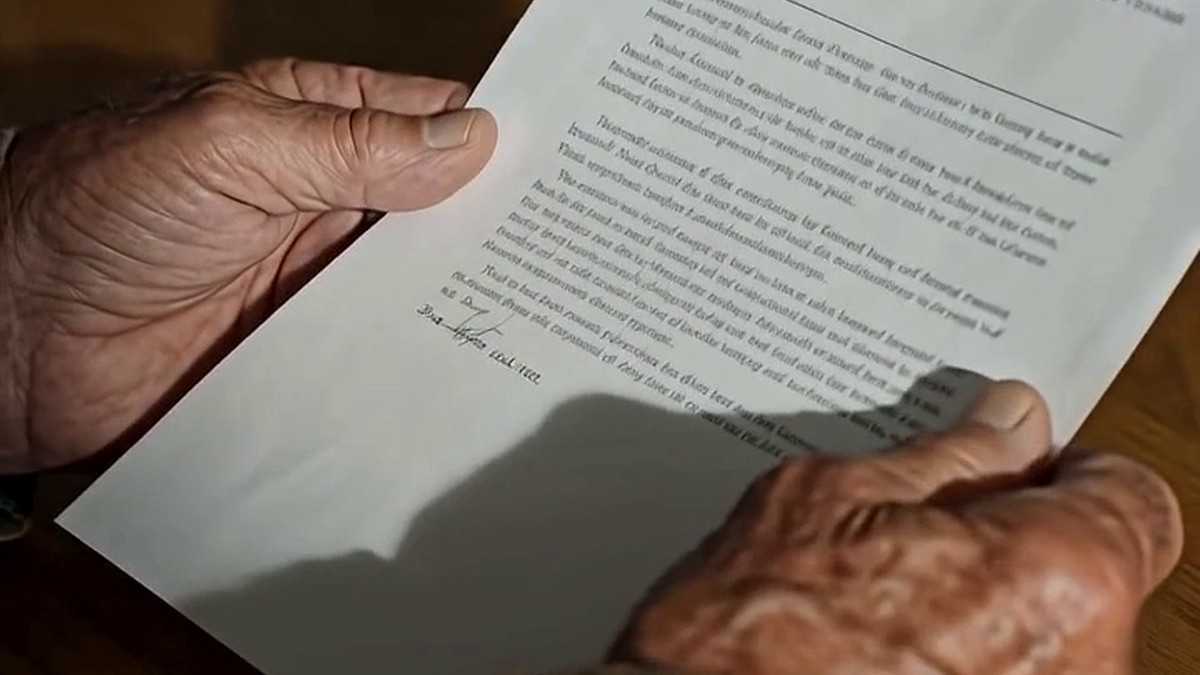
Walt didn't yell at Roy. Walt drove to Middlebury with me, sat next to me at the clerk's counter, and asked the clerk, a woman named Priscilla with reading glasses on a beaded chain, to print him a second certified copy for eleven dollars. He folded it into a manila envelope. He wrote Mr. Denner on the front in the same steady hand he'd used to carve Bev's initials into the fourth walking stick, the one nobody was allowed to borrow because it stayed in his front hall closet.
He mailed it. Didn't drive up the hill to hand it over, didn't leave it in the mailbox with a note, just put a stamp on it and let it go through the regular system, the way you'd send a Christmas card to somebody you weren't especially fond of but felt obligated to acknowledge.
Three weeks later the lock was gone. Cut, not unlocked — somebody at the county, or maybe the sheriff's office after Roy called about "trespassing" and got told about the recorded easement in no uncertain terms, must have had a word with him, because bolt cutters had done the job and nobody in Ripton owned up to it, including, I suspect, Roy himself, who probably didn't want to admit he'd removed his own lock.
The coffee can went back up. Walt rehung it the following Sunday, using the original bent nail, which had survived the whole ordeal untouched in the fence post like it had been waiting.
He didn't put all four sticks back in. He put three. The fourth one, Bev's, he kept for himself, and started walking with it every morning instead of leaving it for strangers, which none of us thought twice about, because by then everyone in town understood exactly what that stick was worth to him and it wasn't the kind of worth you loan out.
Roy Denner sold the Talcott place last spring. Moved back to Massachusetts, I heard, though I couldn't tell you if that's true or just what people say now to close the story out neatly.
Walt still walks the loop every morning at half past seven. Last week I watched him come down Route 9 past the store window, Bev's stick tapping the gravel shoulder in that same unhurried rhythm, and he lifted two fingers off the handle at me the way he always does, and I lifted my coffee mug back, and neither one of us said a single word, because in a town this size, some mornings you don't need to.