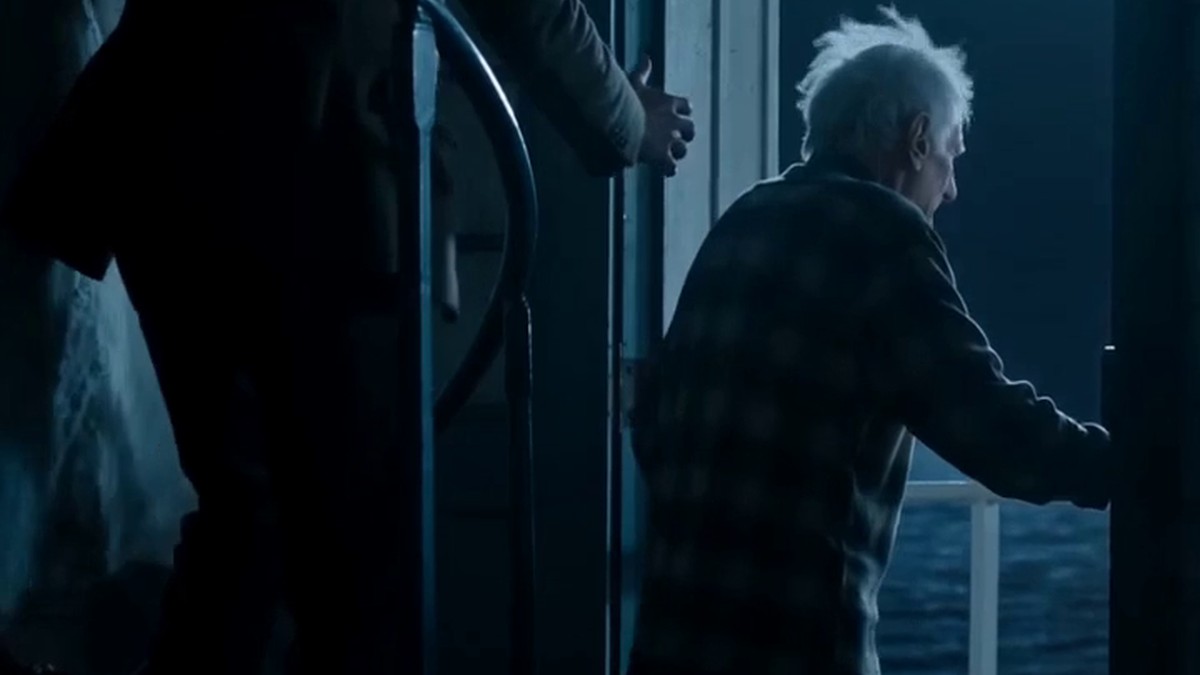
The band was halfway through a mangled version of “At Last” when I saw my grandfather slip out the back door of the reception hall. He moved like a man who’d just remembered a stove left on—shoulders tight, gaze fixed on something nobody else could see. I’d been watching him all night, nursing the same glass of flat champagne, not eating a thing. His hands shook when he lit his pipe on the deck earlier. That wasn’t like him. Gramps had hands steady enough to suture a torn sail in a squall.
Maya squeezed my fingers under the table. She’d kicked her heels off an hour ago and her bare feet rested on top of mine. “Hey. You okay? You’ve been a thousand miles away.”
“Just hot,” I said. “That storm’s pushing in. I’m gonna get some air.”
I didn’t tell her the rest. I didn’t tell her about the journal.
Two days before the wedding, I’d driven up to the old keeper’s house on Harrow Point to grab Gramps for the rehearsal dinner. He wasn’t in the cottage. His truck was there, keys in the ignition, which made the back of my neck prickle. I found him up in the lantern room of the lighthouse, a squat granite tower the Coast Guard decommissioned back in ’04. He was gazing at the dead Fresnel lens—a massive beehive of glass and brass, dark for almost two decades—with an expression I’d never seen on him before. Not sadness. Something closer to dread.
“Gramps? We’re gonna be late.”
He turned, startled, and a small leather book slipped from his lap and hit the iron floor. I picked it up. He didn’t try to stop me.
The handwriting was his. Dates going back fifteen years. One entry, written in a hand so tight it pressed grooves into the page, stopped my breath. He’d written about a man named Harlan Decker who’d offered him five thousand dollars to “forget” to light the lamp for three nights. A storm had been forecast. Gramps wrote: *I told him no. Twice. But Lily was sick—whooping cough, she was six. The bills were eating us alive. I said yes on the third night. A crabber out of Beals Island hit the rocks. Four men. I killed four men.*
He’d never told anyone. Not my mother, not the police, not even the pastor he played chess with every Thursday. He’d buried it inside that tower and let it fester.
I didn’t confront him. I thought I could wait. Wait until after the cake, after the toasts, after I’d danced with my wife. But when the lights in the reception hall flickered and died—some grid overload from the heat wave rolling up the coast—I saw his face in the darkness. And I knew he was going back to the lighthouse. Not for nostalgia. For a goodbye.
—
I didn’t run after him at first. I walked. Past the tables littered with shrimp tails and crumpled napkins, past the bar where my best man, Tommy, was arguing with the bartender about whether a Dark ’n Stormy required Gosling’s or Myers’s. The emergency lights clicked on, painting everything a sickly green.
Maya caught my arm by the door to the parking lot. She’d followed me, still in her dress, hair coming loose from the clip. “Leo. What’s going on?”
“It’s Gramps. Something’s wrong. I have to go.”
“Then I’m coming with you.”
“Maya—”
“We just promised each other *in everything*. So I’m in this. Whatever it is.”
I looked at her. This woman who’d agreed to marry a guy who spent half his life on a container ship, who’d fallen for me in the maritime history section of the Portland Public Library when I knocked a stack of atlases into her lap. She wasn’t asking. She was telling.
“Okay,” I said. “We take my truck.”
The road to Harrow Point is a crumbling stripe of asphalt that winds through a thicket of scrub pine and beach rose. In the dark, with my high beams bouncing off the fog, it felt like driving into a throat. Maya gripped the oh-shit handle and said nothing. Her dress pooled around her ankles, already smudged with parking lot gravel.
The gate to the lighthouse grounds was wide open.
Gramps’s truck was there. And his cottage door was ajar. Inside, a kerosene lantern guttered on the table, next to a mug of cold coffee and his old maritime radio—smashed on the floor, like he’d thrown it against the wall.
“The tower,” I said.
We ran. Maya kicked off her heels entirely and sprinted barefoot over the crushed shells of the path. The lighthouse door—a slab of rust-pitted iron—stood open just a crack. The air that leaked out was cold and smelled of salt and machine oil and something sharper, like burnt wax.
“Gramps!” My voice echoed up the spiral staircase and died.
No answer.
I took the stairs two at a time, Maya right behind me. The stone walls sweat moisture. Every landing had a slit window that showed nothing but black Atlantic and the far-off blink of a buoy. Ninety-seven steps to the lantern room. I’d counted them as a kid.
At the top, the room opened into a circle of glass. The old lens sat in the center like a dormant heart. And there was Gramps, standing on the far side, one hand on the railing of the open service door that led to the outside catwalk. The wind ripped through the gap and screamed in the copper fittings.
He heard us and turned. His face was wet. Not from the spray—he’d been crying.
“Leo.” His voice came out hoarse, chewed up. “You shouldn’t have come.”
“Yeah, I should have.” I stepped toward him, careful, the way you approach a spooked horse. “I read it, Gramps. The journal. I know what happened.”
He flinched like I’d struck him. Maya stayed by the stairs, her hand pressed to her mouth.
“Then you know what I am,” he said. “You know why I can’t sit at your table and raise a glass to your bride. I took four souls, boy. I took them for money.”
“You took it for my mom,” I said. “She had whooping cough. She was six. The bills were drowning you and Grandma. I’m not saying it was right. I’m saying I understand how a man can break.”
Gramps looked at me, his eyes unblinking. The wind snatched at his thin white hair. “I was going to step off this ledge tonight. Fifteen years I’ve been climbing up here, trying to find the guts. And every time, I’d see your mother’s face. Or yours. And I’d climb back down. Tonight, I thought… the wedding’s done. You’re taken care of. Nobody needs the old man anymore.”
“That’s crap,” Maya said.
We both turned. She’d let go of the railing and walked into the center of the room, into the shaft of moonlight that fell through the lens. Her dress was ruined, her feet were bleeding, and she looked furious.
“You don’t get to check out,” she said, her voice shaking. “Not tonight. I just stood up in front of everyone I know and swore I’d be part of this family. So you’re my family now. And I’m telling you—we are not starting this marriage by scraping you off the rocks.”
Gramps opened his mouth. Closed it. His hand on the railing loosened.
I moved then. Crossed the floor and put my arm around his shoulders. He felt light, hollow-boned like a bird. “Here’s what’s going to happen,” I said. “We’re going to walk down those stairs together. Then you’re going to sit in my truck while I call Sheriff Dunphy. You’re going to tell him what you told that journal. Every word.”
“They’ll put me away.”
“Maybe. And we’ll be there. Visiting hours, lawyer fees, all of it. But you don’t get to make me complicit in a second death. You taught me a lighthouse keeper’s first rule. The light doesn’t judge the ships it saves. It just shines. You’ve been living in the dark so long you forgot that even a busted lamp can be relit.”
He said nothing for a long moment. Below us, the surf hammered the granite cliffs with a sound like distant thunder. Then he reached up and gripped my forearm. His fingers were cold but steady.
“All right,” he said. “All right.”
—
Three months later, the fog was thick again, the kind that muffles the bell buoy off Harrow Point. I sat on the tailgate of my truck and watched the lantern room window. A single work lamp was on inside—not the big beam yet, just the warm glow of a trouble light. Gramps had been up there since sunrise, rewiring the old rotation motor. Community service. The judge had given him a suspended sentence, five hundred hours, and Gramps had chosen to do them here, on the tower he’d once let go dark.
Maya climbed up beside me with two cups of coffee from the thermos she’d brought. She’d traded her wedding dress for jeans and one of my old flannel shirts, sleeves rolled past her wrists. “How much longer?”
“He said dusk. He wants to test the lamp.”
The town had voted to fund the restoration a few weeks after the news broke. Now a small crowd had gathered down by the dock—lobstermen, the librarian, the pastor—waiting. They’d all known Gramps as the old keeper who still walked the rocks every morning, not as the man who’d confessed to something from three decades ago. Some of them didn’t come. Some did.
A few minutes later, the lamp inside the lens flickered, then bloomed white. The beam swept out through the glass, cut through the fog, and kept going. It raked the water, steady as a slow breath. The crowd on the dock clapped, a ragged sound carried on the damp air.
Gramps came out on the catwalk. He leaned on the rail and looked down at us in the truck. I gave him a thumbs-up. He lifted his chin in acknowledgment, then turned his face back to the sea.
Down in the keeper’s cottage, where Maya and I had been staying on weekends to help with the restoration, a pot of clam chowder was heating on the stove. I could smell it from here—salt pork and onion and cream. My mother had brought it over that morning and left it simmering with a note: *For when you’re done.*
I got down from the tailgate and offered Maya my hand. She took it, and we walked toward the cottage to set out bowls.