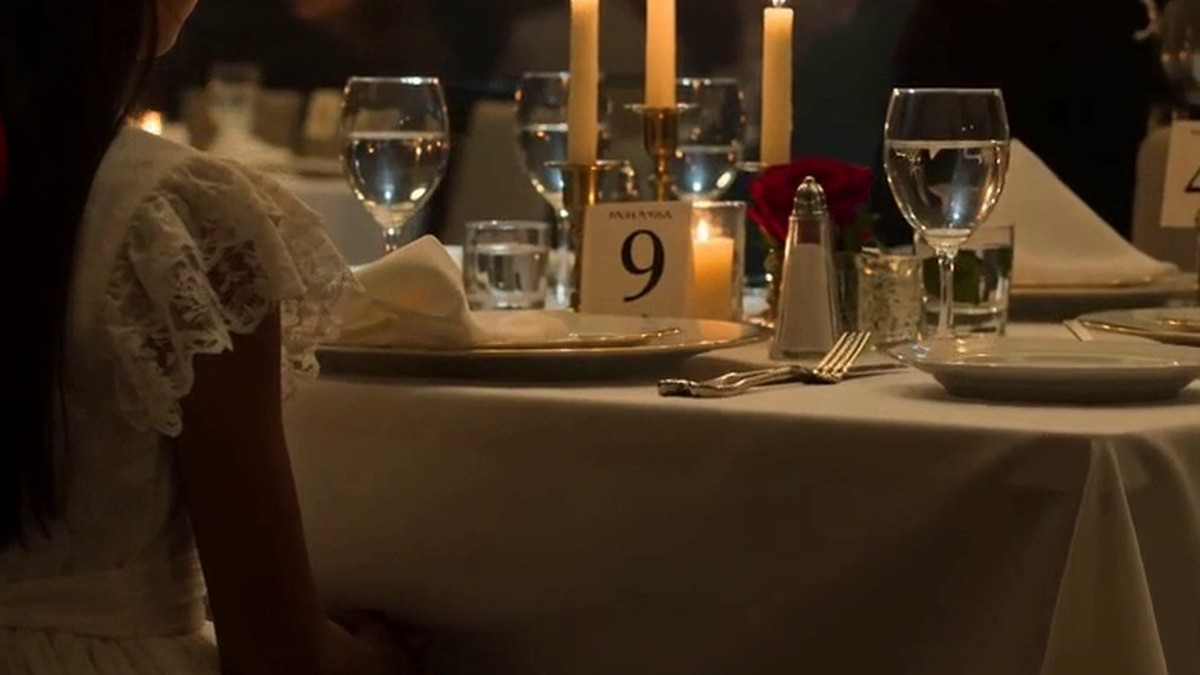
The woman at table nine set her wine glass down with two fingers, the way people do when they're deciding whether to stay. I was refilling water at table eleven and I caught the whole thing because the little girl selling roses had stopped between the tables like a deer in headlights.
The woman in the black suit didn't look like she needed roses. She looked like she needed to finish a phone call that wasn't coming. The girl, maybe twelve, had a basket over her arm and a ribbon in her hair that had come loose. And then the girl said it.
"Ma'am, your ring looks just like my mom's."
You don't hear that in a place with twelve-dollar lemonade. I know because I've worked there eleven years. The room got kind of still.
The woman's hand went flat on the tablecloth. The ring caught the light, a gold rose with a red stone in the middle. She didn't answer right away, and the girl got nervous, shuffled her sneakers on the carpet.
Then the woman said, very carefully, "That's a beautiful compliment." She turned the ring so the stone faced her palm. "This ring has been in my family for a very long time."
The girl didn't move. She pushed hair out of her face and looked at the ring again.
"My mom has the same one," she said, quieter now. "She never wears it. She keeps it in a little blue box."
The woman's face didn't change, but her other hand found the stem of the wine glass and rotated it an inch. "Many rings look alike."
"No." The girl shook her head. "It's exactly the same. It opens."
The woman's back went straight.
I had a water pitcher in my hand and I should have moved to table twelve, but I didn't. The restaurant sounds went on around us—the clink of forks, the low hum of the jazz trio, some man laughing too loud near the bar—but at table nine, the air turned private.
"What do you mean, it opens?" the woman asked.
The girl shifted the basket higher on her arm. "There's a little clasp on the side, and it opens. There's a name inside."
The woman's face went a shade lighter. She pulled her hand under the table, and the ring disappeared from sight.
"What's your name?" she asked.
"Maya."
"Maya what?"
"Maya Delgado."
The woman reached for her purse, which was on the empty chair beside her, and took out a twenty. She held it out, not for the roses, just held it.
"Maya," she said, "where do you live?"
The girl looked at the money and didn't take it. "On Marigold Street. The apartments by the car wash."
"With your mother?"
"Yes."
"What's your mother's name?"
"Cecilia. Cecilia Delgado."
The woman's hand with the twenty sank to the table. She sat there for a long moment, and I saw her chest rise and fall once, twice, like she was doing math behind her eyes.
"Would you sit with me for a minute, Maya?"
The girl hesitated. She looked around at the other tables, maybe checking if someone would yell at her. Then she set her basket on the floor and got up onto the chair across from the woman.
The woman took off the ring. She turned it over in her fingers, found the clasp, and opened it. I couldn't see the inside from where I stood, but I saw the way she looked at it.
"Do you know what my name is?" she asked.
"No, ma'am."
"It's Vanessa. Vanessa Cruz. But before I was married, my name was Harlow. Is that the name in your mother's ring?"
The girl's eyes went wide. She grabbed the edge of the table.
"My mom's ring has Harlow in it. She said it was her sister's name."
The woman closed the ring and pressed it into her palm. "I am her sister."
The girl just sat there, mouth open.
"I've been looking for my sister for nine years," the woman said. "Since before you were born, probably."
And that's when I figured the boy at table twelve could wait. I stepped back behind the service station, but I stayed close enough to hear. You work a place this long, you learn when to be invisible.
The woman—Vanessa—called over a manager. Not for the girl. She asked for a phone number, the restaurant's landline, so she could reach her driver. I didn't even know she had a driver. She was the kind of woman who buys the wine, not the kind who leaves before the dessert menu.
She paid her bill in cash, which was a thing nobody does, and she left three hundred dollars on the table for a meal that cost maybe ninety. She held out her hand to the girl, and the girl took it. They walked out together, the basket of roses forgotten on the floor under the table.
I picked it up. I could have returned it, but they were already in the black car. The girl looked back once through the rear window, and her mouth was open like she was already telling the story to someone who wasn't there yet.
I stood there holding someone's entire life in a basket of red roses. The kitchen door swung open behind me, and Michelle from the host stand came out with a stack of menus. She saw the basket.
"Those for sale?" she asked.
I set them on the host stand. "They're already sold."
Michelle looked at me funny, but I didn't explain. I punched my break early on the time clock. Eleven years in that restaurant, and I had never once punched out before the night rush. But I walked to the back, sat in the break room, and pulled up my sister's name on my phone. We hadn't spoken since March. I texted her: "Call me when you can."
No answer. I set the phone face-down on my knee and went back to my station.
The next Friday, the same woman came back. She wasn't alone. She had Maya with her, and another woman, a little older, with dark hair and a gold ring on her finger that matched. They sat at table nine. All three of them ordered the lemonade.
I brought them a basket of bread. "Welcome back."
Vanessa looked up. "You remember us."
"Table nine," I said. "I remember."
She didn't say anything else. She didn't have to. Cecilia kept touching the ring on her finger, checking it was still there, the way you'd touch a bruise to see if it still hurt. Maya ate the whole basket of bread and asked for another. And Vanessa laughed at something her sister said — not a polite laugh, a real one, head back — and that was the first time I saw her teeth.
I cleared their table around nine that night. Under Maya's chair, half-hidden by the leg, was a single loose petal, red, a little crushed. I picked it up and put it in my apron pocket instead of the trash.
Walking home, I pulled it out once, turned it in my fingers the way Vanessa had turned that ring, then texted my sister again.
"Call me."