The shelter volunteer said it plainly: “He’s old and sick.” But the woman’s answer caught them all off guard.
Sarah stood in front of kennel number twelve, where a large, graying dog lay motionless against the far wall. Behind her, the volunteer was already rehearsing the gentle letdown speech she’d given a hundred times. It was a damp March morning, the air thick with the smell of wet asphalt and thawing earth. Sarah had ridden the first bus out, counting every stop, and now she was here for the third time that week. The first two times she’d gotten as far as the shelter gates before her nerve failed. This morning she’d brought a leash.
The kennel corridor smelled of bleach and damp fur. From the far end came a hollow, weary barking—dogs barking not at humans, but just to remember the sound of their own voices. Sarah walked past cages where animals whimpered, shuffled, pressed noses through chain-link. She stopped at twelve.
The dog—a large mixed breed with a muzzle frosted white—lay on his side, ribs rising and falling so heavily that each breath seemed a separate labor. His eyes were open but cloudy, fixed on something beyond the metal bars, beyond people, beyond everything. A laminated card on the gate read: *Duke. Male. 12 years. Arthritis, heart murmur. Not aggressive.* Not aggressive. As if that summed up twelve years of a life.
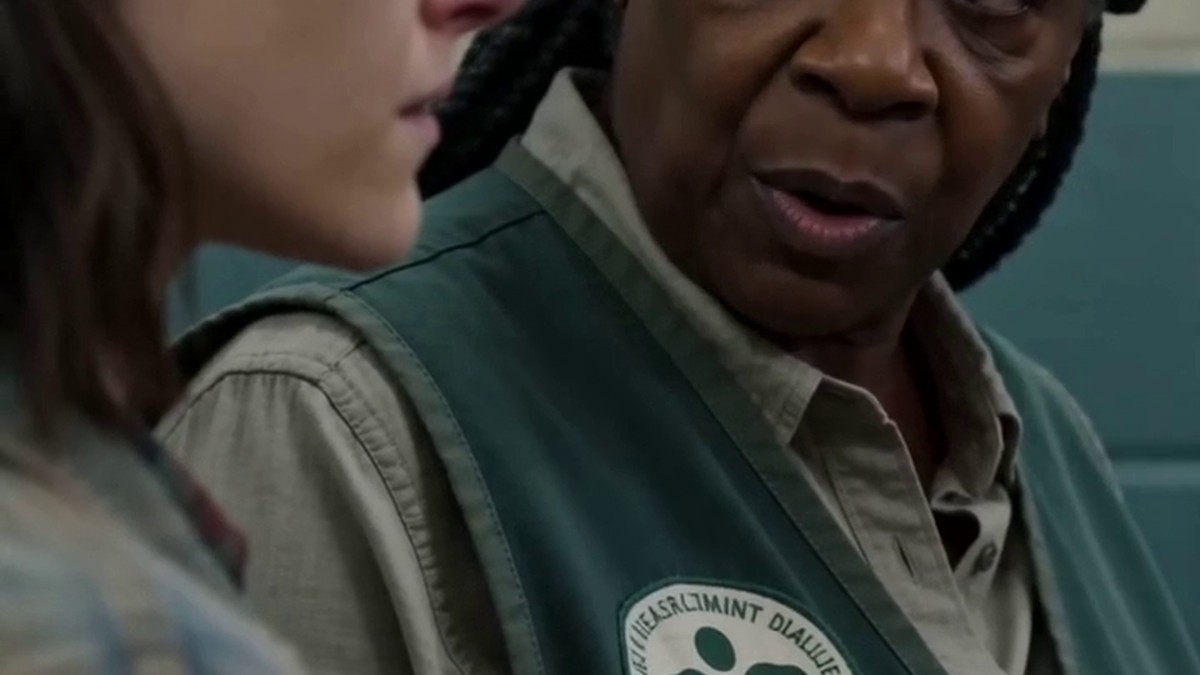
Lauren, the volunteer in a crooked green shelter vest, touched Sarah’s elbow. “Look, that’s Duke. Arthritis in his hind legs, grade-three heart murmur, vision’s almost gone. Most of his teeth too.” She spoke quickly, efficiently, like someone used to delivering bad news. A faded scar ran from her wrist to her elbow, a relic from a rescue long ago. Sarah said nothing.
“We’ve got younger dogs,” Lauren went on, nodding toward the next kennel, where a tan pit bull was hurling himself against the door in a joyful frenzy. “That’s Buddy, three years old, sweet as pie. Or Daisy, a year and a half, perfect on a leash. Want to see them?”
“I already saw them,” Sarah said quietly, not shifting her gaze from kennel twelve.
Lauren paused and looked at her more closely: faded denim jacket, dark hair tucked behind her ears, fingers still red from the morning cold. The woman didn’t flinch at the noise or the stench, and she wasn’t looking at Duke with the cheap pity that visitors often wore. She looked at him the way you look at someone you already know.
“Look, I have to warn you,” Lauren said, her voice softening. “He might not have long. Six months, maybe a year. The medicine isn’t cheap—monthly vet visits, pills, injections, special food. He barely manages stairs. His joints are shot.”
“I live on the first floor,” Sarah said.
Lauren hesitated. After seven years at the shelter, she knew that silence didn’t save dogs. People would take one look at Duke, ask why he wouldn’t wag his tail, and walk away. In the next kennel, Buddy barked and spun in circles, desperate for attention. Duke didn’t even twitch an ear.
They moved to the adoption room, a cramped space with a metal desk and a coffee machine that brewed something more like warm mud. Lauren spread out the papers: an ownership contract, a thick veterinary file, a care sheet for senior dogs.
“Are you sure you understand?” Lauren asked, wrapping both hands around her cup. “He’s not a puppy who’ll chase a tennis ball. He might not leave his bed for a week. Might whine all night from the pain. He might…”
“He might die,” Sarah finished, her voice steady. “I understand.”
Somewhere a door slammed. The smell of cold, wet concrete seeped through the vent. Sarah picked up her coffee but didn’t drink it. “I don’t need a puppy,” she said. “I need the one nobody else will choose. Because I know exactly how that feels.”
She said it simply, without explanation. In her apartment, there was a closet she hadn’t opened in three months—not because she couldn’t, but because it still held the faint scent of someone else’s cologne. She didn’t mention it.
Sarah looked at the line that read *Prognosis: guarded*, at the smudged blue stamp of the shelter vet. “I’ll sign whatever you need.”
She took the pen and signed carefully, each loop and line a quiet promise. Lauren gathered the paperwork. The kennel gate groaned open, and Sarah stepped inside, lowering herself to the concrete floor a few feet from Duke. She didn’t reach for him. She didn’t call his name. She just sat there, close enough that the heat of her body reached him.
From the next kennel came Buddy’s delirious yips. But in kennel twelve, there was only silence. Then, after a long minute, Duke’s good ear twitched. Slowly, painfully, he turned his head. His cloudy eyes searched the blur beside him and found warmth. His muzzle lifted, just a little. Sarah didn’t move. Then he lowered his head again, but this time he faced her, not the wall.
Sarah opened her bag. Beneath her wallet and keys lay a worn brown leash—not new, not bright, but sturdy. She laid it on the concrete between them. “This is for you,” she murmured.
Duke sniffed. The leather smelled of another home, another hand, another life. He pushed himself up with a grim crack of arthritic joints, and for the first time in weeks, he sat. Sarah extended her open palm, stopping it a short distance from his nose, letting him decide. He looked at her for a heartbeat, then rested his heavy head in her hand, the way a tired traveler drops onto a pillow.
Sarah’s jaw tightened. She pressed her lips together and didn’t pull away. Lauren, beyond the wire, turned her back, fumbled with her phone, and typed into the staff chat: *Kennel twelve is going home.*
They walked out through the service door. Duke moved slowly, his hind legs dragging, pausing every few steps to catch his breath. Sarah didn’t hurry him. Outside, a wide puddle reflected the pale sky, and Duke edged around it with exaggerated care. At the shelter steps, he stopped, suddenly overwhelmed by the roar of a world too big: wet earth, gasoline, distant traffic. He flattened his ears.
Sarah crouched beside him and placed a hand on his ribs, where his breath rose and fell in uneven waves. “Take your time. We’ve got plenty now.”
She knew it wasn’t true. Maybe he knew it too. But sometimes the kindest lie is truer than the truth. Duke turned toward her voice and took a step. Then another. Beyond the chain-link fence, Sarah adjusted the leash, and he squinted into the thin March sun. The gray on his muzzle seemed softer, somehow, as if light could make even age look different when it was finally seen with love.
They walked away together. Kennel twelve stood empty. But now that emptiness meant something entirely different.
—
The first week was a careful dance of trust. Sarah had laid a thick orthopedic bed in the corner of her living room, next to a radiator that gave off a gentle, constant warmth. Duke slept for most of those early days, rising only to hobble to his water bowl or to accept the small, chalky pills she wrapped in cream cheese. At night he whimpered quietly, the sound muffled by the pillow she’d placed beside his bed, and she would come sit with him in the dark, her hand on his flank until his breathing steadied.
The second week, he started following her. Not far—just from the bed to the kitchen, where he would lower himself onto the cool tile and watch her make coffee. His cloudy eyes tracked her shape, and his tail gave a stiff, experimental wag when she spoke his name. On Thursday, he made it to the front door when she came home from work, standing shakily with his head low, as if he’d been waiting. Sarah dropped her bag and knelt to press her forehead to his.
The neighbors noticed. Mrs. Patterson from 1B, a retired nurse with a sharp eye and a softer heart, stopped Sarah in the hallway. “He’s not exactly a therapy dog, is he?” she said, not unkindly, glancing at the gray-muzzled dog leaning against Sarah’s leg.
“He’s exactly what I need,” Sarah said.
Mrs. Patterson studied her for a moment, then nodded. “Well, if you ever need someone to check on him while you’re out, I’ve got nothing but time and a soft spot for old souls.”
Spring came slowly, and with it, small victories. On a warm Saturday in April, Duke made it halfway down the block before his legs gave out, and Sarah simply sat on the curb with him, letting the sun soak into their backs. He rested his head on her knee, and a jogger passing by said what people always say: “Aw, how old is he?” Sarah answered without flinching. “Twelve. He’s just getting started.”
But the truth was carved into his medical file. The heart murmur was progressive, the arthritis degenerative. The vet—Dr. Mitchell, a kind-eyed woman who treated Duke like the regal creature he was—laid it out plainly. “You’re giving him a beautiful retirement. But you need to understand: when the time comes, you’ll have to make a decision. You’ll have to be brave enough to let him go.”
Sarah had heard words like that before, in a different room, from a different mouth. *Brave enough to let go.* She’d walked out of a hospital three months ago knowing she’d never be the same. She didn’t argue now. She just pulled Duke a little closer and said, “I know.”
Summer arrived with blistering heat. Duke’s breathing grew more labored, his appetite uneven. Sarah bought a cooling mat, learned to give subcutaneous fluids, and spoon-fed him chicken and rice when he refused his kibble. The closet stayed shut. But every evening, when the sun cooled enough to walk, she’d clip on that old brown leash and they would go—sometimes only ten yards, sometimes to the tiny community garden behind the building, where Duke would lie in the shade of a bench and sniff the air, the ghost of a younger self flickering in his eyes.
Then came the night in late July.
Duke collapsed by the front door. One moment he was standing, waiting for his evening outing; the next, his legs buckled and he fell, a terrible wheezing sound escaping his throat. Sarah was on her knees in an instant, feeling his heartbeat flailing against her palm, his gums pale. Panic cut through her like a blade. She grabbed her phone, her keys, her tears already spilling as she dialed the emergency vet.
She couldn’t carry him. He was too big, too heavy, and even lifting his front half sent a jolt of pain through him. She did the only thing she could: she ran down the hall and hammered on Mrs. Patterson’s door.
The older woman opened it in her bathrobe, took one look at Sarah’s face, and followed without a word. Together they lifted Duke onto a blanket and carried him like a makeshift stretcher to Sarah’s car. Mrs. Patterson climbed into the back seat with him, her hands steady, her voice calm, while Sarah drove as fast as she dared through the empty streets.
At the clinic, the vet on duty—a grim-faced man who introduced himself as Dr. Harper—ran an exam while Sarah stood in the hallway, her shirtfront smeared with mud and dog hair, her hands shaking. Minutes stretched like hours. Finally, he emerged.
“It’s a cardiac episode. His mitral valve is failing. We can stabilize him tonight, but… Sarah, his heart is giving out. You need to think about what’s kindest.”
The words hung in the air, a brutal echo of everything she’d been trying to outrun. Sarah walked past him into the exam room, where Duke lay on a padded table, an IV line snaking into his leg, a low oxygen mask over his muzzle. His eyes were half-open, but when she approached, they found her. His tail—that stubborn, arthritic tail—thumped once against the metal table.
Sarah pressed her face into his neck, the familiar scent of his fur mingling with antiseptic. She thought of the closet. Of the hospital bed she’d stood beside. Of all the years she’d spent loving people who left. And then she thought of the first night Duke had rested his head in her hand, a simple surrender that felt like being chosen.
“Not tonight,” she whispered to him. “We have more mornings.”
Dr. Harper, watching from the doorway, saw the resolve in her face and didn’t argue. Instead, he adjusted the medication, showed her how to monitor Duke’s breathing, and sent them home at dawn with a pager number and strict instructions.
For the next five days, Sarah didn’t leave Duke’s side. She slept on the floor next to his bed, woke every two hours to give him medication, and sat through the long quiet hours simply listening to him breathe. Mrs. Patterson brought casseroles and sat with Duke while Sarah showered. Lauren, the shelter volunteer, texted once: *How is he?* Sarah replied: *Fighting.*
On day six, Duke lifted his head while Sarah was preparing his pills. He wobbled to his feet, took three shaky steps toward her, and nudged her hand with his nose. It was not a miraculous recovery—his heart still stuttered, his legs still trembled—but it was a decision. He wasn’t done yet.
They got another autumn. A glorious, golden autumn of slow walks under turning leaves and lazy afternoons on a blanket in the garden. Duke’s muzzle grew whiter, but his tail learned to wag again, a steady, contented sweep that seemed to say *I am here, I am warm, I am loved.* Sarah started leaving the closet door open, letting her mother’s old quilt breathe.
December came with its sharp frost and holiday lights. On Christmas Eve, Sarah wrapped Duke in a plaid blanket and carried him to the window to watch the neighborhood kids build a snowman. His breathing was shallow now, and his eyes stayed closed more often than not, but when she whispered “You’re my good boy,” his tail still answered.
He passed on a quiet January morning, in his bed by the radiator, with Sarah’s hand resting on his ribs the way it had on that first day in the shelter. She felt his last breath, a soft exhale against her palm, and she didn’t scream or rage against the unfairness. She just knelt there, weeping, her forehead pressed to his, and told him thank you over and over until the tears stopped.
They came for his body—a gentle vet tech who wrapped him in his blanket—and Sarah watched the van pull away into the winter dawn. Then she sat in the silence of her apartment, the brown leash coiled on the table, and realized that the space he’d left wasn’t empty at all. It was filled with every moment they’d stolen from a world that said he wasn’t worth choosing.
Later that week, Lauren called. Her voice was hesitant. “Sarah, we have a new dog. A senior, ten years old, abandoned at a gas station. He’s going to be impossible to place. I thought of you, but I didn’t want to…”
“What’s his name?” Sarah asked.
“We’re calling him Gus.”
There was a long pause. Sarah looked at the closet, now wide open, her mother’s quilt folded neatly on the shelf. She looked at the leash still coiled beside it.
“I’ll be there at eight tomorrow morning,” she said. “Tell Gus I’m coming.”