The Dog at the Door
The call from the foreman came at 6:47 a.m. Not a text, not a heads-up—a direct call, which already felt wrong. Nate fumbled for the phone, still half-dreaming of spreadsheets.
“We got a situation,” Wayne said, no greeting, no preamble. “Dog.”
Nate sat up in bed, blinking at the gray light seeping through the blinds. The house in Millbrook was supposed to be a fresh start, a fixer-upper with good bones and a detached garage at the edge of the property that needed to come down yesterday. The garage was a wreck—rotted shiplap siding, a roof that sagged like a swayback horse, and a smell that drifted across the lawn whenever the wind shifted. He’d scheduled the demolition for Saturday. Paid the deposit. Rented the dumpster.
“What do you mean, a dog?” he asked, already swinging his legs to the floor.
“A big reddish mutt. Parked herself right in front of the doors. Growls if we get close. We tried yelling, waving a two-by-four, stomping around—she backs off ten feet and comes right back. Lies down on the threshold like she owns the place.”
Nate rubbed his eyes. “Wayne, you’ve got four guys with sledgehammers.”
“Yeah, well, none of us signed up to get bit. You want to come down here, or should we call Animal Control and wait till Tuesday?”
Tuesday. The dumpster rental alone would eat a hole in his budget if it sat there for three extra days.
“Give me twenty minutes,” he said, and hung up.
The drive out to the property was quiet. Oregon mornings in late April still carried a chill, mist clinging to the fields along Route 18. Nate gripped the steering wheel harder than necessary, running through the absurdity in his head. A stray dog. Halting a full demolition crew. He’d seen strays around town—skittish things near the grocery store dumpsters, a pair of lean hounds trotting along the railroad tracks. But none of them had ever squared off against grown men with crowbars.
When he pulled up to the gate, the scene looked almost peaceful. Wayne sat on an overturned bucket near the fence, nursing a cup of gas-station coffee. Two of the crew leaned against the pickup, scrolling on their phones. The sledgehammer lay in the wet grass like a prop nobody wanted to claim. The dumpster loomed behind them, a green steel box waiting to be filled.
And at the garage doors, stretched out on the packed dirt like she’d been born there, lay the dog.
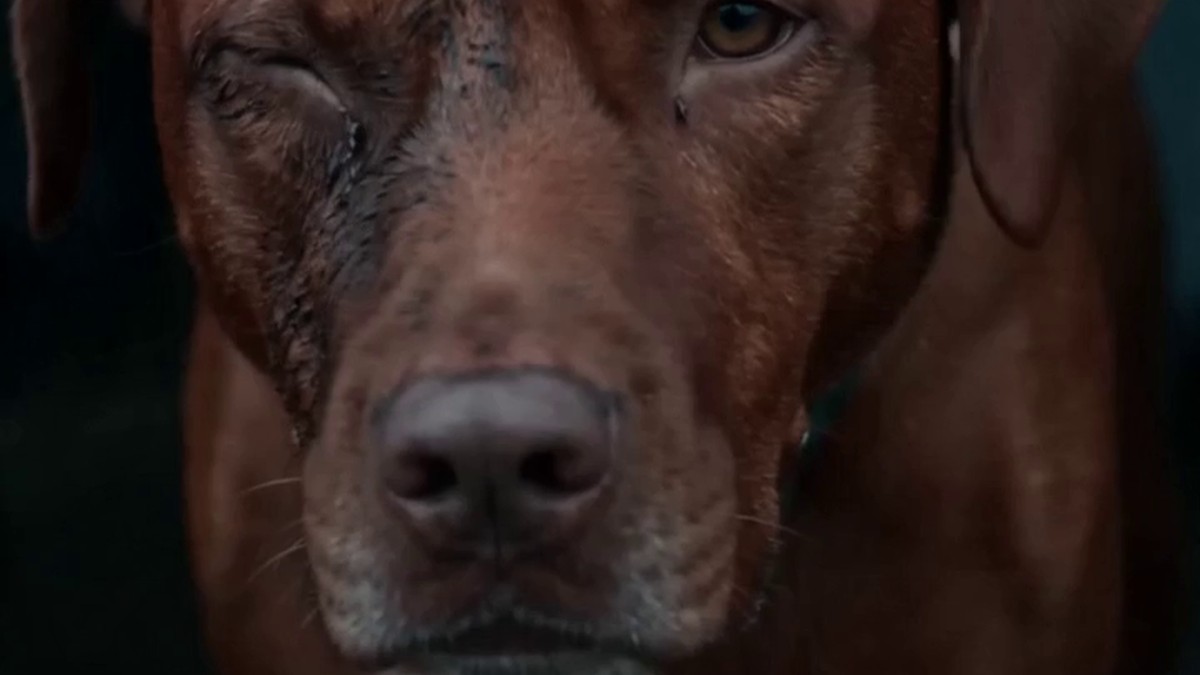
She wasn’t big. Medium-sized, maybe forty pounds, with matted auburn fur and ribs that showed faintly through her sides. One eye seemed permanently narrowed, as if she’d taken a hit long ago and never quite recovered. Her muzzle rested on her paws. She didn’t bark. Just watched them.
“We tried going around back,” Wayne said, falling into step beside Nate. “Thought we could pry off some boards, start from the rear. She circles around and blocks whatever spot we’re at. Smart, for a stray.”
Nate walked toward the garage, his boots squelching in the damp soil. The smell hit him in layers: wet earth, rot, old paint, and something else underneath, something organic and warm that he couldn’t name. The dog lifted her head. Her hackles rose in a slow ripple from neck to tail, but she didn’t snarl. She stood, legs braced, and placed herself squarely between him and the door.
“Move,” he said, loud enough to echo.
She flinched but held. Took half a step back, then returned to her post, her body blocking the gap where the warped door met the frame.
One of the workers offered him a broken shovel handle. “Want me to chase her off?”
“No,” Nate said. He wasn’t sure why. Something in the way the dog stood—not aggressive, not cowering, but rooted. As if leaving wasn’t an option she could even process. “I’ll go in.”
“She might bite.”
“She won’t.”
He said it with more certainty than he felt. The dog growled low in her throat, a private sound, almost apologetic. Nate pushed the door open, the hinges screaming, and slipped sideways through the gap.
Inside, the darkness swallowed him for a moment. The air was thick and humid, carrying a scent that transported him somewhere unexpected—back to his childhood porch in Mississippi, to the cardboard box where his mother had kept a litter of abandoned kittens. Warm milk. Dusty fur. Life trying to root itself in a hostile world.
Sunlight filtered through a crack in the roof, a single golden column cutting through the gloom. Old paint cans lined a shelf. A handleless shovel leaned against the wall. Cobwebs draped from the rafters like gray lace. His eyes adjusted, and he saw the floor—packed dirt with scattered bits of straw. And in the far corner, where the roof still held, a rumpled gray blanket had been shaped into a nest.
On it lay four puppies.
They were impossibly small, maybe two weeks old, with shut eyes and ears pressed flat like velvet leaves. They squirmed over each other in a blind, instinctual wriggle, tiny paws paddling the air, their mouths opening in silent pink yawns. The smallest one, a runt with a dark splash across its back, burrowed under a fold of the blanket and kicked one hind leg in its sleep.
Nate crouched. His knees popped in the stillness. He reached out without thinking and brushed a fingertip against one warm, downy spine. The puppy didn’t stir, just shifted closer to its siblings with a squeak so faint it was almost imaginary.
A rustle behind him. He froze.
The mother had slipped in, silent as breath. She circled around him—didn’t growl, didn’t bare her teeth—and lay down beside the litter. Her tongue swept over the puppies one by one, a slow, methodical grooming, as if Nate weren’t even there. The runt found a teat first, latched on, and began to knead with tiny urgent paws. The others followed, and the garage filled with the soft, rhythmic sound of nursing.
The dog rested her head on her paws and half-closed her good eye. The tension drained from her body. She was no longer the fierce guardian on the threshold. She was just a mother, exhausted and relieved, doing the only thing she knew how to do.
Nate stayed there, squatting in the dirt, for a long time. Minutes blurred. The cold seeped up through the soles of his boots. When he finally stepped back outside, squinting against the daylight, Wayne was waiting by the fence with an unreadable expression.
“Well?” the foreman asked. “Rats? Raccoons?”
“Puppies,” Nate said.
Wayne stopped mid-sip of his coffee. “You’re kidding.”
“Four of them. Newborn, eyes still closed. She had them in the back corner on an old blanket.”
Wayne scratched the scar on his forearm, a nervous habit Nate had noticed whenever a job went sideways. “So… are we tearing this thing down or not?”
Through the gap in the door, Nate could see the curve of the dog’s flank, still and trusting. She hadn’t moved. She knew he’d seen them. She’d made her stand, and now she’d handed the decision to him.
That was what lodged in his chest. She hadn’t attacked. She hadn’t run. She’d simply held the line with nothing but stubbornness and love, and all the crowbars and shouting in the world hadn’t moved her an inch.
“Not today,” he said. “We’ll wait.”
Wayne let out a long breath. “How long?”
“Until they’re old enough to move.”
The crew packed up with the usual clatter—crowbar ringing against steel, tailgate slamming, radio crackling to life. Nate pulled out his phone as the pickup rumbled toward the gate.
“Trish?” he said when his wife answered. “Change of plans. I need you to pick up some puppy food. And a couple of bowls. The shallow kind.”
She started asking questions, but he was watching the garage door. The dog’s muzzle emerged from the gap, tracking the departing truck with a steady, unblinking gaze. The dumpster sat idle in the yard, a green monument to plans that had suddenly veered off course. Nate walked back to his car, grabbed the half-eaten burrito Trish had tossed into his bag that morning, and the unopened bottle of water. Near the garage door, he found an old metal bowl crusted with dirt and rust, left behind by the previous owner.
He filled it with water from the bottle and set it on the ground. The dog didn’t come out. But through the gap, he saw her nostrils flare, catching the scent.
Nate sat on the front steps of the house and took a bite of the cold burrito. Overhead, a bird repeated the same three-note call, over and over, like it was waiting for an answer. The garage stood crooked against the pale sky, paint peeling, roof sagging, every bit as condemned as it had been at dawn. But something had shifted in the air around it. The smell of milk and warm bodies drifted through the cracked door. That gray blanket in the corner wasn’t trash anymore.
It was the first bed four small creatures had ever known, guarded by a mother who’d decided, against all logic, that this rotten, forgotten structure was worth defending with everything she had.
—
The reprieve was supposed to be temporary. Two weeks, maybe three—just long enough for the puppies to open their eyes, grow steady on their legs, and transition to solid food. Then Nate told himself he’d find them homes, call the demo crew back, and finally flatten the eyesore that had been mocking him since closing day.
But the garage had other plans, and so did the dog.
He named her Rusty, because it was obvious and because Trish said she looked like a patch of autumn leaves that had decided to become an animal. Rusty accepted the name with the same quiet dignity she brought to everything. She never begged. Never barked for attention. When Nate arrived each morning with supplies, she would rise from the nest, stretch one leg at a time, and walk out to greet him with a single slow wag of her tail. Then she’d drink from the water bowl he refilled, eat the kibble he poured, and return to her puppies without a backward glance.
The puppies grew fast. Within a week, their eyes cracked open—four pairs of cloudy blue that sharpened day by day into deep amber. The runt, the one with the dark spot, turned out to be the boldest. By day ten, he was wobbling out of the nest on unsteady legs, tumbling over his siblings, and squeaking indignantly when Rusty nudged him back with her nose. Nate named him Huck, because the little creature seemed constitutionally opposed to staying put.
Trish came out on the second weekend. She stood in the doorway of the garage, watching the puppies tumble over each other, and didn’t say anything for a full minute. Then she walked back to the car, retrieved a soft-sided pet carrier from the trunk, and said, “We can foster them at the house until they’re adopted.”
“The rental has a no-pets clause,” Nate pointed out.
“I already talked to the landlord. He said a temporary situation is fine, as long as we cover any damage.” She knelt down, offering her knuckles for Rusty to sniff. “Besides, we’re not leaving them out here when there’s coyotes in the hills.”
That was how, three weeks after the aborted demolition, Nate found himself sharing his living room with five dogs. Rusty settled onto an old quilt near the radiator, watchful as ever, while the puppies turned the rug into a racetrack. Huck developed a habit of climbing onto Nate’s shoe and falling asleep there, a warm little weight against his ankle.
Word spread through Millbrook faster than Nate expected. Trish posted a photo of the litter on the local community page, and within hours, three of the four puppies had prospective homes lined up. A young couple from McMinnville wanted one. The elderly woman who ran the bookstore downtown claimed another. A family with two kids and a fenced yard drove out to meet the third, and the children spent an hour on the floor, giggling as the puppies chased a squeaky toy.
Huck remained unclaimed.
“Nobody wants the runt,” Trish said one evening, stroking the dark spot on his back. Huck was asleep in her lap, oblivious to his uncertain future.
“Give it time,” Nate said, but even as he spoke, he felt something tighten in his chest. He’d spent weeks telling himself this was a rescue mission, a temporary detour on the way to his renovation plans. But Rusty had started following him around the property whenever he came to work on the house. She’d lie in the grass a few feet away, her mismatched eyes tracking his every move, and when he packed up to leave, she’d watch his car disappear down the gravel drive with an expression that made him feel like he was abandoning something important.
The trouble started on a Thursday.
Nate was at the property, sanding the living room floor, when a silver sedan pulled up to the gate. A man in a polo shirt and pressed khakis stepped out, holding a clipboard. He surveyed the garage with a frown, then walked toward the house.
“Nathan Reeves?” he called through the screen door.
Nate set down the sander and wiped his hands on his jeans. “That’s me.”
“Brad Holloway. I’m with the Millbrook Homeowners’ Association.” The man smiled, but it didn’t reach his eyes. “We’ve had some complaints from neighbors about the structure on your property. The detached garage.”
“I’m aware of it,” Nate said evenly. “It’s scheduled for demolition.”
“So we understood. But I’m told the demo was canceled three weeks ago, and now there are animals living on the premises. Dogs.” He checked his clipboard. “Multiple dogs.”
“A stray had puppies in there. I’m fostering them until they’re old enough for adoption.”
Brad nodded slowly, the way people do when they’ve already decided you’re a problem. “I appreciate the charitable impulse, Mr. Reeves. But the HOA guidelines are clear. The garage is a hazard—it’s been flagged for months. And keeping a litter of dogs in an unsafe structure, not to mention the noise and sanitation concerns, violates several bylaws.”
Nate felt his jaw tighten. “They’re puppies. They aren’t making noise, and I clean the space every day.”
“Be that as it may, we need a timeline for resolution. The board is prepared to issue fines if the situation isn’t remedied promptly.” Brad pulled a folded paper from his clipboard and held it out. “This outlines the violations and the daily penalties. You have until Monday to either remove the dogs and proceed with demolition, or present a compliant alternative.”
Nate took the paper without looking at it. “And if I don’t?”
“The fines start at two hundred dollars a day. After thirty days, the board can pursue legal action.” Brad’s smile tightened. “We don’t want it to come to that. No one does.”
He drove away, leaving Nate standing on the porch with the citation crinkling in his fist.
That night, he and Trish sat at the kitchen table, the HOA letter spread between them like a bad hand of cards. Rusty lay near the back door, her head on her paws, her eyes moving from Nate to Trish and back again.
“We can move them to a shelter,” Trish said quietly. “The three are adopted already—we just need to hold them until pickup. And Huck…”
“Huck doesn’t have anywhere to go.” Nate stared at the ceiling. “And Rusty’s been in that garage since before we bought the place. It’s her home. The only one she knows.”
“The fines add up fast, Nate. We can’t afford a legal fight with the HOA.”
He knew she was right. The numbers didn’t lie. The house was already stretching their budget; the demo had been carefully planned, every dollar accounted for. A daily penalty would bleed them dry.
But every time he closed his eyes, he saw Rusty standing on that threshold, planting herself between the crowbars and her blind, helpless litter. She hadn’t asked anyone for permission. She hadn’t filed a request with the board. She’d simply decided what mattered and held the line.
Monday morning arrived gray and cold, a low ceiling of clouds pressing down over the valley. Nate drove to the property alone. The adoption pickups for the three puppies were scheduled for the afternoon—homes waiting, families excited, everything arranged. Huck was still unclaimed. The HOA deadline loomed at five o’clock.
He found Brad Holloway already waiting by the gate, clipboard in hand, a second man in a suit beside him. A county vehicle was parked on the shoulder. Animal Control.
“Mr. Reeves,” Brad said. “I hope you’ve reached a decision.”
Nate got out of the car. Through the fence, he could see Rusty standing at the garage door, her body rigid. She knew something was wrong. Huck was at her feet, a small bright-eyed shadow, oblivious.
“The garage is coming down,” Nate said. “But not today.”
Brad’s expression flickered. “The board requires immediate compliance. We’ve already been patient.”
“I said I have an alternative. You want to hear it, or do you want to stand there waving that clipboard?”
The man from Animal Control shifted his weight. “Sir, if there are animals in an unsafe structure, we have the authority to remove them for their own welfare.”
Nate looked at him. “Their welfare? That dog has kept four puppies alive in there for a month. She’s fed them, warmed them, protected them from coyotes and raccoons and anything else that prowls this valley at night. The only thing unsafe about that garage is that it might fall down someday. And it won’t, because I’m going to fix it.”
Brad blinked. “Fix it?”
“I’m applying for a permit to renovate. The structure stays. I’ll reinforce the frame, replace the roof, re-side the whole thing. It won’t be an eyesore anymore. It’ll be a workshop. And a dog house.”
“The bylaws don’t allow—”
“The bylaws allow accessory structures that meet code,” Nate cut in. “I’ve already talked to a contractor. I can have plans submitted by Friday. And in the meantime, the dogs aren’t living in a hazard—they’re living in my house. All of them.” He paused, letting the words settle. “Including Rusty and Huck.”
Brad’s mouth opened and closed. The Animal Control officer looked from Nate to Brad, clearly reassessing whether this was a call he needed to be on.
“You’re telling me,” Brad said slowly, “that you’re going to spend thousands of dollars renovating a collapsed garage… for a stray dog?”
Nate walked to the gate and unlatched it. Rusty came toward him, her tail wagging low, Huck bouncing at her heels. He knelt down and scooped up the puppy, cradling him against his chest. Rusty pressed her nose into his palm.
“She’s not a stray,” Nate said. “She’s mine. Both of them are. And I’m not tearing down their home.”
Brad stared at him for a long moment. Then he flipped a page on his clipboard, scribbled something, and turned toward his car. “I’ll expect those permit applications by Friday, Mr. Reeves. If they’re in order, the board will review the exemption. If not—” He didn’t finish the sentence. He didn’t need to.
The sedan pulled away. The Animal Control truck followed, its lights dark. The clouds overhead cracked open, and a pale shaft of sunlight fell across the yard, catching the rusty tin of the garage roof and turning it briefly to copper.
Nate sat down on the damp grass, Huck squirming in his lap, Rusty settling beside him with a contented sigh. The garage still leaned. The paint still peeled. But the dumpster was gone—he’d called to cancel the rental that morning—and in his pocket was a folded sketch of the renovated workshop, with a dog door cut into the side and a wide, sunny window facing the house.
Trish arrived an hour later with the pet carrier and a bag of puppy treats. The adopters came that afternoon—a young couple, bright-eyed and nervous, who fell in love with their new puppy the moment it licked their fingers. The bookstore owner arrived next, a sturdy carrier in hand and a bag of homemade dog biscuits tucked under her arm. The family with the fenced yard came last, the children solemnly promising to send photos and visit whenever they could.
By sunset, the litter had scattered to their new lives, and only Huck remained. He chased a grasshopper across the yard, tumbled over his own feet, and came up sneezing. Rusty watched him from the porch, her expression inscrutable.
Nate sat on the steps beside her and scratched behind her ears. “Looks like it’s just the three of us now,” he said.
Rusty leaned into his hand. The garage stood behind them, bathed in the last orange light of evening, no longer condemned, no longer waiting for the wrecking ball. Just a crooked old building with a gray blanket in the corner, soon to be something better.
Some lines, Nate thought, weren’t meant to be broken. They were meant to be rebuilt around.