The key stuck halfway. Ksenia yanked her hand back in frustration, then rammed the door with her knee. The lock gave with a grinding turn — the old mechanism had been sticking for weeks; she'd been meaning to ask Oleg to fix it.
The smell hit her before anything else. Dense and suffocating. Like an old diner: burnt oil, cheap cafeteria grease, and industrial soap all rolled into one. She set the heavy paper bag of groceries down on the mat.
The entryway she'd spent weeks decorating — those warm, carefully chosen colors — was gone. Buried. Two massive plaid duffel bags, blue and red, were piled across her velvet bench, cinched tight with rough twine, a clump of dried mushrooms poking out from under a half-open zipper. Next to them, directly on her pale porcelain tile, sat a pair of beat-up men's sneakers and a set of enormous women's boots. Just sitting there. Like they owned the place.
Voices and clattering dishes spilled from the kitchen.
"Nina, I'm telling you — those blinds are straight from hell." A deep, wilting contralto. "Dust traps, every last one of them. You need real lace curtains, like normal people. And her frying pans — absurd. I could barely lift them."
"Oh, let it go, Raika." The second voice, and Ksenia recognized it instantly — her mother-in-law, Nina Fyodorovna. "Young people have their own ideas. Oleg picked them out, he bought them — let them be."
Ksenia peeled off her coat slowly. A dull, sickening weight settled in her chest.
The agreement with her husband had been clear: Nina Fyodorovna would come in a month — just for a few doctor's appointments at the city clinic. And absolutely nothing had been said about bringing along her older sister Raisa.
She walked into the kitchen.
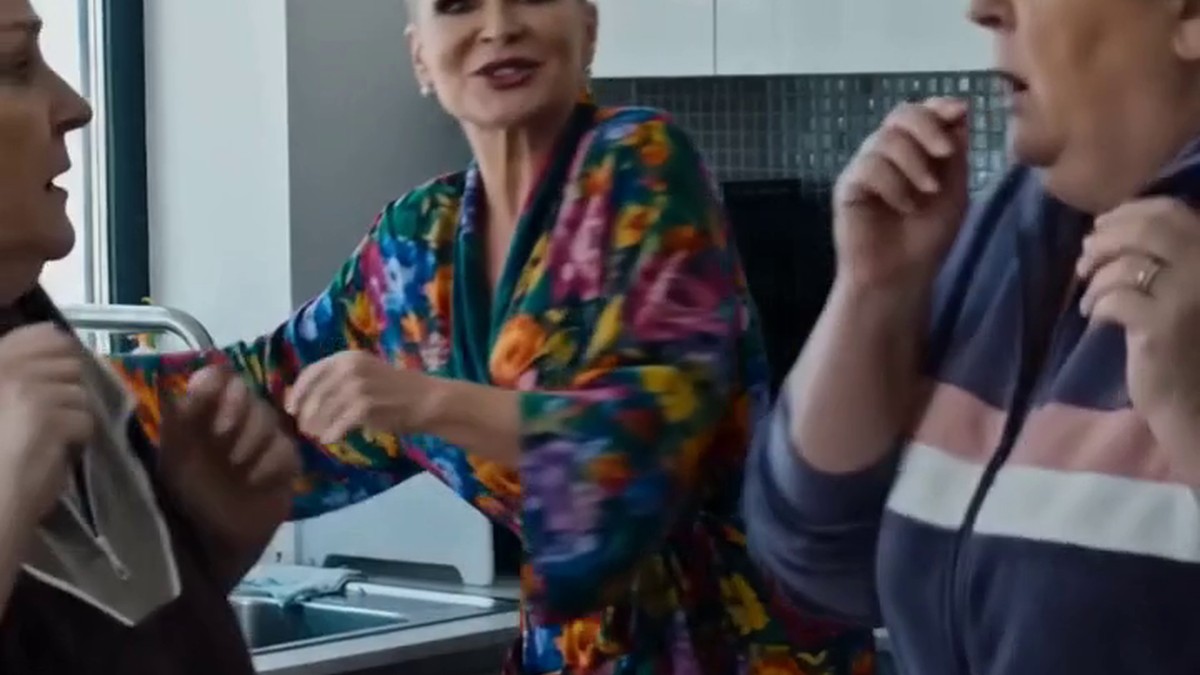
The scene was breathtaking. Nina Fyodorovna, wrapped in a loud floral housecoat, was enthusiastically scraping the nonstick coating off an expensive pan with a metal spatula. Aunt Raisa sat perched at the kitchen island, tearing chunks of bread directly onto the countertop.
"Good evening," Ksenia said.
Both women flinched. Nina Fyodorovna dropped a wet rag into the sink, wiped her damp hands on the hem of her housecoat, and stretched into a wide, blooming smile.
"Ksenechka! You're home already! And here we thought we'd have supper ready by the time you walked in —"
"Good evening," Aunt Raisa interrupted, without looking up from her bread. She tore off another chunk. A scatter of crumbs skipped across the counter Ksenia had wiped down that morning.
Ksenia looked at the pan. The nonstick surface — the dark, smooth interior she'd babied for two years — was gouged through in pale silver streaks. Like someone had taken a chisel to it.
"Nina Fyodorovna," she said carefully. "That's a coated pan. Metal scratches it."
"Oh, it's fine." Nina Fyodorovna waved the spatula. "I've been cooking since before you were born. These fancy coatings, they're all marketing anyway. My pans at home, I've had them thirty years —"
"Where is Oleg?"
A half-second pause. Just long enough.
"He ran down to the pharmacy," Nina Fyodorovna said brightly. "Raika's knee has been giving her trouble."
Ksenia set her phone face-down on the counter. She did not trust herself to look at it. If she looked at it she would text him something she couldn't take back.
"Nina Fyodorovna." She kept her voice low, even. "When did you arrive?"
"This afternoon! The twelve-forty train. Oleg picked us up —"
"*Us.*"
"Well." The older woman smoothed the front of her housecoat. "Raika's knee, like I said. She can't manage the train alone, you understand. And the clinic appointments, three of them in one week, I couldn't —"
"How long is Raisa staying?"
The question landed in the kitchen like a glass dropped on tile. Nina Fyodorovna glanced sideways at her sister. Raisa finally looked up from her bread. Her eyes were small, pale, entirely unimpressed.
"As long as necessary," Raisa said.
—
Oleg came back forty minutes later. Ksenia heard his key turn smoothly in the lock and the rustle of a pharmacy bag. She was sitting at the kitchen island with a cup of tea she hadn't touched. The women had migrated to the living room, where the television was now running at a volume that suggested partial deafness.
He walked in, saw her face, and stopped.
"Ksenia —"
"Sit down."
He sat. He was still wearing his jacket. He put the pharmacy bag on the counter between them like it was something he could hide behind.
She looked at him for a long moment. He had her mother-in-law's same wide-set eyes, the same way of going very still when cornered.
"You knew," she said. "Not just today. You knew before she bought the ticket."
"She called me two weeks ago." His voice was quiet. "Raisa's knee is genuinely bad — the MRI showed —"
"Oleg."
"— they couldn't get an appointment in their city, and Mom can't navigate the metro alone, and I thought —" He stopped. Pressed his hand flat on the counter. "I thought you'd say no."
"So you said yes without asking me."
He didn't answer. That was the answer.
Outside in the living room, the television laugh track swelled. Something clattered — Raisa rearranging, probably, settling herself deeper into the apartment like sediment.
"My pan is ruined," Ksenia said. Not because it was the most important thing. Because it was something she could say without her voice breaking.
"I'll buy you a new one."
"That's not —" She stopped. Breathed. "That's not what I'm talking about and you know it."
He did know it. She could see it in the set of his shoulders, the way he wasn't quite meeting her eyes. This wasn't about the pan. It wasn't even about Raisa's knee, or the duffel bags with dried mushrooms, or the smell of cafeteria grease soaking into her curtains.
It was about the agreement. The agreement they'd made, carefully and specifically, after his mother's last visit — when Nina Fyodorovna had reorganized the entire pantry "for efficiency" and thrown away Ksenia's good olive oil because she'd mistaken it for something gone off. They had sat at this same counter and Oleg had said: *I hear you. Next time, we set terms. We agree on dates. We agree on duration. I ask you first.*
He had looked her in the eye and said that.
"I need you to go out there," Ksenia said, "and tell them how long they're staying. Specific date. And I need you to tell your aunt that the kitchen is not her kitchen."
"Ksenia, she's sixty-seven, she's not going to —"
"Oleg." She finally picked up her tea. Cold. "I'm not asking you to be cruel. I'm asking you to be my husband."
Silence.
The television in the next room cut to a commercial — something loud and cheerful, a jingle she could feel in her back teeth.
He sat with that for a long moment. She watched something move through him, some internal negotiation she wasn't party to, the lifelong calculus of a man caught between two versions of love, both of them real, neither of them willing to be small.
Then he stood up.
She listened to him cross the hallway. Listened to the television volume drop — actually drop — on the first ask. His voice came through low and steady, not sharp, not apologetic. She couldn't make out the words. She didn't need to.
Nina Fyodorovna said something. There was a pause. Raisa said something longer, with an edge to it. Oleg's voice again, still even, still quiet.
Then silence.
Then Nina Fyodorovna, in a different register — softer, the bluster gone out of it.
Ksenia set her cold tea in the sink. She stood at the kitchen window and looked out at the street below, the yellow wash of the streetlights, a man walking a small dog in the November dark. The dog was wearing a sweater. The man looked like he'd rather be anywhere else.
*Same*, she thought. And then, against her will, almost laughed.
Oleg came back. He leaned in the doorway.
"Two weeks," he said. "The last appointment is the fourteenth. They leave the fifteenth." He paused. "Raisa said the curtains are fine. Apparently."
"High praise."
"I also told Mom about the pans." He crossed the kitchen and stopped behind her, not quite touching. "She said she'll replace it. She actually — she was embarrassed. She didn't know."
Ksenia watched the man with the dog disappear around the corner.
"She never knows," she said. "That's not malice, I understand that. She just —" She stopped. Found the words. "She just walks in and rearranges the world and assumes the world is grateful."
"Yeah." A beat. "I know."
"You do that too sometimes."
"Yeah." Quieter. "I know that too."
She turned around. He was close, still in his jacket, the pharmacy bag forgotten on the counter. He looked tired. He looked like a man who had just done something difficult and wasn't sure if it had been enough.
She thought about the agreement. About the way he'd looked at her when he made it. She thought about two weeks — the fourteenth, the fifteenth — and how that was finite, and how finite things could be survived.
"Don't do it again," she said. "Don't decide for me."
"I won't."
She studied his face. He meant it. He'd meant it last time too, and then the calculus had caught up with him and he'd gone quiet and made the call he thought would cause the least damage. She knew that. She also knew that people were not simply fixed, that meaning something and doing something were two different muscles and the second one took longer to build.
But he had gone out there. He had lowered the television. He had said the specific date.
"Two weeks," she said.
"Two weeks."
She picked up the pharmacy bag. Looked inside — knee cream, some kind of joint supplement, a small pack of caramel candies that Nina Fyodorovna must have asked for. She set it back down.
"Go tell your mother dinner is her responsibility tonight," Ksenia said. "Since she started it. And find out if Raisa actually has a dietary restriction or if the no-garlic thing is just a personality choice."
Something in his face loosened. Not relief exactly. Something more careful than relief.
"Okay," he said.
"And Oleg." She turned back to the window. "I'm glad her knee is getting looked at. I mean that."
She heard him cross the kitchen. Heard him stop.
"I know you do," he said. "That's the thing about you."
Then his footsteps moved back down the hall, and the television came back up — lower than before, but present — and the smell of burnt oil and mushrooms settled into the apartment like weather, like something that had arrived and intended to stay for exactly as long as it had been told it could.
Fourteen days.
Ksenia opened the window an inch and let the cold November air come in.
She could work with fourteen days.